January 23, 2026
Who decides how much control a country should have over its technology?
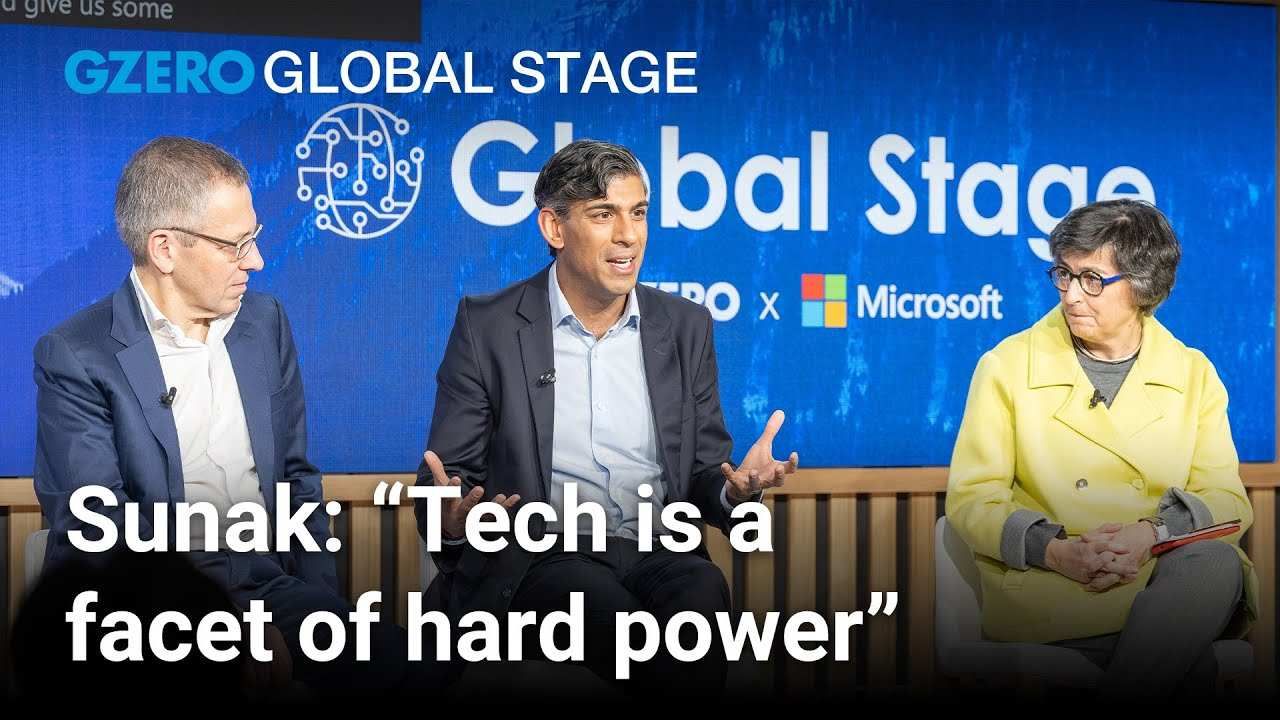
Speaking at the 2026 World Economic Forum in Davos, former UK Prime Minister Rishi Sunak discussed the balance between national sovereignty and global interdependence.
“Technology is a facet of hard power today,” Sunak said, highlighting its role alongside energy security, economic strength, and defense. He stressed the need for a measured approach: “I don’t think the right answer is everyone rushing to become some independent autarky. It’s not practical, it’s not sensible.”
Sunak differentiated between aspects of sovereignty, noting the importance of both data control and operational resilience. His remarks underscore the nuanced strategies governments must consider as technology becomes central to global power.
This clip is drawn from a GZERO Media Global Stage panel discussion recorded at the 2026 World Economic Forum. To watch the full conversation, visit gzeromedia.com/globalstage.
The Global Stage series, presented by GZERO Media in partnership with Microsoft, convenes leaders from government, business, and civil society at major international forums to examine the critical issues at the intersection of technology, politics, and society, and to explore how global cooperation can deliver solutions in an era of accelerating change.
More For You
Medical workers treat injured people at Ameth Bek hospital after a drone strike on a market in the disputed Abyei region along the border between South Sudan and Sudan, October 19, 2026.
REUTERS/Medecins Sans Frontieres
South Sudan is accusing neighboring Sudan of launching a drone strike that killed at least 73 people at a market in Abyei, a disputed, oil-rich region of roughly 4,000 square miles claimed by both countries.
Most Popular
- YouTube
In this Quick Take, Ian Bremmer says President Donald Trump's approach to the war in Ukraine is putting more pressure on President Volodymyr Zelensky and raising concerns among European allies about the future of NATO.
Protesters set up barricades and burn materials near Place de la Republique in Paris, France, on October 18, 2026, the day following a large demonstration.
Jerome Gilles via Reuters Connect
Ongoing student protests in France descended into looting and riots over the weekend as more than half a million people took to the streets across the country.
After his father was killed in a plane crash in 2023, Pavel was tapped to lead Wagner.
© 2025 GZERO Media. All Rights Reserved | A Eurasia Group media company.