October 25, 2021
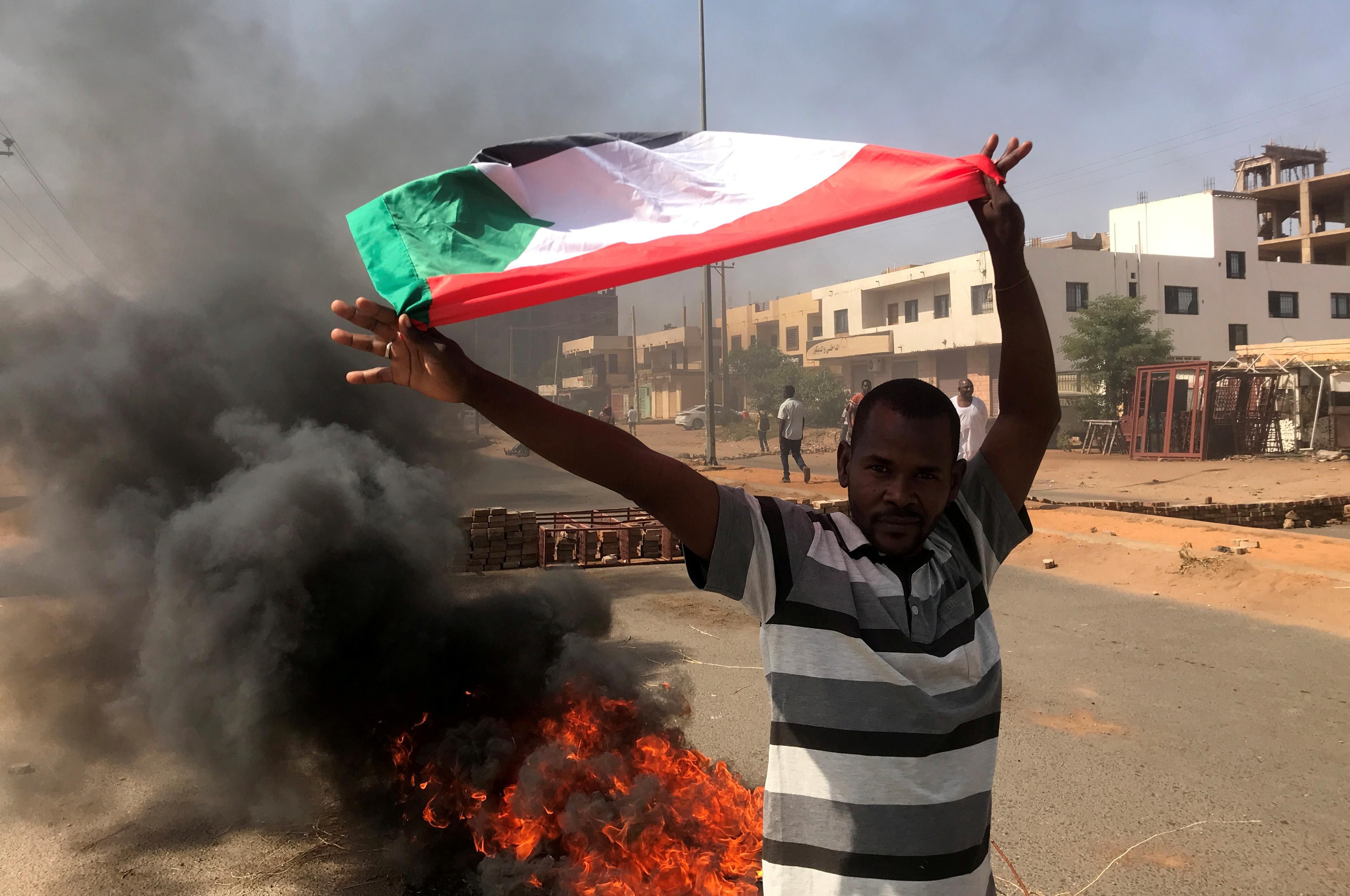
"The people are stronger," pro-democracy demonstrators chanted as news broke that the Sudanese military had staged a coup Monday, overthrowing the joint civilian-military government and dashing hopes of democracy in the war-torn country.
The backstory. In 2019, Omar al-Bashir – a despot who ruled Sudan with an iron fist for 30 years – was deposed after a months-long popular uprising.
Al-Bashir was a bad guy: he cozied up to terrorists like Osama bin Laden and dropped barrel bombs on his own people. He also embezzled truckloads of money from oil production while millions of Sudanese went hungry, and oversaw a genocide in the Darfur region that left 300,000 people dead and displaced 1.6 million.
When some of al-Bashir's allies flipped in 2019, a bloody power struggle ensued (hundreds of pro-democracy demonstrators were killed) before a transitional government – made up of six civilians and five military personnel – was appointed for a three-year transition period, at which time democratic elections were to be held. Since then, the very tenuous government has remained mostly intact despite ongoing violence and ethnic clashes.
However, things got particularly heated in recent weeks, as a November 17 deadline loomed for the civilian wing to take control of the government's decision-making body. (Per the power-sharing agreement, the military's representatives had mostly been calling the shots.)
Clashes broke out on the streets between pro-democracy activists and military loyalists, before the government's military wing took charge this week, declaring a state of emergency and seizing power. Civilian leaders and ministers – including Prime Minister Abdalla Hamdak, an economist who previously worked at the UN – have been arrested.
What does this mean for Sudan? At a basic level, it makes the prospect of democracy more illusory. The likelihood of fresh elections going ahead next year as planned is slim given that the military personnel who staged the coup are former allies of al-Bashir who built a career on quashing dissent.
What's more, there was also hope that when the civilian wing took over, al-Bashir would be handed over to the International Criminal Court at The Hague to face charges over his government's brutality in Darfur (2003-2009). But because al-Bashir's extradition and testimony would expose crimes committed by some of the generals, that's likely to be a moot point, too – at least for now.
Moreover, if the takeover stands, it'll be a massive economic blow for Sudan, which has been trying to revive economic ties with the international community after years of sanctions and isolation. In late 2020, the US removed Sudan from its state sponsors of terrorism list, restoring Khartoum's access to global financial markets and international aid. This paved the way for crucial debt relief from institutions like the IMF, so the transitional military-civilian government in Khartoum could access the cheap international credit it needs to address the country's deep economic crisis. This is all at stake now.
Who cares what's happening in Sudan? Well, several countries are surely keeping a close eye on unfolding events.
Egypt has been trying to improve cross-border relations with Sudan in recent years, after the two countries had long been locked in a border dispute over access to the mineral-rich Halayeb triangle. More recently, Cairo and Khartoum have joined forces against Ethiopia amid a messy dispute over water access in the Nile. Though Egyptian President Abdel Fattah el-Sisi is no democracy warrior, he is hardly interested in seeing more instability and chaos on Egypt's southern border.
Meanwhile, Turkey – which backs Ethiopia in the water dispute – has been pushing to play a larger political and economic role in Africa, and to build a port off Sudan's Red Sea coast that would be a hub for Muslim pilgrims crossing the Red Sea to Mecca.
Additionally, Gulf states like the United Arab Emirates and Saudi Arabia have capitalized on the ousting of al-Bashir to bring Sudan under their sphere of influence. In exchange for certain concessions (like tempering ties with the Gulf states' nemeses in Qatar and Iran), the Saudis and Emiratis have lushed Khartoum with cash. (Though the Saudis have backed off a bit, the Emirates have continued to act as a key powerbroker in Sudan.)
What happens now? The signs are ominous: Khartoum's airport is closed, and the internet has been shut down. Meanwhile, coup leader Gen. Abdel Fattah Burhan said that elections could take place in July 2023, but trust is low and fears are high of a return to civil war.
More For You
- YouTube
In his latest Quick Take, Ian Bremmer discusses the on-again off-again ceasefire between the United States and Iran and why it has failed to hold, arguing that both sides remain locked in a fundamental disagreement over who has the leverage.
Most Popular
Walmart sponsored posts
Empowering associates with comprehensive benefits
Sponsored posts
Why open-weight AI matters for innovation and competition
- YouTube
Can a war-torn Lebanon disarm Hezbollah, end Israel’s occupation of its southern territory, and reclaim control of its future? Beirut-based journalist Kim Ghattas joins Ian Bremmer on GZERO World.
As Hezbollah’s power weakens and Israel occupies parts of southern Lebanon, could the country finally reclaim its sovereignty? Or is it headed toward another war? Journalist Kim Ghattas joins Ian Bremmer on the GZERO World Podcast.
- YouTube
Ian Bremmer breaks down how Iran spent four decades building Hezbollah into a powerful proxy against Israel, and why the group’s uncertain future could reshape the Middle East.
© 2025 GZERO Media. All Rights Reserved | A Eurasia Group media company.