News
Rage and violence paralyze France
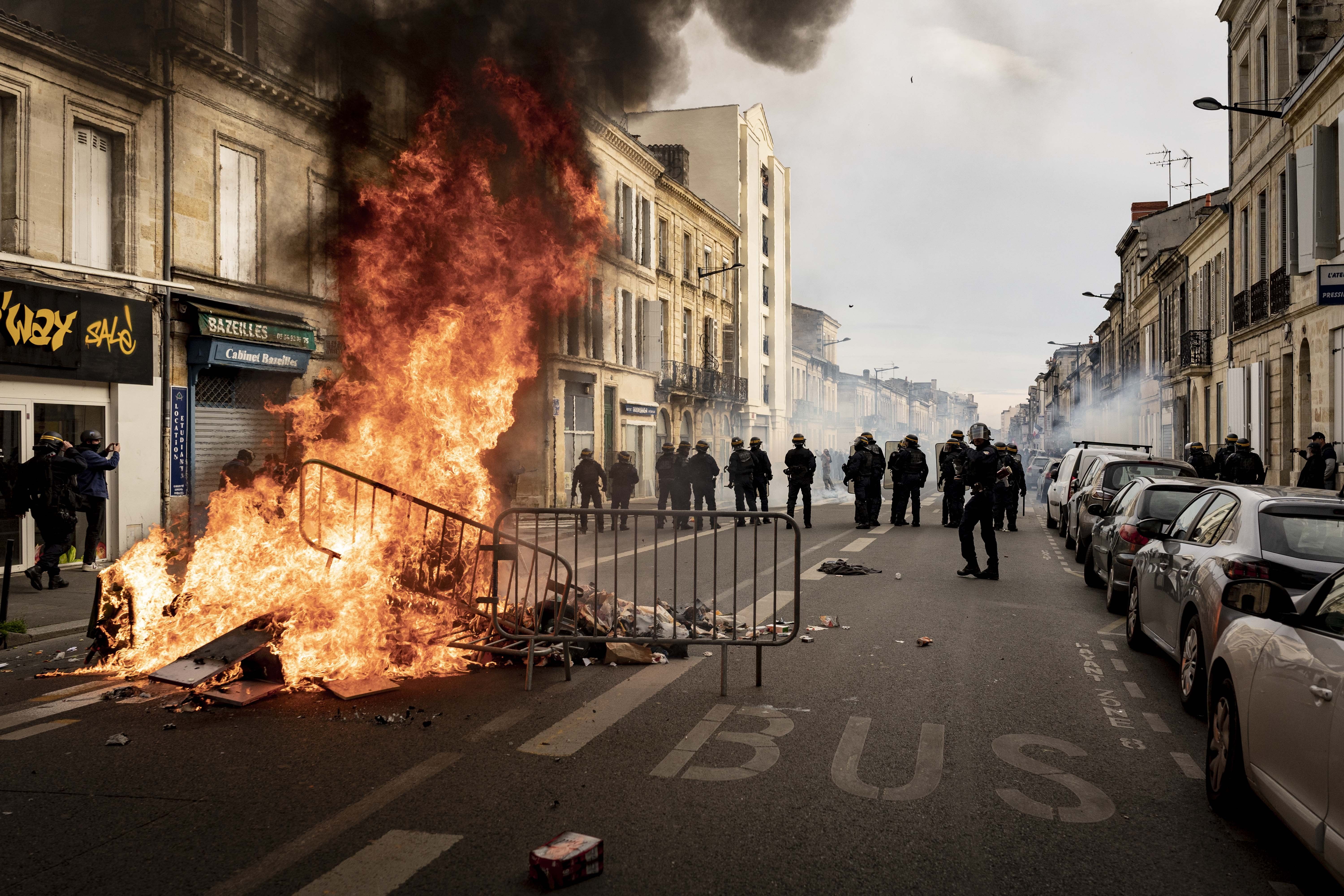
Demonstration against pension reform took place in Bordeaux.
Reuters
Days after the French government passed much-despised pension reforms, chaos reigns throughout the country.
At least 457 people were arrested and more than 441 security personnel were injured on Thursday in protests over the reforms, which will incrementally increase the retirement age from 62 to 64. For background on why President Emmanuel Macron says the reforms are central to plugging France’s ballooning debt hole and boosting productivity, see here.
Unions claimed that 3.5 million workers protested on Thursday, while the government said the number was closer to 1 million. Either way, it was the most violent day in a series of protests that have gripped the country for months.
What’s more, there are claims that agitators have taken advantage of the discord to wreak havoc. The interior minister, Gérald Darmanin, said that the majority of protesters arrested in Paris were members of “ultra left” groups, though that claim has been difficult to verify.
Indeed, fires were rife in Paris, where trash has been piling up for weeks amid strikes, and in the famed-wine region of Bordeaux, demonstrators set fire to the town hall. Additionally, schools remain closed and transportation grounded to a halt – including air travel – as a result of industrial strikes.
Many French say they were moved to hit the streets with renewed intensity after Macron made a media appearance earlier this week saying that protests were “legitimate” but that he would not back down on the reforms.
Meanwhile, the unrest is alarming enough that King Charles III has postponed a planned visit to the country set to take place next week.
Unions want the strikes to force a government U-turn, but authorities are now cracking down on protester violence with more forceful containment measures. Who will flinch first?
South Sudan is accusing neighboring Sudan of launching a drone strike that killed at least 73 people at a market in Abyei, a disputed, oil-rich region of roughly 4,000 square miles claimed by both countries.
In this Quick Take, Ian Bremmer says President Donald Trump's approach to the war in Ukraine is putting more pressure on President Volodymyr Zelensky and raising concerns among European allies about the future of NATO.
Ongoing student protests in France descended into looting and riots over the weekend as more than half a million people took to the streets across the country.
After his father was killed in a plane crash in 2023, Pavel was tapped to lead Wagner.