Supreme Court rejects abortion pill challenge
The nation’s highest court on Thursday unanimously rejected a broad ban on the abortion medication mifepristone, meaning patients and doctors will retain access to the increasingly important drug.
The Supreme Court is set to issue rulings on government power, including the power of cities to remove homeless encampments and the power of federal agencies to interpret Congress's laws.

The US Supreme Court heard arguments on Tuesday on whether access to mifepristone, an oral drug used to terminate a pregnancy, should be restricted.
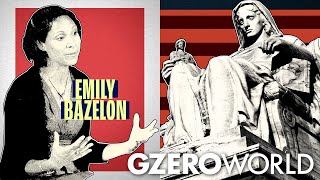
Surprises and non-surprises surrounded the Supreme Court's landmark Dobbs ruling to overturn Roe v. Wade last year. It started with the infamous leak to POLITICO about the ruling to come and then the decision itself came down, nearly a year ago today. But according to GZERO World guest, Yale Law legal expert Emily Bazelon, one of the biggest surprises happened after the ruling.

What We’re Watching: US preps Sudan embassy evacuation, Kosovo election boycott, US abortion pill decision, Ukrainian grain curbs, Schumacher’s “interview"
Dive deeper with our top stories and analysis.
Privacy notice: By signing up, I acknowledge that I have read, understand, and consent to the Privacy Policy and Terms of Use, including the transfer of my personal data to the United States from my country of residence (if different).
50 years ago, when the Supreme Court granted the constitutional right to abortion, the country was far less divided than is it today. Now with that Roe v. Wade decision overturned, roughly half the states have "trigger laws" on the books restricting abortion, New York Times columnist Emily Bazelon tells Ian Bremmer on GZERO World.

Having faced mounting criticism from many Democrats for his tepid response to the recent Supreme Court ruling overturning Roe v. Wade, US President Joe Biden hit back Friday, issuing an executive order protecting some abortion rights. So what's his plan?
The US is now a much more divided country than it was almost 50 years ago, when the Supreme Court granted the constitutional right to abortion — recently overturned by the court. Interestingly, most of the rest of the world is moving in the opposite direction, including in majority-Catholic countries. But striking down Roe v. Wade will surely have a bigger impact on US politics. On GZERO World, Ian Bremmer speaks to New York Times columnist Emily Bazelon, who knows a thing or two about this ultra-divisive issue because she's also a a senior research fellow at Yale Law School.

Listen: Americans now live in a much more divided country — as has been on full display after the US Supreme Court overturned Roe v. Wade and removed the constitutional right to an abortion, while the rest of the world - including largely Catholic countries in Latin America and Europe - is moving in the opposite direction. But the SCOTUS ruling is already making waves around the world. On GZERO World, Ian Bremmer speaks to New York Times columnist and senior research fellow at Yale Law School, Emily Bazelon, who knows a thing or two about abortion law.