GZERO North
Team Trudeau adds fresh faces
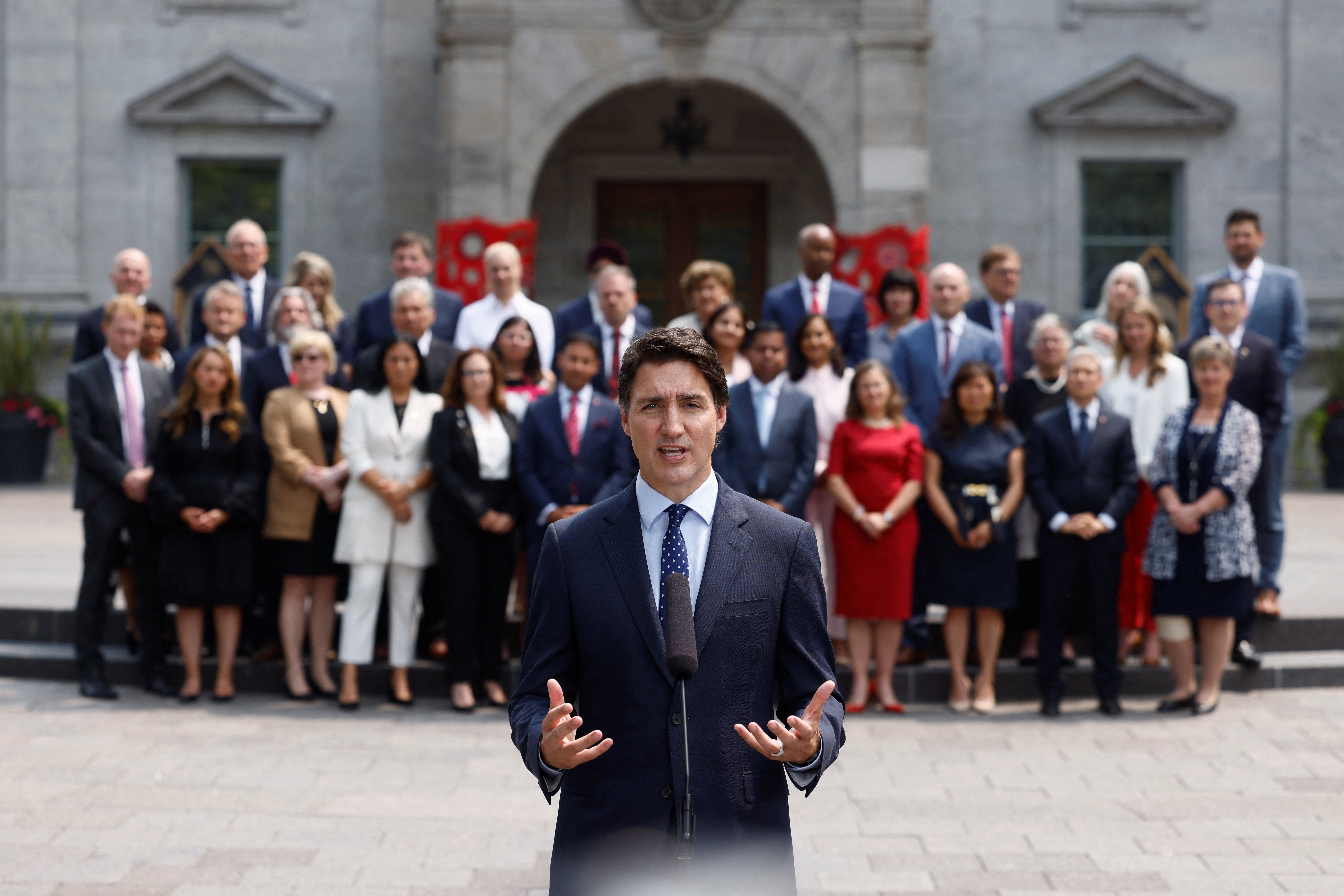
Canada's Prime Minister Justin Trudeau speaks to the media following a cabinet shuffle at Rideau Hall in Ottawa.
REUTERS/Blair Gable
Justin Trudeau shuffled his cabinet on Wednesday, a major shakeup as his government struggles in the polls ahead of an election in which the Conservatives look poised to make gains. Trudeau dropped seven ministers who were seen to be struggling and introduced seven newcomers.
Most of the key players on Canada-US files stay in place. Chrystia Freeland, the deputy prime minister and finance minister who played a central role in negotiating USMCA, keeps her dominant position. Foreign Affairs Minister Mélanie Joly remains in place, as does François-Philippe Champagne, the energetic industry minister, who has been busy luring EV companies to open plants in Canada.
Anita Anand, the well-regarded defense minister who worked with her American counterpart on upgrades to the joint NORAD northern defense system, takes the helm at the Treasury Board, a powerful but less public-facing post. Taking her place at defense is former Toronto police chief Bill Blair. Pablo Rodriguez, the Quebec MP who led the government’s (so far) unsuccessful effort to squeeze money for journalism out of the tech giants, is shifted to Transport. Pascale St-Onge, another Quebecer, will take over his department, perhaps opening the door to a fresh approach to Google and Meta.
The shuffle comes as Trudeau approaches eight years in office. He is now the longest-serving leader in the G-7, but he faces a difficult path to reelection, with low approval ratings and signs that the public is losing faith in his leadership, particularly on economic issues. A poll released Wednesday shows his Liberals 10 points behind the opposition Conservatives. Trudeau has said he plans to lead his party into the next election, expected either next year or in 2025, but no prime minister has won a fourth consecutive election since Wilfrid Laurier, in 1908.Could China give Europe a shortcut in the AI race?
Europe has struggled to build models that compete with American and Chinese rivals. But Chinese models that companies can download, customize, and run themselves could offer another way forward—with more control over data and security.
With the midterms just weeks away, Democrats are hoping for a blue wave, while Republicans are fighting to hold onto Congress. Amy Walter and Liam Donovan join Ian Bremmer to break down the races, the issues driving voters, and what the results could mean for Trump's presidency.
With the midterms just weeks away, Democrats are eyeing control of Congress as Republicans struggle with the political fallout from the Iran war, rising prices, and Trump's unpopularity. Amy Walter and Liam Donovan join Ian Bremmer to break down what could happen in November and what it means for the future of both parties.
Since returning to power in 2025, the Trump administration has drastically changed the answer to this question, pursuing an ‘America First’ philosophy that is dramatically more transactional: the US will give you money, but you must give the US something valuable in return.