GZERO North

Canada faces a choice between the US and China

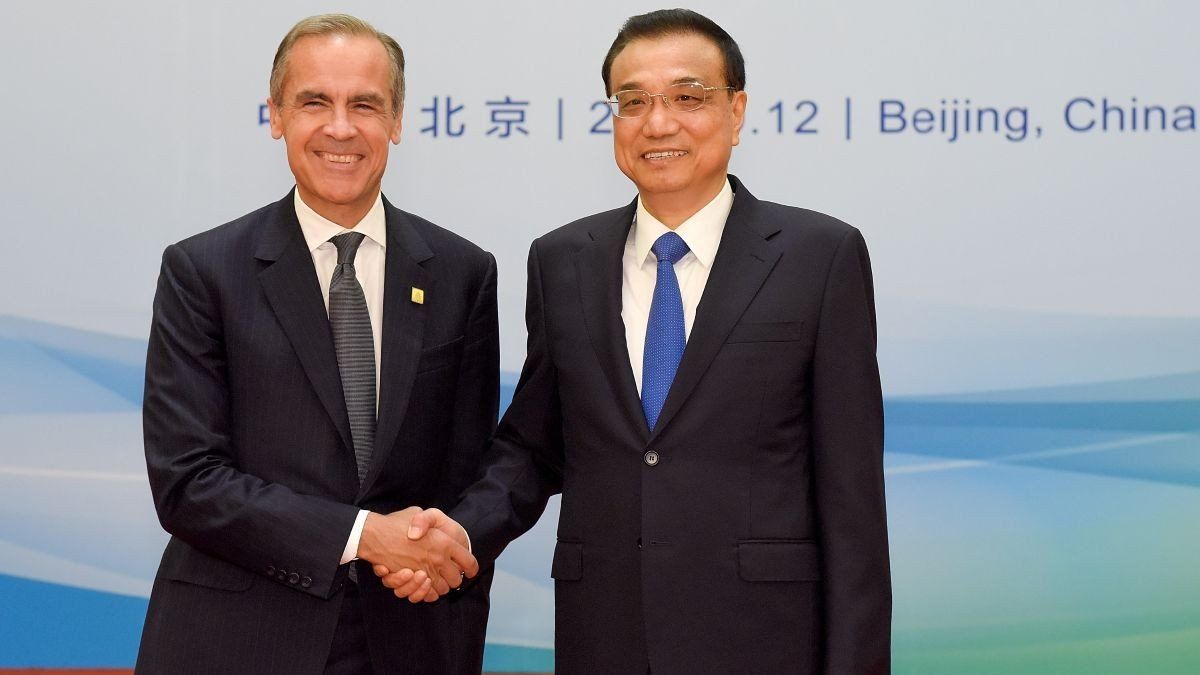
Then-Bank of England Governor Mark Carney shakes hands with then-Chinese Premier Li Keqiang in Beijing, China, on September 12, 2017.
Then-Bank of England Governor Mark Carney shakes hands with then-Chinese Premier Li Keqiang before the 1+6 Round Table Dialogue meeting at the Diaoyutai State Guesthouse, in Beijing, China, on September 12, 2017.
REUTERS/Etienne Oliveau/Pool

Amid a trade war and annexation threats, most eyes are on the US-Canada relationship right now. But the future of Canada’s relationship with China, the world’s second-largest economy, is also an open question, and observers wonder what rookie Prime Minister Mark Carney is going to make of it.

During Canada’s recent election, Carney said China was the country’s biggest security threat. On trade, the Liberal Party’s platform mentioned the Southeast Asian grouping ASEAN and the South American trade bloc MERCOSUR as potential partners for new trade deals, but not China. In fact, the party’s only mention of the superpower was in the context of security, and the necessity of being prepared to “face a hostile Russia or emboldened China.”

Some have called on Carney to build a stronger relationship with China — Canada’s second largest trade partner — particularly in the face of economic threats from Donald Trump, but his government seems wary of deepening ties with Beijing while Trump is trying to decouple the US from China.

The US and Canada have a trade relationship worth roughly $1 trillion a year, and they share a border, deep cultural ties, and a longstanding security relationship. The Trump administration, which is waging its own trade war with China, has made it clear that other countries must choose between Washington and Beijing. For now, it looks like Canada is siding with its neighbor.
More For You

Armoured vehicles of the El Salvador Army operate separately from the UN-authorized Gang Suppression Force (GSF), after additional troops were deployed following an October 18 ambush in which four Salvadoran GSF personnel went missing, in Port-au-Prince, Haiti, November 3, 2026.
REUTERS/Patrice Noel

Over the past two weeks, President of El Salvador Nayib Bukele has sent around 2,000 troops to Haiti to rescue four Salvadoran nationals working in Haiti who were kidnapped by gangs. But the self-proclaimed “world’s coolest dictator” may have bigger ambitions.

Supporters react after media outlets projected Democratic US Senate candidate and Texas State Representative James Talarico's victory in the US midterm elections in Austin, Texas, US, November 3, 2026.
REUTERS/Mike Segar

In the end, the long-predicted “blue wave” turned into a tsunami as the Democrats, harnessing widespread frustrations over high living costs, opposition to the war in Iran, and misgivings about Trump’s deportation policies, swept back to power on Capitol Hill.

Election posters of South Africa's African National Congress (ANC) and other political parties are displayed on street poles ahead of South Africa's municipal elections on November 4, in Pretoria, South Africa, October 29, 2026.
REUTERS/Siphiwe Sibeko

The elections are widely seen as a referendum on the African National Congress (ANC), the party that has governed South Africa since the end of apartheid, amid frustration over pervasive corruption, crumbling public services, and rising migration.