Trending Now
We have updated our Privacy Policy and Terms of Use for Eurasia Group and its affiliates, including GZERO Media, to clarify the types of data we collect, how we collect it, how we use data and with whom we share data. By using our website you consent to our Terms and Conditions and Privacy Policy, including the transfer of your personal data to the United States from your country of residence, and our use of cookies described in our Cookie Policy.
{{ subpage.title }}
How society plays an active role in shaping the future with AI
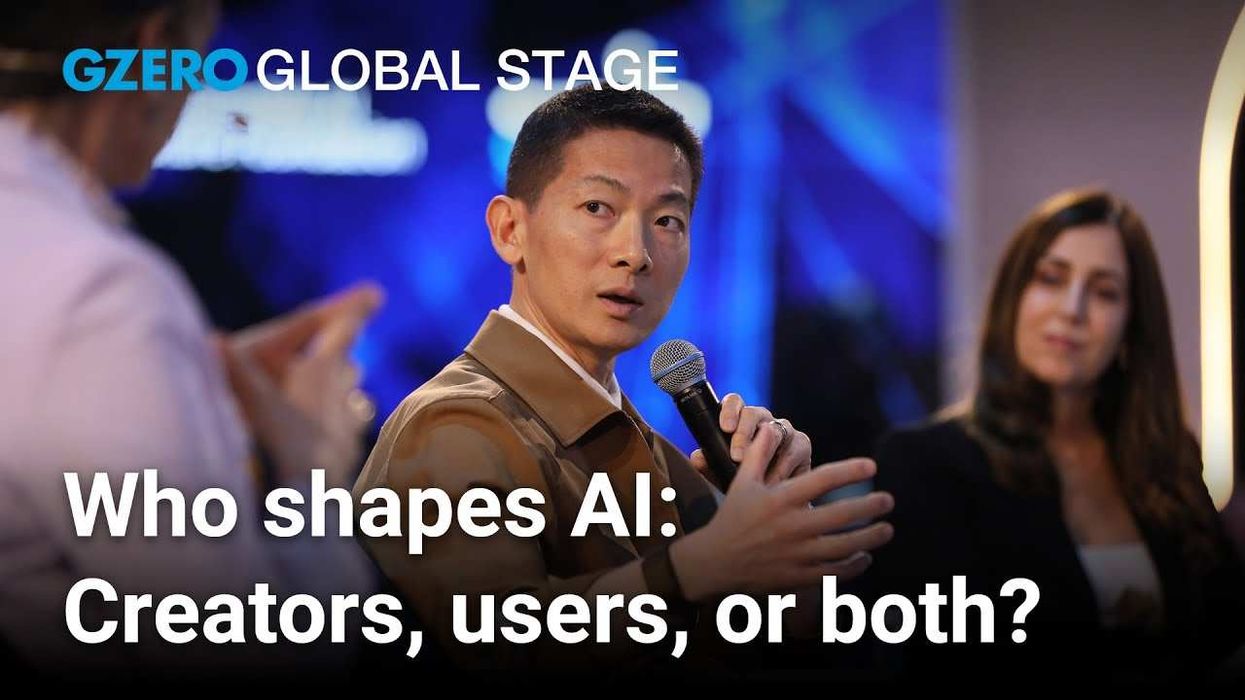
Who really shapes and influences the development of AI? The creators or the users?
Peng Xiao, Group CEO, G42, argues it’s both. “I actually do not subscribe that the creators have so much control they can program every intent into this technology so users can only just respond and be part of that design,” he explains. He stresses, “The more a society uses AI, the more we can influence the development of it. We are co-creators, co-influencers of this technology.”
Highlighting the UAE’s national AI strategy, Xiao points to Mohamed bin Zayed University of Artificial Intelligence, where undergraduates as young as 16 are founding their own companies.
The UAE has also launched programs teaching AI to learners aged 7 to 70 and is deploying billions of AI agents to augment productivity across industries, including oil, cybersecurity, and agriculture.
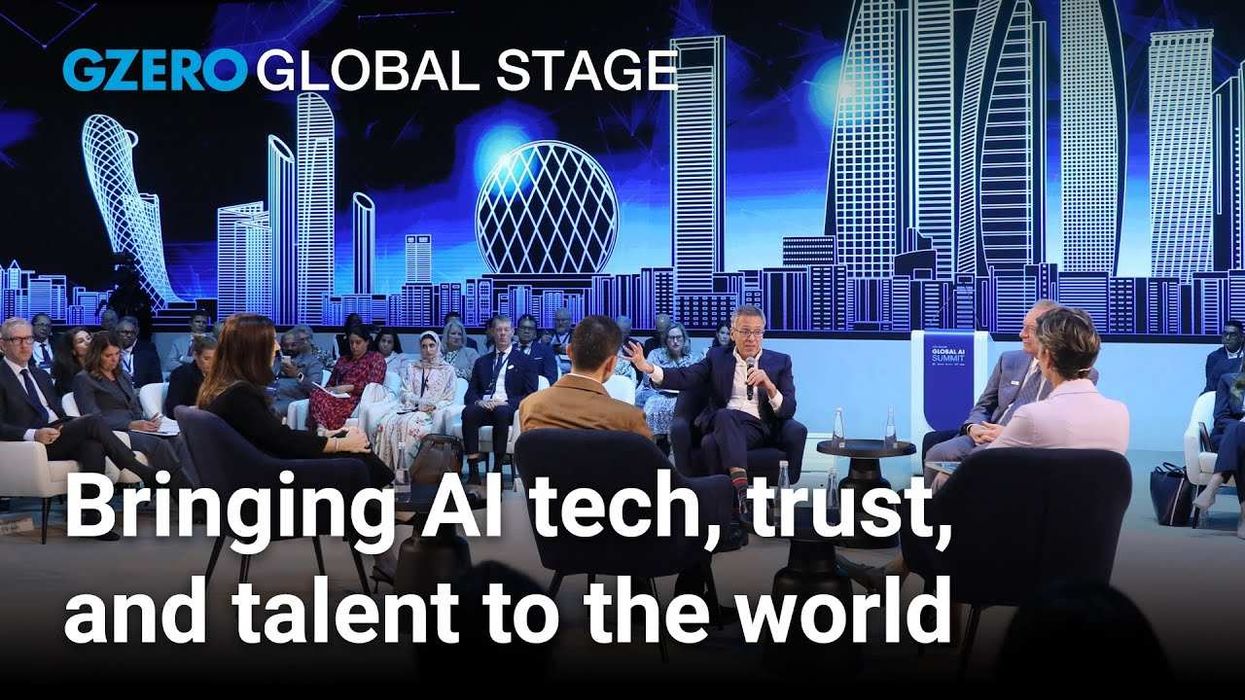
Xiao spoke at the 2025 Abu Dhabi Global AI Summit panel “Bringing AI Technology, Trust, and Talent to the World,” part of GZERO Media’s Global Stage series in partnership with Microsoft. The Global Stage series convenes global leaders for critical discussions on the geopolitical and technological trends shaping our world.
Global Stage: Bringing AI tech, trust, and talent to the world
AI is the fastest-growing general-purpose technology in history but its benefits are uneven. Half the world lacks the combined foundations of electricity, internet access, and digital skills needed to use AI at all.
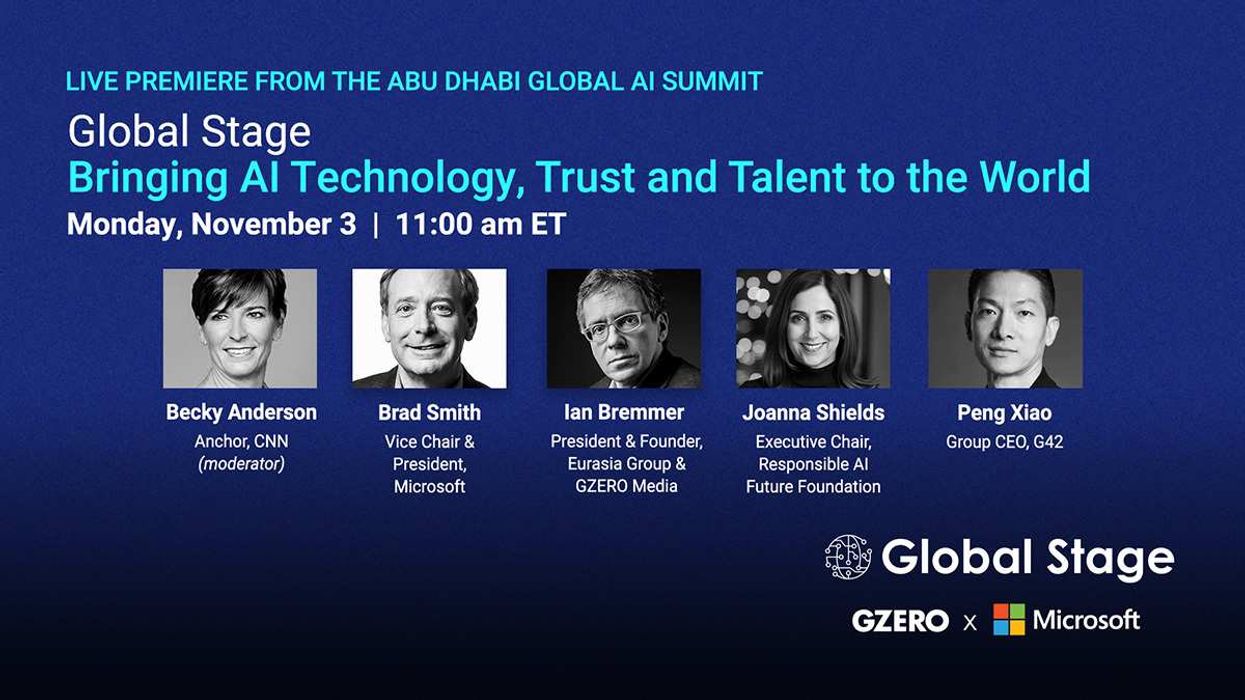
In this Global Stage panel, Becky Anderson (CNN) leads a candid discussion on how to close that gap with Brad Smith (Vice Chair & President, Microsoft), Peng Xiao (CEO, G42), Ian Bremmer (President & Founder, Eurasia Group and GZERO Media), and Baroness Joanna Shields (Executive Chair, Responsible AI Future Foundation).
What does “AI diffusion” actually require? Power first, then connectivity, then skills. As Brad Smith explains, “You can’t build AI in the sky, it needs a foundation: electricity, internet, and digital skills.” The panel explores the hard realities of energy capacity, data-center diplomacy, and why grid investment will determine which nations can compete in the next phase of AI development.
Building on that theme, Peng Xiao underscores the centrality of energy to progress: “The cost of intelligence will become the cost of energy.” His company, G42, is expanding AI infrastructure from the Gulf to Africa and Southeast Asia, leveraging regional power resources to unlock broader access.
From AI fluency to AI engineering and organizational change, the conversation also breaks down the capabilities countries need and how local ecosystems can create jobs rather than replace them. Ian Bremmer reminds the audience that geopolitics and skilling are linked: “AI is geopolitical by design. The winners who shape the algorithms will shape society.”
As AI races ahead of some societies’ ability to adapt, the panel highlights the UAE’s investment in national AI education, from early-age programs to university-level innovation, as a model for inclusive growth.
How do we embed responsibility into models, content, and agentic workflows? Baroness Joanna Shields calls this a defining moment: “This is a civilization-uplift moment we can’t afford to miss.” She stresses that responsible AI means empowering everyone equally, ensuring that local cultures, values, and languages shape the systems built for them.
The discussion explores emerging tools like watermarking and auditable agent interactions, alongside the global governance efforts led by the UN and multistakeholder coalitions, to balance innovation and accountability across regions.
The Global Stage series, presented by GZERO Media in partnership with Microsoft, convenes leaders from government, business, and civil society at major international forums to examine the critical issues at the intersection of technology, politics, and society, and to explore how global cooperation can deliver solutions in an era of accelerating change.
Live premiere today at 11 AM ET: Global Stage at the Abu Dhabi Global AI Summit
LIVE PREMIERE TODAY AT 11 AM ET: What does it take to build AI economies? Our global experts explore this question, touching on data infrastructure, skilling, and governance, in a conversation at the inaugural Abu Dhabi Global AI Summit.
Watch our live premiere of "Global Stage: Bringing AI Technology, Trust, and Talent to the World" today at 11:00 AM ET at gzeromedia.com/globalstage. The panel was recorded live in front of an audience of global leaders, investors, and technologists attending the Abu Dhabi Global AI Summit, presented by G42, Microsoft, the Responsible AI Future Foundation (RAIFF) AI Future Foundation (RAIFF), and Eurasia Group. The event was held on November 2-3 at the Abu Dhabi Energy Center.
The discussion is moderated by CNN anchor Becky Anderson, and will feature a distinguished panel including Ian Bremmer, President and Founder, Eurasia Group and GZERO Media; Baroness Joanna Shields, Executive Chair, Responsible AI Future Foundation; Brad Smith, Vice Chair and President, Microsoft; and Peng Xiao, Group CEO, G42.
This livestream is the latest in the award-winning Global Stage series, a partnership between GZERO and Microsoft that examines critical issues at the intersection of technology, politics, and society.
Join us on Monday, November 3, 2025 at 11:00 AM ET at gzeromedia.com/globalstage to watch the live premiere.
Live Premiere from the Abu Dhabi Global AI Summit | Global Stage: Bringing AI Technology, Trust, and Talent to the World
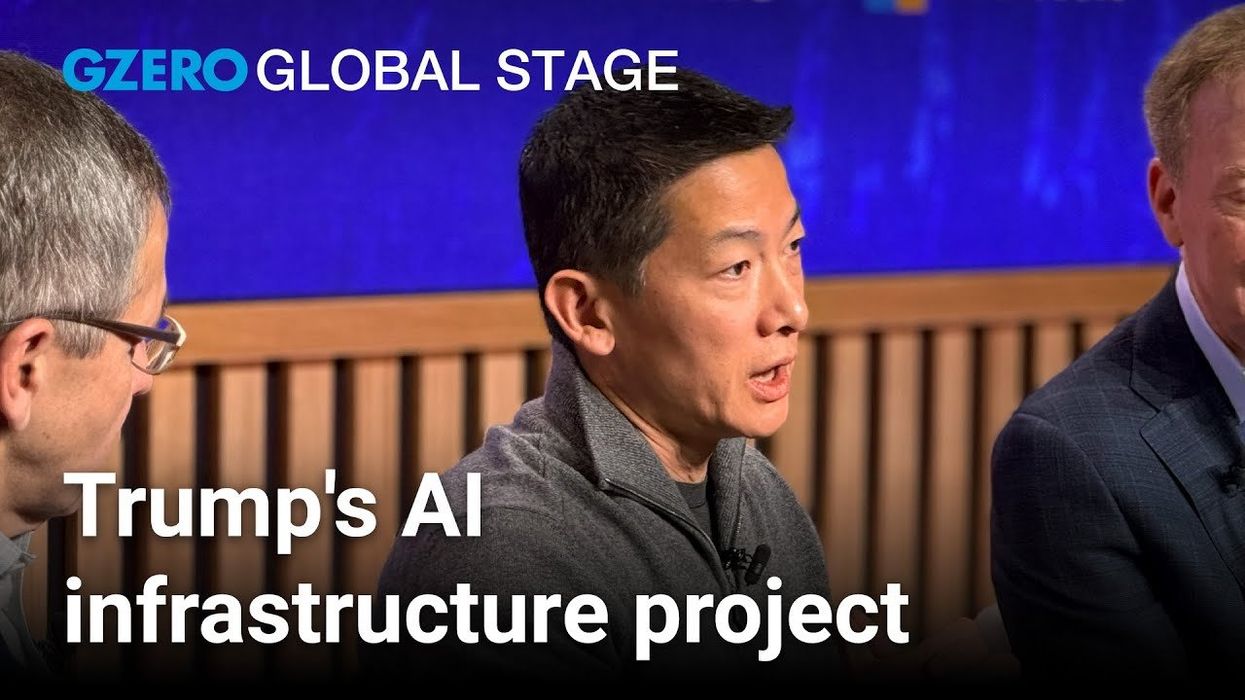
We're on path to building an intelligence grid, says Peng Xiao
"We are on the right path to building, what I call, the 'intelligence grid' alongside the electricity grid," said Peng Xiao, CEO of G42.
As Donald Trump begins his new term, artificial intelligence has reemerged as a major topic of discussion. During a Global Stage livestream at the World Economic Forum in Davos, Peng highlighted the benefits and challenges of advancing AI technology. He praised Trump’s global infrastructure build-out initiative and AI’s potential to integrate seamlessly into daily life but underscored, "We cannot afford for intelligence not to be equally distributed."
Peng emphasized the need for global governance and development to be "equitable, systematic, and coordinated across regions." Thus as private sector investments in AI surge, policy decisions in the coming months will be closely watched
This conversation, moderated by Becky Anderson, was part of the Global Stage series at the 2025 World Economic Forum in Davos, Switzerland, presented by GZERO in partnership with Microsoft.
Click to watch the full discussion for our panel's insights on AI's future and how it is expected to transform our economy and society by 2030.
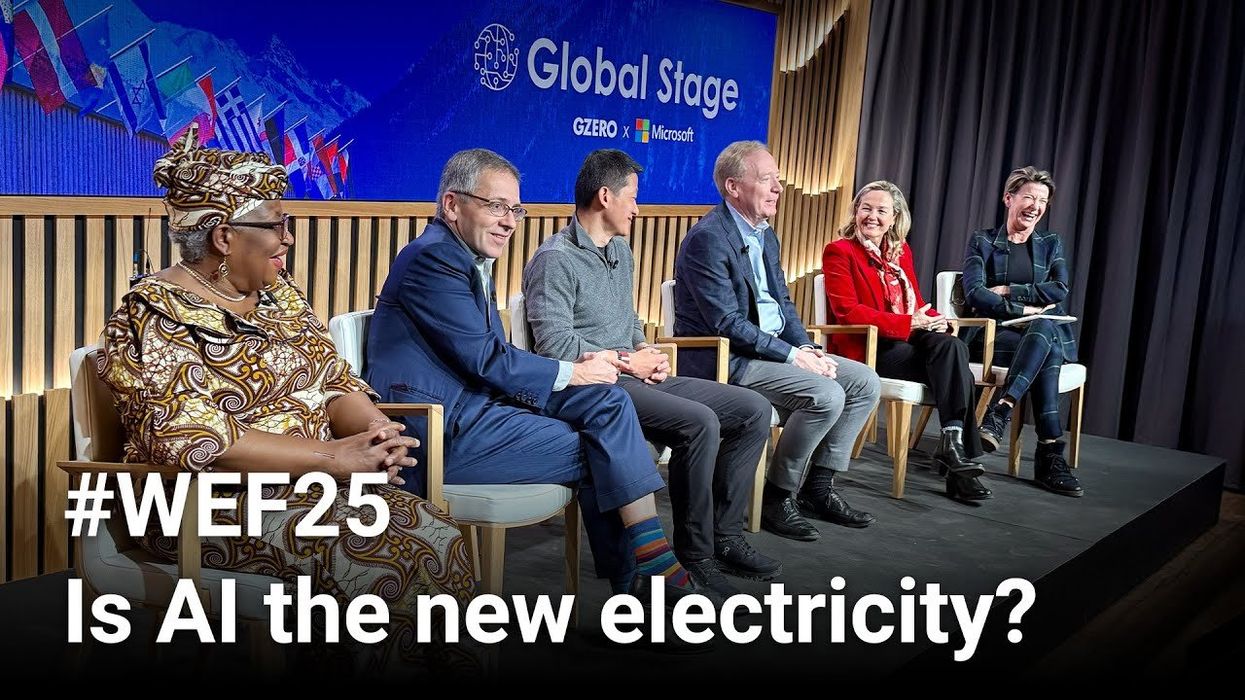
AI in 2025: The "new electricity" could create huge economic growth
Artificial intelligence is no longer a distant vision of the future—it’s here, and it’s transforming the way we live, work, and innovate. At the 2025 World Economic Forum in Davos, Switzerland, our Global Stage panel brought together some of the world’s brightest minds to discuss the profound impact AI could have on global growth, society, and infrastructure.
Our thought-provoking panel discussion, moderated by Becky Anderson, Anchor & Managing Editor of CNN Abu Dhabi, featured Ian Bremmer, President and Founder of Eurasia Group and GZERO Media; Nadia Calviño, President of the European Investment Bank; Ngozi Okonjo-Iweala, Director General of the WTO; Brad Smith, Vice Chair and President of Microsoft; and Peng Xiao, CEO of G42. They shared unique insights into the opportunities and challenges of the AI revolution.
The Global Stage series is a partnership between GZERO Media and Microsoft presenting conversations about critical global issues at the intersection of technology, politics, and society.
We’ve entered a new phase of the AI conversation, moving beyond debates over whether it will save or destroy humanity. Instead, the focus has shifted to the ways this powerful technology, when used correctly and ethically, can enhance human life. From revolutionizing healthcare and expediting scientific breakthroughs to creating infrastructure investment opportunities, AI holds the potential to contribute up to $20 trillion to global GDP over the next five years.
Geopolitical competition is also heating up. While the US-China rivalry dominates headlines, the Middle East—particularly the UAE—is emerging as a significant player in the AI space with increasing investments and innovations.
As Microsoft's Brad Smith noted during the expert panel discussion, AI could become as essential as electricity. However, ensuring its benefits are equitably shared across all societies is vital. Achieving this requires collaboration between governments, multilateral organizations, and private sector leaders.
Watch the full discussion now for our panel's insights on AI's future, and how it is expected to transform our economy society by 2030.
- Ian Bremmer: On AI regulation, governments must step up to protect our social fabric ›
- For AI access for all, investment is the key, says Microsoft's Brad Smith ›
- What impact will AI have on gender equality? ›
- AI's evolving role in society ›
- The AI economy ›
- We're on path to building an intelligence grid, says Peng Xiao - GZERO Media ›
- Why neither the US nor China is the world’s strongest country - GZERO Media ›
- Protecting your money in today's unpredictable market - GZERO Media ›
- Join us live from the 2025 UN Science, Technology, and Innovation Forum this Wednesday - GZERO Media ›
- Live premiere Nov. 3: Global Stage at the Abu Dhabi Global AI Summit - GZERO Media ›
- Is Abu Dhabi becoming the global capital of AI development? - GZERO Media ›
From Davos: Watch our Global Stage discussion on the AI economy
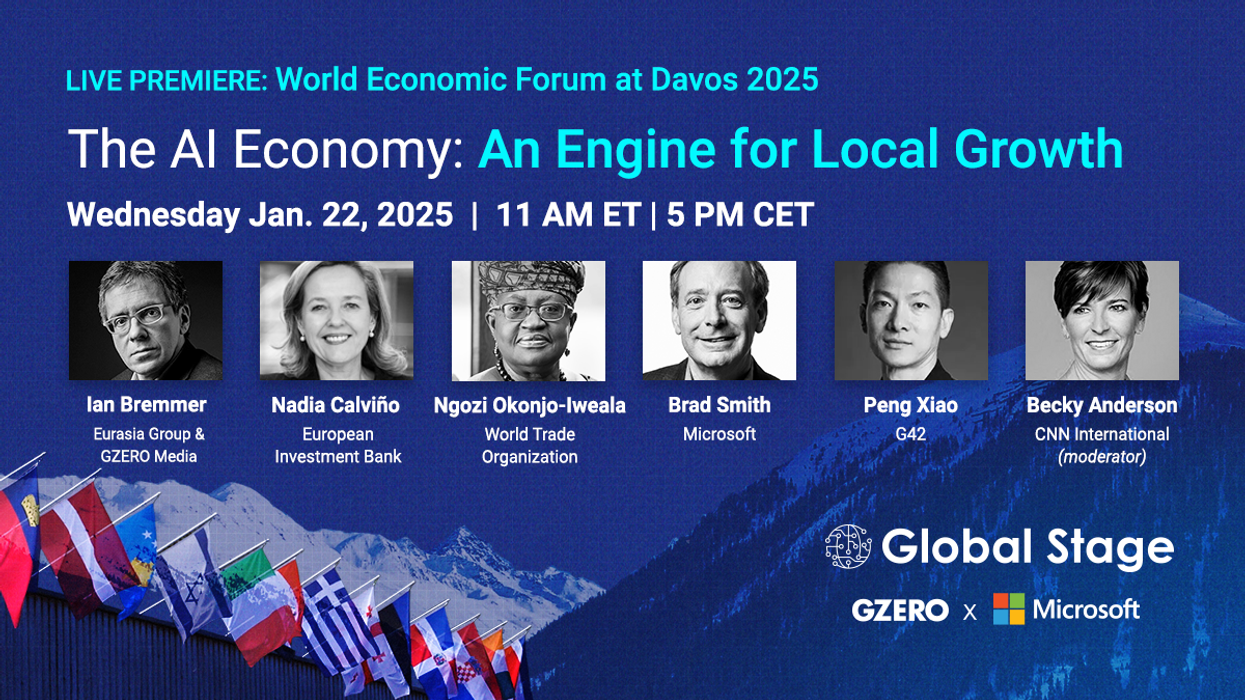
At this year's World Economic Forum in Davos, Switzerland, our Global Stage panel discussion, "The AI Economy: An Engine for Local Growth", will examine AI’s growing global impact, the potential for enormous benefits to society, and the investments necessary to ensure equitable diffusion and adoption of AI tools. As artificial intelligence continues to reshape economies, its potential to drive massive growth is undeniable. The International Data Corporation (IDC) estimates that through 2030, AI will contribute $19.9 trillion to global GDP and drive 3.5% growth. However, realizing this potential requires careful attention to how and where AI expands, and who is included in its growth.
Watch the live premiere now at gzeromedia.com/globalstage.
Participants:
- Ian Bremmer, President and Founder, Eurasia Group and GZERO Media
- Nadia Calviño, President, European Investment Bank
- Ngozi Okonjo-Iweala, Director General, World Trade Organization
- Brad Smith, Vice Chair and President, Microsoft
- Peng Xiao, CEO, G42
- Becky Anderson, (moderator) Host of CNN Connect and Managing Editor of CNN Abu Dhabi
This livestream is the latest in the Webby-nominated Global Stage series, a partnership between GZERO and Microsoft that examines critical issues at the intersection of technology, politics, and society.
Live premiere: Wednesday, January 22 at 11 AM ET/ 5 PM CET
- Ian Bremmer and Amina Mohammed on the promise and peril of AI ›
- Tech accord on AI & elections will help manage the ‘new reality,’ says Microsoft’s Brad Smith ›
- Davos 2024: China, AI & key topics dominating at the World Economic Forum ›
- Ian Explains: How will AI impact the workplace? ›
- Davos 2024: AI is having a moment at the World Economic Forum ›