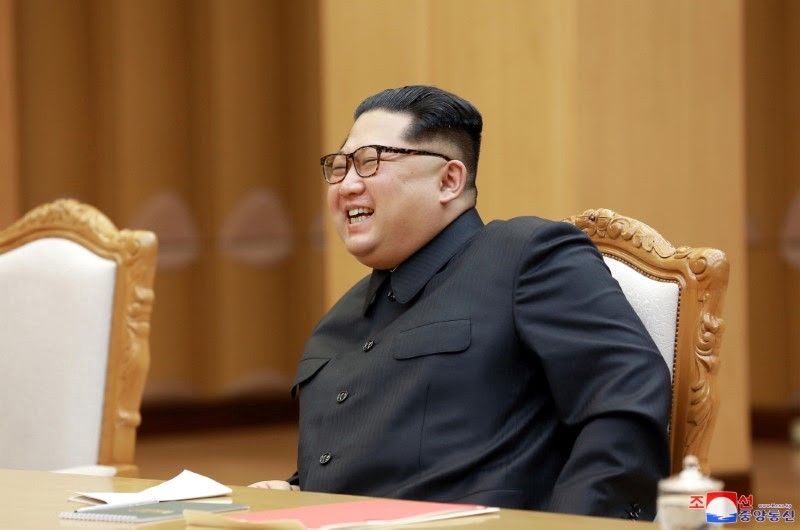
North Korea's Wildly Inflated Blowup

Assuming that you’re a journalist in Northeast Asia with $10,000 to spare this week, you can get tickets to a killer show: the destruction of North Korea’s main underground nuclear test site, nestled deep within Mount Mantap near the Chinese border.

It will surely be a spectacle — the North Korean regime is good at that — but as Trump and Kim warily circle each other ahead of a possible face-to-face meeting in June, is it a meaningful gesture in the gyres of diplomacy? Well, for one thing, the nuclear site has reportedly already partially collapsed following its last use.

Second, the site has already largely served its purpose, which was to develop a nice batch of nuclear warheads. Whether Kim was able to develop missiles that could reliably carry those warheads to the United States is less certain. But that’s not the work of fission specialists in the bowels of Mount Mantap.

The big question at the summit will be: How does each side define denuclearization? We learned last week that Pyongyang and Washington still have very different ideas about this. Blowing up the nuclear test facility won’t advance either side’s understanding here.

So while $10,000 seems like a bargain to hang with Kim Jong-un and watch the destruction of a nuclear test site, the event is more media spectacle than diplomatic substance. And Kim certainly knows it.

More from GZERO Media

- YouTube

In this Global Stage panel recorded live in Abu Dhabi, Becky Anderson (CNN) leads a candid discussion on how to close that gap with Brad Smith (Vice Chair & President, Microsoft), Peng Xiao (CEO, G42), Ian Bremmer (President & Founder, Eurasia Group and GZERO Media), and Baroness Joanna Shields (Executive Chair, Responsible AI Future Foundation).

A Palestinian Hamas militant keeps guard as Red Cross personnel head towards an area within the so-called “yellow line” to which Israeli troops withdrew under the ceasefire, as Hamas says it continues to search for the bodies of deceased hostages seized during the October 7, 2023, attack on Israel, in Gaza City, on November 2, 2025.
REUTERS/Dawoud Abu Alkas
Farmers proceed to their fields for cultivation under Nigerian Army escort while departing Dikwa town in Borno State, Nigeria, on August 27, 2025. Despite the threat of insurgent attacks, farmers in Borno are gradually returning to their farmlands under military escort, often spending limited time on cultivation.
REUTERS/Sodiq Adelakun
US President Donald Trump (sixth from left) and Japanese Prime Minister Sanae Takaichi (seventh from left) arrive at the nuclear-powered aircraft carrier USS George Washington (CVN-73) in Yokosuka City, Kanagawa Prefecture, Japan, on October 28, 2025.
Akira Takada / The Yomiuri Shimbun via Reuters Connect

Last Thursday, US President Donald Trump announced that Washington will restart nuclear weapons testing, raising fears that it could end a 33-year moratorium on nuclear-warhead testing.

Behind every scam lies a story — and within every story, a critical lesson. Anatomy of a Scam, takes you inside the world of modern fraud — from investment schemes to impersonation and romance scams. You'll meet the investigators tracking down bad actors and learn about the innovative work being done across the payments ecosystem to protect consumers and businesses alike. Watch the first episode of Mastercard's five-part documentary, 'Anatomy of a Scam,' here.

- YouTube

"We are seeing adversaries act in increasingly sophisticated ways, at a speed and scale often fueled by AI in a way that I haven't seen before.” says Lisa Monaco, President of Global Affairs at Microsoft.

US President Donald Trump has been piling the pressure on Russia and Venezuela in recent weeks. He placed sanctions on Russia’s two largest oil firms and bolstered the country’s military presence around Venezuela – while continuing to bomb ships coming off Venezuela’s shores. But what exactly are Trump’s goals? And can he achieve them? And how are Russia and Venezuela, two of the largest oil producers in the world, responding? GZERO reporters Zac Weisz and Riley Callanan discuss.

- YouTube

Former New Zealand Prime Minister Jacinda Ardern says AI can be both a force for good and a tool for harm. “AI has either the possibility of…providing interventions and disruption, or it has the ability to also further harms, increase radicalization, and exacerbate issues of terrorism and extremism online.”