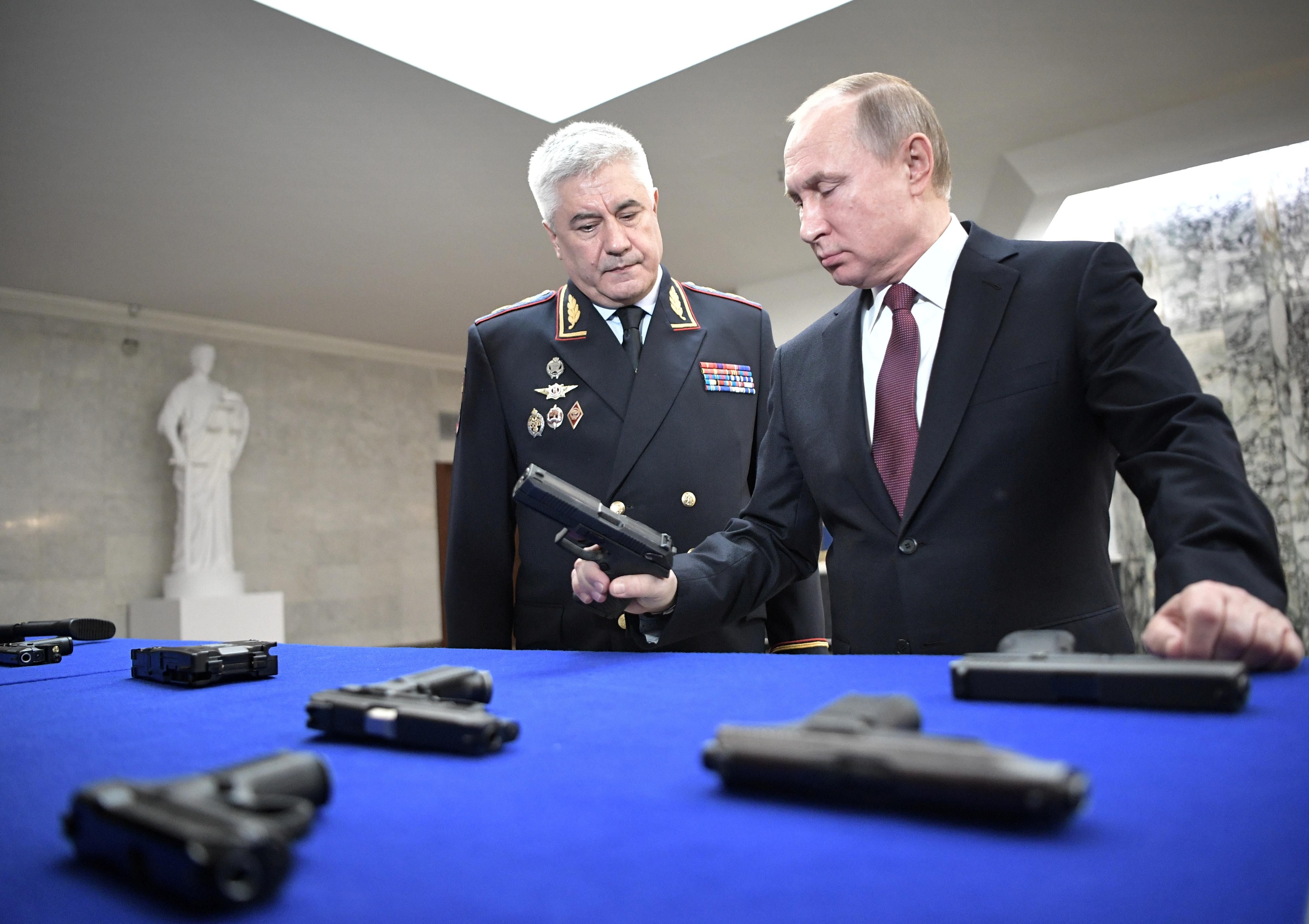
Putin orders review of gun laws after school shooting: Details remain sketchy following a shooting at a school in the Russian city of Kazan. At least seven children and one teacher were killed, and a 19-year-old has been arrested, according to local officials. In response to the attack, President Vladimir Putin "gave an order to urgently work out a new provision concerning the types of weapons that can be in civilian hands, taking into account the weapon" used in this shooting, according to a Kremlin spokesman. There's an irony here that extends to the United States, where school shootings are all too common. In 2018, a Russian woman named Maria Butina pleaded guilty to using the National Rifle Association, the gun rights lobbying group, to "establish unofficial lines of communication with Americans having power and influence over American politics." At the time, Putin described Butina's 18-year sentence as an "outrage." The NRA, of course, works hard to prevent Congress and the president from taking precisely the kinds of actions that Putin swiftly ordered following the shooting in Kazan.
Forests growing back: Finally some good news about the environment. According to a new WWF study, an area of forest equivalent to the size of France has regrown across the world in the past 20 years. These "new" forests in places like Brazil, Mongolia, Canada or parts of Africa could possibly trap up to 5.9 gigatons of carbon dioxide annually — more than the US, the world's second largest emitter, puts into the atmosphere annually. The forest regrowth is the result of planting new trees, keeping livestock away, eliminating invasive plants, and, interestingly, not doing anything at all. While this is a welcome development in the global struggle against climate change, unfortunately it's still being offset by alarming rates of deforestation, especially in the Amazon. The experts tell us that for forests to become a true climate solution, we would need to grow new forests at least twice as fast as we're destroying them around the world. So time to plant a lot of trees, or to just leave forests alone.
Iran-Saudi talks: Could longtime bitter Middle East rivals Iran and Saudi Arabia be on the cusp of an understanding? Tehran has just
confirmed that both sides actually sat down recently for the first time in years to ease tensions — perhaps in part as a consequence of the Biden administration's move to cut support for the Saudis in Yemen, where Saudi Arabia and Iran have been fighting a proxy war since 2014. Washington, which aims to
draw back from the region more broadly, also wants the Saudis to go along with any US-Iran deal to
resurrect the 2015 Iran nuclear deal. Saudi Crown Prince Mohamed bin Salman recently
said he wants to get along with the Iranians, a major change of tone for him. Let's not get carried away of course: there's still a lot of bad blood between both sides, but the mere fact that Iran and Saudi Arabia are talking is progress towards avoiding a major conflict between the region's two main powers.