Analysis
Five stories to be thankful for
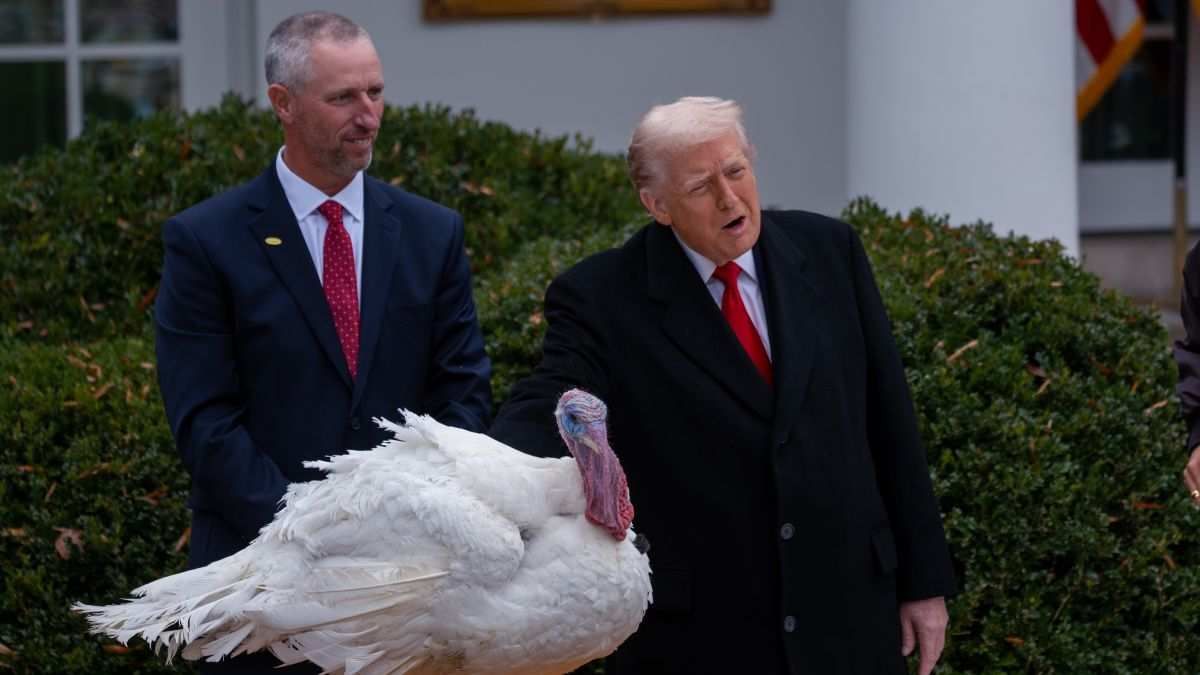
US President Donald Trump pardons a turkey at the annual White House Thanksgiving Turkey Pardon in the Rose Garden in Washington, D.C., USA, on Nov. 25, 2025.
Andrew Leyden/NurPhoto
Well, it’s about to be Thanksgiving in the United States. Although not all of our global readers celebrate that particular holiday, it’s still good to remind ourselves that while the world offers plenty of fodder for doomscrolling and despair, there are still lots of things to be grateful for too. Here’s a selection of five good news stories from around the world in 2025!
First, energy is getting cleaner, faster. This year, renewables quietly overtook coal as the planet’s top source of electricity – a milestone driven almost single-handedly by China’s clean-energy boom. Beijing added more solar capacity than the rest of the world combined, pushing solar-panel prices to record lows and making renewables the cost-effective choice for fast-growing power grids in the developing world. Across Africa, solar panel imports from China rose 60% over the last year, trends echoed from Malaysia to Mexico. Yes, the US wobbled a bit, with fossil-fuel use increasing and green-energy projects scuttled, but analysts still call 2025 a “turning point”: coal’s long, filthy reign is ending.
Second, people are much kinder than we think. Global data shows lost wallets are returned at about twice the rate people expect, according to the World Happiness Report. The researchers found that most of us dramatically underestimate the honesty of our neighbors. And that that optimism gap matters. The researchers found that believing you live among people who’d return your wallet turns out to be one of the strongest predictors of happiness. Big smiles to the Nordic countries, which top both the happiness rankings and the wallet-return charts.
Third, fragile but real diplomatic breakthroughs emerged in long-running conflicts. Whether you love or hate US President Donald Trump’s diplomatic style, he has made progress in stopping some of the world’s most intractable conflicts. In June, the Democratic Republic of the Congo and the Rwandan-backed M23 rebels agreed to US-brokered peace negotiations and signed a “comprehensive” peace framework in Qatar this month – their most concrete progress in years. Meanwhile, in August, Armenia and Azerbaijan’s leaders agreed to a political framework to end the 37-year long Nagorno-Karabakh conflict. And in Gaza, Hamas and Israel agreed to the first phase of a ceasefire. While the crucial second phase is riddled with challenges, the (mostly) sustained pause in violence has allowed for desperately-needed humanitarian aid to Gaza and diplomatic negotiations on the enclave’s future.
Fourth, stranded astronauts finally made it home. NASA’s Butch Wilmore and Suni Williams returned to Earth after an unplanned nine-month stay on the International Space Station. The pair were ferried back to earth by a SpaceX ship, which was greeted by dolphins when it splashed down off the Florida coast. Their eight-day mission stretched to more than a year after Boeing’s Starliner ran into trouble and couldn’t return back to earth, but they kept busy while waiting for their rescue: they ran experiments, went on spacewalks, and even celebrated Christmas in orbit. Williams now holds the record for most spacewalk hours by a woman.
And finally, the Smithsonian National Zoo is about to have another elephant in the room. Twelve-year-old Nhi Linh is expecting her first calf — the zoo’s first in 25 years! Early ultrasounds of the 150-pound fetus suggest everything looks healthy. The team is now reinforcing the enclosure for a newborn who is expected to arrive before spring, a symbol of home for a species with fewer than 50,000 living in the wild.
In news cycles that often swirl around negativity, these stories remind us that progress – whether in geopolitics or the pachyderm-population – marches on. Happy Thanksgiving!
A year after USAID shut down, we’re seeing the effects of such a drastic drop in foreign aid during some major crises. David Miliband joins Ian Bremmer on GZERO World to discuss the shock to the system and what comes next.
Think you know what's going on around the world? Here's your chance to prove it.
Check out the latest swag from the official Puppet Regime merchandise store! Browse an array of products that will show the world you are a devoted subject of the Regime, including: A big, beautiful mug for drinking coffee very strongly, A handsome tote bag to carry your favorite classified documents, Collectible stickers, Stylish t-shirts and hoodies – now also available in pink. We ship worldwide! Shop now at shop.puppetregime.tv!
Iran-linked cyberattacks on US water systems show how a war thousands of miles away can reach Americans through something as basic as the tap.