Japan confronts the “dark side” of AI

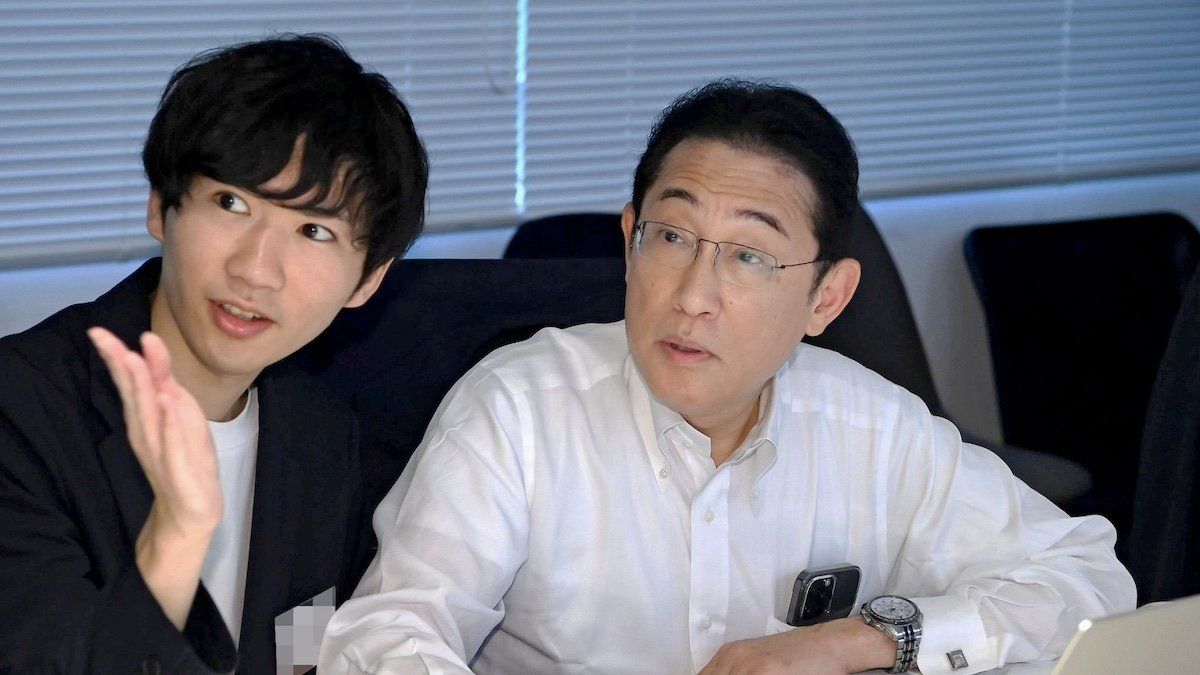
Prime Minister Fumio Kishida (R) takes part in a class on generative artificial intelligence at the University of Tokyo in Japan's capital on Aug. 14, 2023.
Kyodo via Reuters Connect

Japan detailed a global framework for international cooperation on artificial intelligence on May 1, building off the Hiroshima Process announced at last year’s G7 summit. The framework focuses on stemming the risks that generative AI poses for global disinformation — but details are a bit lacking.

“Generative AI has the potential to be a vital tool to further enrich the world,” Prime Minister Fumio Kishida said in an address to the OECD in Paris. “[But] we must also confront the dark side of AI, such as the risk of disinformation.” Kishida said 49 countries and regions have signed on to the agreement, which includes guiding principles and a code of conduct for generative AI developers. It aims to improve transparency, risk mitigation, safety, and authentication.

Eurasia Group analyst David Boling says that the Hiroshima process is a rather incremental attempt at global regulation. “[It] shows that Japan wants to influence how countries regulate AI,” Boling said. “But its approach will be to nudge countries, not judge countries.”

It will be hard for the Hiroshima Process, he said, to “produce anything but statements of high-level principles with limited value.”

More from GZERO Media

Luis Fernando Cerimedo, advisor of Presidential candidate Nasry Asfura of the National Party of Honduras (PN), speaks during a press conference after the general election, in Tegucigalpa, Honduras, December 1, 2025.
REUTERS/Jose Cabezas

There are close presidential races, and then there’s the one in Honduras, where just 515 votes separate the top two candidates following Sunday’s election in the Central American nation.

Ukrainian President Volodymyr Zelensky inspects a guard of honor by the Irish Army at Government Buildings during an Irish State visit, in Dublin, Ireland, on December 2, 2025.
REUTERS/Clodagh Kilcoyne

Even though an energy corruption scandal is roiling his leadership, Ukrainian President Volodymyr Zelensky isn’t necessarily in a rush to accept a deal to end the Russia-Ukraine war – especially if the terms are unfavorable.

In this episode of Tools and Weapons, Microsoft Vice Chair and President Brad Smith sits down with Ed Policy, President and CEO of the Green Bay Packers, to discuss how purpose-driven leadership and innovation are shaping the future of one of the world’s most iconic sports franchises. Ed shares how technology and community-focused initiatives, from Titletown Tech to health and safety innovations on the field, are transforming not just the game of football, but the economy and culture of Green Bay itself. He explains how combining strategic vision with investment in local startups is keeping talent in the Midwest and creating opportunities that extend far beyond Lambeau Field.

Subscribe and find new episodes monthly, wherever you listen to podcasts.

The Gen Z group led by Miraj Dhungana escalates their ongoing demonstrations, confronting police outside the prime minister's official residence in Kathmandu, Nepal, on Nov. 26, 2025.
Sanjit Pariyar/NurPhoto

Youth unemployment is making headlines from China to Canada, with many countries’ rates at historic highs. The fallout is fueling Gen Z discontent, creating migration pressures, and threatening social unrest in nations around the globe.

People stay at a school, which is functioned as the temporary shelter at flooded area, on November 30, 2025 in Sumatra, Sumatra. The authorities in Indonesia were searching on Sunday for hundreds of people they said were missing after days of unusually heavy rains across Southeast Asia that have killed hundreds and displaced millions.
Photo by Li Zhiquan/China News Service/VCG

800: The death toll from the tropical storm that battered parts of Southeast Asia is now close to 800.