October 31, 2024
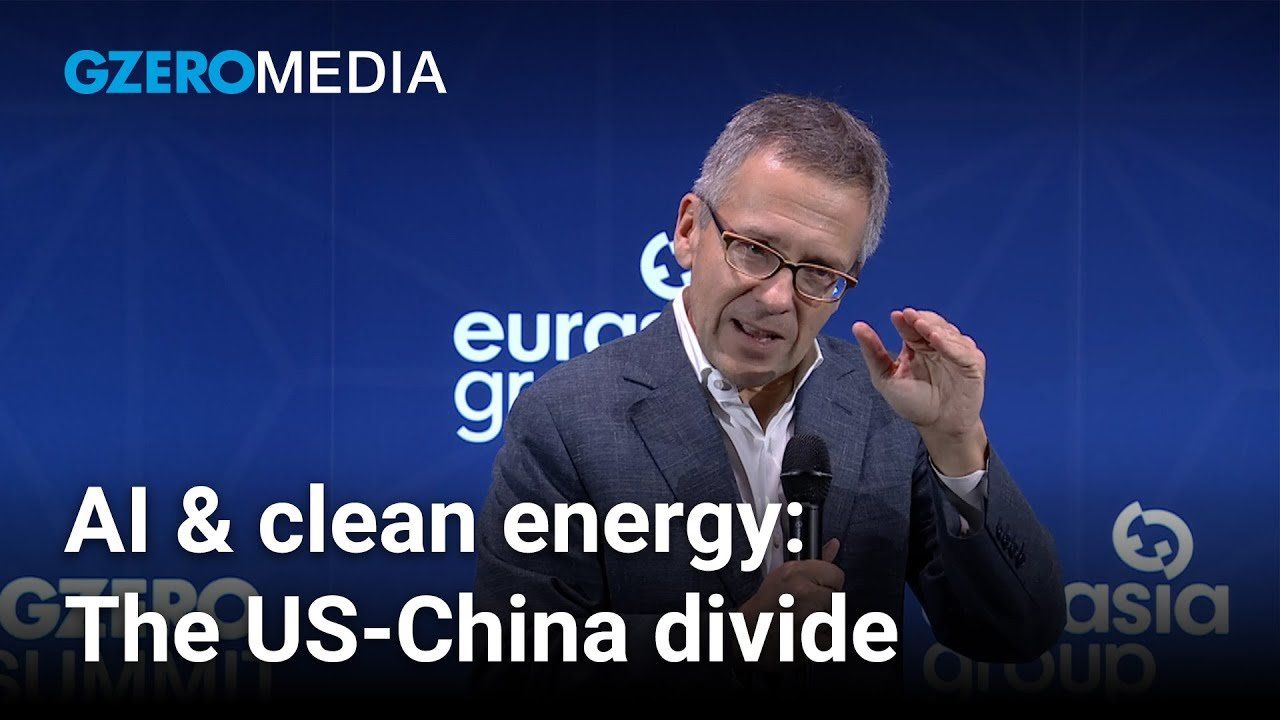
What happens when the Chinese government decides that its own people can't be trusted with the state-of-the-art AI tools being developed by American companies? At the GZERO Summit in Japan, Ian Bremmer explored the tech-driven US-China rivalry. The US remains a key player in AI innovation, developing tools that are improving efficiency, health, and access to information on a global scale. Yet China’s rising dominance in clean energy, particularly in electric vehicles, solar, wind, and next-generation nuclear power, is compelling global alignment. "If we don't want to work with the Chinese, it won't stop them," Bremmer said, underscoring the inevitability of China's post-carbon influence.
As these technological races accelerate, it remains clear that the US and China will continue to shape the future in distinct and often opposing ways, leaving other nations to navigate the complex terrain between these global giants.
Click to watch Ian Bremmer’s analysis and his full 2024 "State of the World" speech.
From Your Site Articles
- After Fukushima, can nuclear power actually help save the planet? ›
- How China fits into global climate change ›
- Davos 2024: China, AI & key topics dominating at the World Economic Forum ›
- China spends big on AI ›
- China’s nuclear noncommitment ›
- Ian Bremmer: Can the US still lead AI innovation while cutting global ties? - GZERO Media ›
More For You
Think you know what's going on around the world? Here's your chance to prove it.
Most Popular
Sponsored posts
Show your undying devotion to The Regime
Sponsored posts
Invested in America’s curiosity
Ukraine's Minister of Defence Mykhailo Fedorov speaks at a joint press conference with his Swedish counterpart Pal Jonson (not pictured), amid Russia's attack on Ukraine, in Kyiv, Ukraine, July 1, 2026.
REUTERS/Alina Smutko
Critics have said that Zelensky – now in his seventh year in office – has been in power for too long.
US-Canada talks hit tariff deadline, Meta goes on trial, Japan to test missiles in Australia
Aug 18, 2026
A banner reading "Buy Canadian", in response to U.S. President Donald Trump's 25% tariffs on goods from Canada, is held aloft by a pair of hockey sticks in front of a house in Winnipeg, Manitoba, Canada March 5, 2025.
REUTERS/Ed White
Washington and Ottawa are down to the wire with last-minute talks to reach an agreement by 12:01 a.m. Wednesday, when President Donald Trump has threatened to impose 50% tariffs on over $20 billion of Canadian goods.
On Monday, public health officials said the virus had killed 2,325 people.
© 2025 GZERO Media. All Rights Reserved | A Eurasia Group media company.