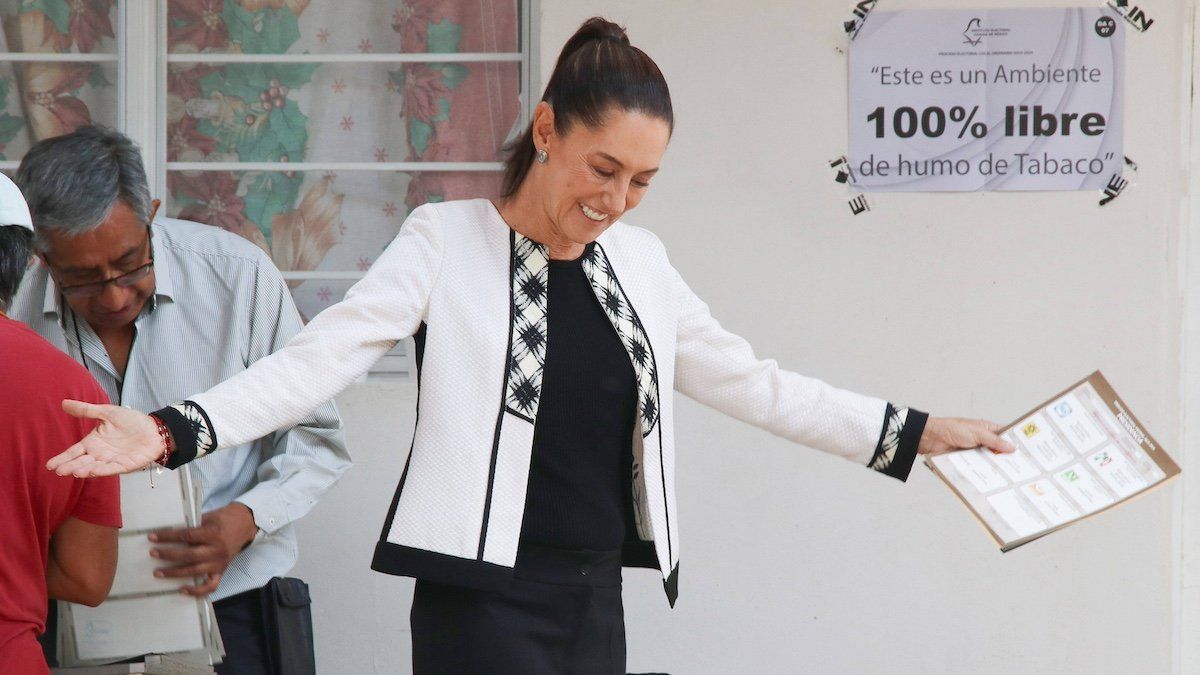
Claudia Sheinbaum made history on Sunday, with preliminary results showing she won roughly 60% of the vote to become the first woman elected Mexico’s president. Her victory was never really in doubt, given the support she enjoyed from outgoing and immensely popular President Andrés Manuel Lopez Obrador. But that same popularity means it will be hard for Mexico’s first female president to emerge from her predecessor’s shadow.
Mexican presidents are limited to a single six-year term, but AMLO has pitched Sheinbaum as his loyal successor. He’s promised she will carry on the work of what he calls Mexico’s populist “Fourth Transformation” (the first three being Mexican Independence in 1821, the civil war of 1858-1861, and the revolution 1910-1917).
Her vote more than doubled the runner-up’s, and her party took 251 seats in the lower house and 60 in the Senate, which should give her so-called “qualified” majorities in both houses alongside coalition partners. In other words, she can change the constitution, and perhaps enact some of the controversial changes AMLO failed to implement.
When the fiesta dies down at Morena headquarters, Sheinbaum will face demands from voters to tackle cartel violence, the country’s historically high murder rate, and immigration – problems she has slim chances of resolving. On the latter issue, she’s at the mercy of Washington, as folks crossing her southern border with Guatemala are trying to get to the United States, not stay in Mexico. She won’t have a clear picture of the policy environment she can act within until the gringos vote in November.
And she’ll need to break away from AMLO’s “hugs not bullets” policy, which has utterly failed to protect Mexicans, especially women and girls, from the predations of drug traffickers. The trick will be doing so without implicitly criticizing her former boss.
“The challenge is to follow Lopez Obrador, manage an extremely challenging security situation, ensure macroeconomic fundamentals remain sound and potentially deal with Trump,” said Eurasia Group analyst Daniel Kerner, who was at Sheinbaum HQ on Sunday. “And if she tries to do the constitutional reforms, economic and social stability will suffer.”