What We're Watching

Harris and Trump get combative in key interviews

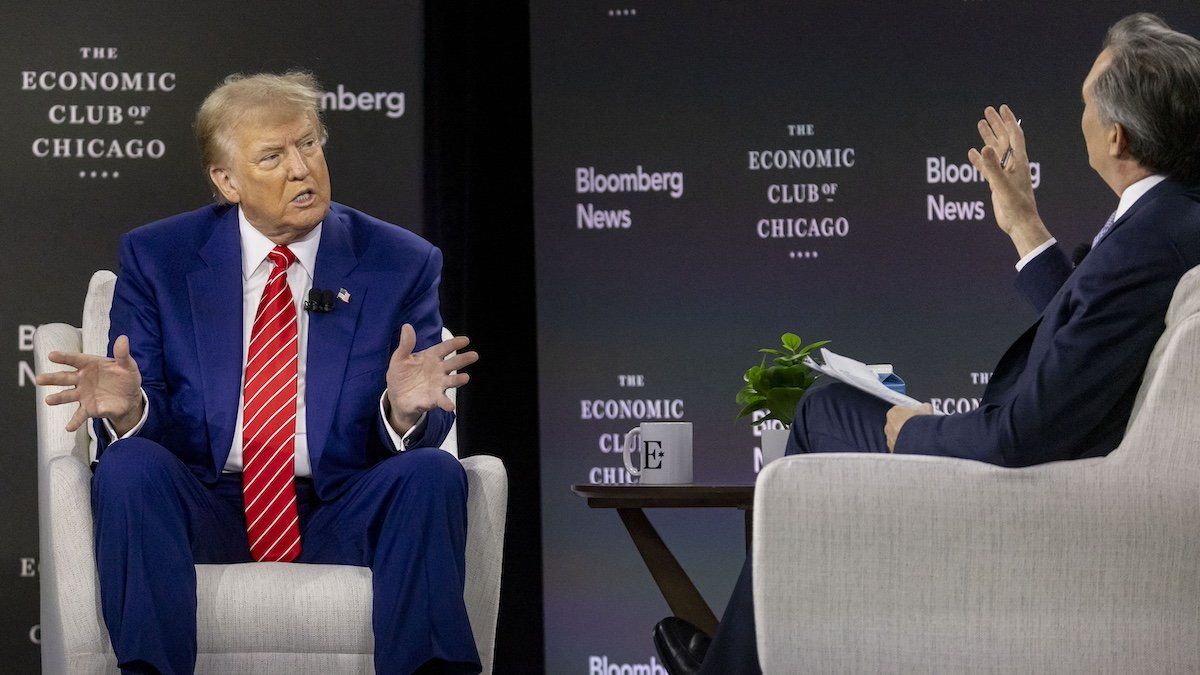
​Republican presidential nominee and former President Donald Trump speaks with Bloomberg Editor-in-Chief John Micklethwait during an appearance with the Economic Club of Chicago on Tuesday, Oct. 15, 2024, at the Fairmont Hotel in Chicago.
Republican presidential nominee and former President Donald Trump speaks with Bloomberg Editor-in-Chief John Micklethwait during an appearance with the Economic Club of Chicago on Tuesday, Oct. 15, 2024, at the Fairmont Hotel in Chicago.
Brian Cassella/Chicago Tribune/TNS/ABACAPRESS.COM

Democratic nominee Kamala Harris had a combative interview with Fox News on Wednesday evening in a play to shake off GOP votes from Donald Trump as the US presidential campaign enters its tense final two weeks.

Harris repeatedly clashed with host Bret Baier, with the two often talking over one another. The Trump campaign said Harris was “angry and defensive,” while her campaign said she “got to show her toughness.”

Trump has declined to hold a second debate with Harris, but the exchange with Baier often resembled a debate.

On Wednesday, Trump held a town hall, hosted by Univision, to court the Latino vote — a demographic that is expected to make up as much as 15% of eligible voters. Trump touted his record on the economy, said that Jan. 6 was a “day of love,” and refused to back off false claims that Haitian migrants were eating cats and dogs in Springfield, Ohio.

The town hall followed an interview with John Micklethwait, editor-in-chief of Bloomberg News, at the Economic Club of Chicago on Tuesday. Micklethwait posed tough questions about Trump’s age and love of tariffs, which economists warn would boost inflation.

Whether either interview will move votes is anyone’s guess. The race remains nearly a dead heat, with pollaggregators showing Harris with a two-point lead nationally, well within the margin of error and not nearly a big enough gap to allow Democrats to relax. Neither candidate has more than a two-point lead in any of the swing-state polls, which are the ones that are likely to decide the election.

In the final days of a razor-close race, both candidates are using the media to cast as wide of a net as possible to reach voters. But with polls this tight, what is likely to matter most is how the campaigns are mobilizing supporters on the ground in key swing states to get to the polls.
More For You

Armoured vehicles of the El Salvador Army operate separately from the UN-authorized Gang Suppression Force (GSF), after additional troops were deployed following an October 18 ambush in which four Salvadoran GSF personnel went missing, in Port-au-Prince, Haiti, November 3, 2026.
REUTERS/Patrice Noel

Over the past two weeks, President of El Salvador Nayib Bukele has sent around 2,000 troops to Haiti to rescue four Salvadoran nationals working in Haiti who were kidnapped by gangs. But the self-proclaimed “world’s coolest dictator” may have bigger ambitions.

Supporters react after media outlets projected Democratic US Senate candidate and Texas State Representative James Talarico's victory in the US midterm elections in Austin, Texas, US, November 3, 2026.
REUTERS/Mike Segar

In the end, the long-predicted “blue wave” turned into a tsunami as the Democrats, harnessing widespread frustrations over high living costs, opposition to the war in Iran, and misgivings about Trump’s deportation policies, swept back to power on Capitol Hill.

Election posters of South Africa's African National Congress (ANC) and other political parties are displayed on street poles ahead of South Africa's municipal elections on November 4, in Pretoria, South Africa, October 29, 2026.
REUTERS/Siphiwe Sibeko

The elections are widely seen as a referendum on the African National Congress (ANC), the party that has governed South Africa since the end of apartheid, amid frustration over pervasive corruption, crumbling public services, and rising migration.