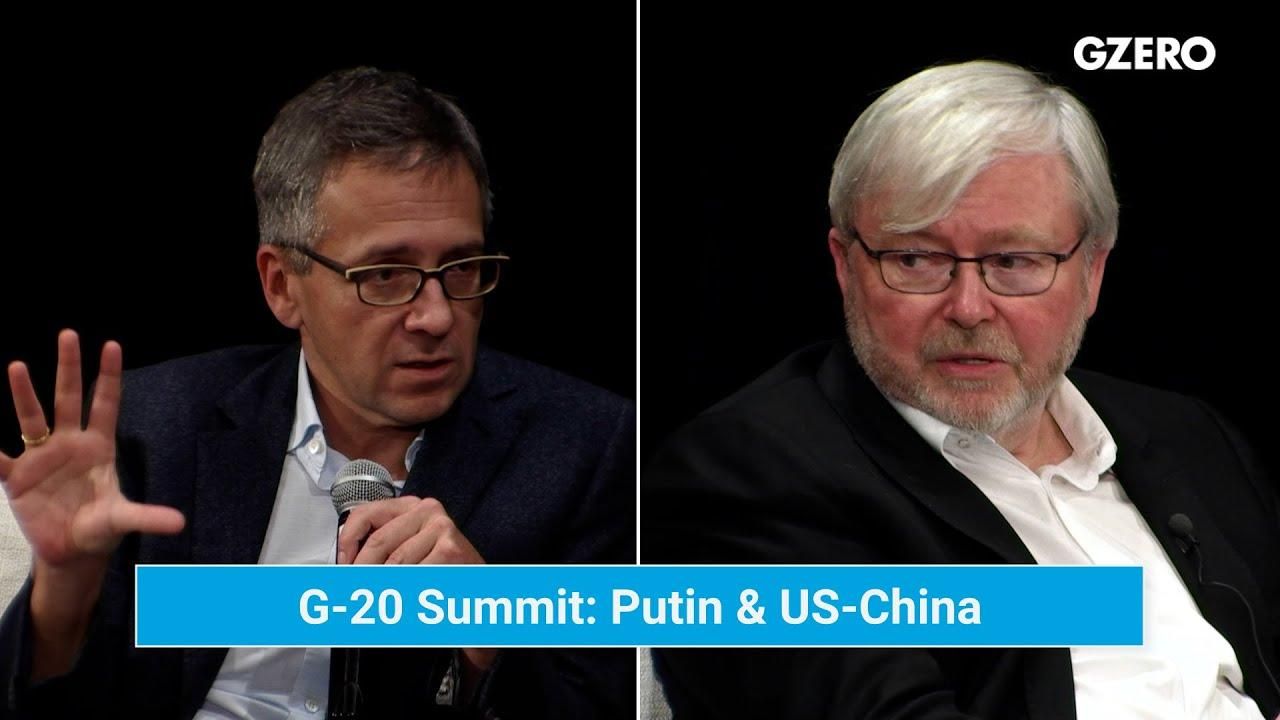
Australia’s former PM says nobody at the G-20 – neither the host, Indonesia, nor Russia’s friends, China and India – wanted President Vladimir Putin to attend the summit.
By bowing out, Putin can’t detract from the main focus, which Rudd – president of the Asia Society – says is finding a way to stabilize the US-China relationship.
When Presidents Joe Biden and Xi Jinping meet in Bali on Monday before the summit, Rudd says to watch for how the discussion formulates “guard rails” to stabilizing relations, which have been in “free fall” for three years.
Speaking with Eurasia Group President Ian Bremmer, he and Rudd agree that the US-China relationship is the most important strategic global issue in the long term.
Washington and Beijing have “lots of reasons to slow the deterioration or stabilize” relations and get away from what’s looking like a “train wreck,” Bremmer says. But in the short term, Bremmer points to the fact that Putin doesn’t have the same incentives to de-escalate – and thus poses the most immediate threat.
More For You
Can sovereignty and cooperation go together? Franck Paris, the new director general of the Paris Peace Forum, says sovereignty without cooperation is "just an illusion."
Most Popular
The tiny South American nation is in turmoil after a spectacular bank collapse left about half of its 6 million people without access to their money.
The California governor announced the move on Thursday in an open letter in which he called state-sanctioned killing “incompatible” with the state’s values and morally wrong.
In this GZERO Europe, Carl Bildt looks at the challenges facing Serbia’s Student List following its dramatic election victory over longtime nationalist leader Aleksandar Vučić, who had ruled the country for 14 years.