World Bank & IMF Meetings
The world "is more coupled than we think"
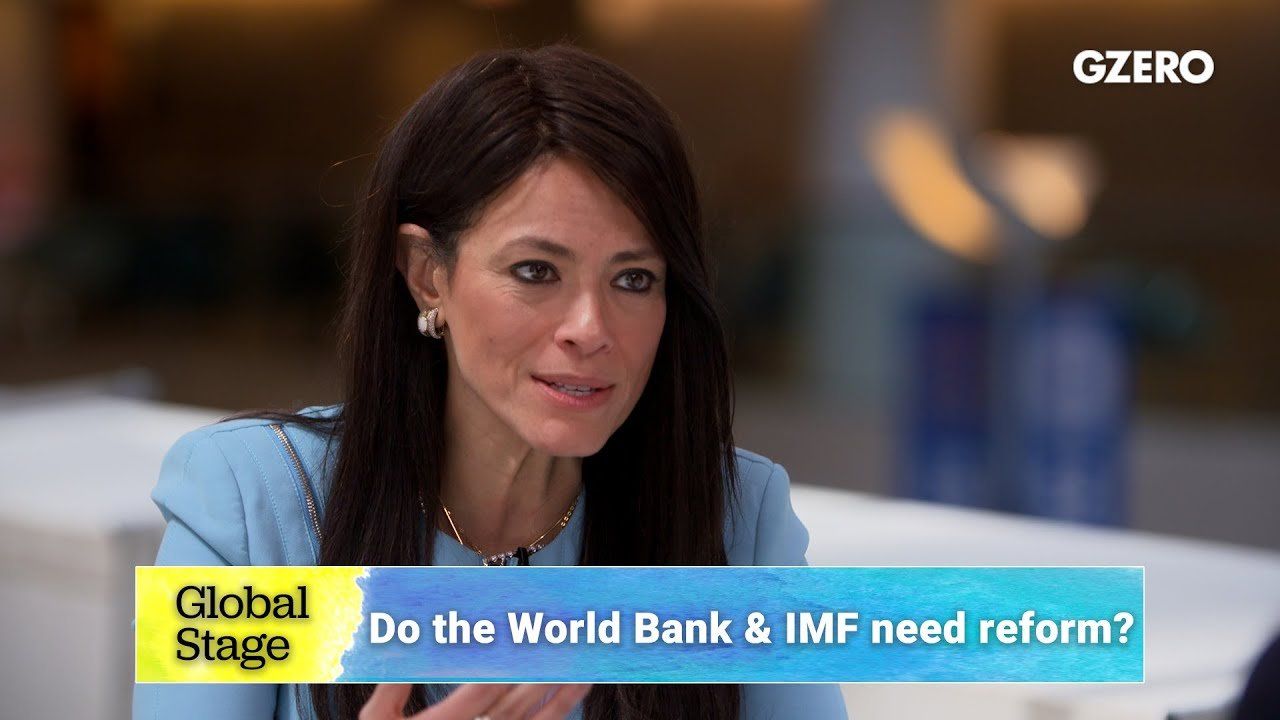
The world "is more coupled than we think" | Global Stage | GZERO Media
Rania Al-Mashat, the Egyptian Minister of International Cooperation, tells GZERO's Tony Maciulis that the pandemic taught us how interconnected we truly are; no one nation can solve a problem as big as climate change, food insecurity, or geopolitical strife on its own. Al-Mashat makes the case for looking beyond the short term problems of inflation and toward longer-term solutions for the most pressing issues of our time.
In a conversation at the World Bank/IMF spring meetings in Washington, DC, she explains the key outcomes of last year's UN Climate Conference COP27, held in her home country, and what the road ahead looks like for climate financing and confronting the looming sovereign debt crisis.
Al-Mashat also states that in the coming months we will learn the new framework and path forward for the World Bank and IMF, institutions whose models have been both challenged and criticized during this historic period of global crises.
Even as Israel grows increasingly isolated on the world stage, there is one region where a whole swath of newly-elected leaders can't seem to get enough of the Jewish State: Latin America.
President Trump has changed course on Ukraine before. We all remember the Oval Office pyrotechnics (and the reconciliation). But his latest turn toward Russia could prove harder to reverse.
South Sudan is accusing neighboring Sudan of launching a drone strike that killed at least 73 people at a market in Abyei, a disputed, oil-rich region of roughly 4,000 square miles claimed by both countries.
Inside China, one kilogram costs a mere $9. But outside of China? $1,150.