As China’s Communist Party gathers this week to draft the country’s 15th five-year plan, the path it’s charting is clear: Beijing wants to develop dominance over 21st century technologies, as its economy struggles with the burgeoning US trade war, a slow-boil real-estate crisis, and weak consumer demand.
The plan will set the government’s priorities for the industries and policies it will prioritize over the next five years. Here’s what it might mean for China, the global economy, and its relationship with the US.
Addressing inequality to spur the economy. Mingda Qiu, China expert at Eurasia Group, says the biggest difference between the 14th and 15th national five-year plans is “the elevation of social equality” as a higher priority — a strategic shift to address imbalances where stimulus policies have not translated into higher incomes for many people.
The numbers tell the story: while China’s exports and factory investment have kept GDP growth around 4-5%, the domestic economy is sputtering. Retail sales grew just 3% in September — the weakest since last November.
The CCP is betting that reducing inequality will boost consumer spending, something the economy desperately needs. Since 2021, China’s housing market has been in freefall, with apartment prices in some areas down 40%. The crash has wiped out much of the public’s savings — and appetite to spend.
The problem runs deep. “Due to the export-oriented nature of China’s development in the past several decades, China’s domestic sector has never fully developed,” Qiu explains. “The economy faces severe imbalances: too much production and too little consumption.”
This creates a vicious cycle. Weak domestic demand “not only puts Chinese firms in ‘involutionary’ cutthroat price wars, but also creates trade frictions as China pushes those products overseas,” says Qiu.
Beijing's response so far — domestic consumption subsidies for smartphones, electric cars, and other domestically-made goods — hasn’t delivered lasting results. “The impact of such spending is not sustainable because it fades away as the subsidy goes down,” Qiu warns. Real change requires Beijing to “spend more effort in building up people’s income and change people's expectations in its economy.”
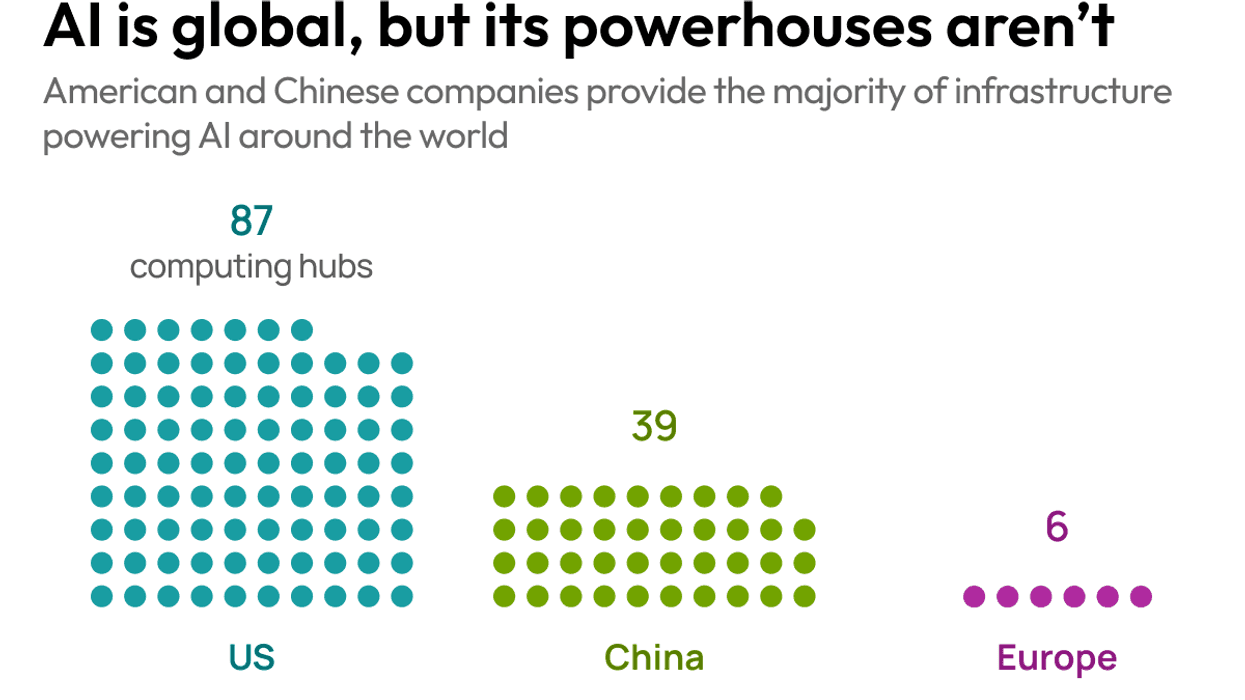
A tech-first strategy. The plan is expected to prioritize massive state-led investment in advanced manufacturing and emerging technologies like artificial intelligence and green energy. In AI, China started behind the US, though it’s already emerged as the world’s second most important player. In green technology, it’s looking to expand its already commanding lead.
“China sees emerging fields such as AI and green technology as where China could play a leading role,” notes Qiu, highlighting Beijing’s ambition to “leap forward in championing development in AI and green technology by leveraging China’s advantage in market size and persistent targeted support from the government.”
Over the next five years, China plans to “double down” on investments in AI, semiconductors, digital infrastructure, and advanced manufacturing.
What this means for the world. China’s strategy presents a double-edged sword for the global economy. Its trade surplus is on track to exceed $1 trillion this year. While exports to the US have dipped due to tariffs, shipments to developing countries have soared, prompting nations from Brazil to Indonesia to impose their own tariffs on Chinese goods. Though China aims to diversify away from export-reliance over the next five years, in the short term, it will continue seeking new markets to prop up its sluggish economy.
For US-China relations, this five-year plan signals the end of an era. “Beijing no longer has the wishful thinking that the US-China relationship would swing back to the good old times of the 2000s and early 2010s,” says Qiu. China’s plan focuses on insulating itself against trade shocks and limiting American leverage.
“By focusing on technological self-reliance, China is essentially preparing itself for a situation if the US would cut essential tech supplies to China,” says Qiu.