As the world largely began shifting to the “we have to learn to live it” stage of the pandemic late last year, many economists anticipated that hard-hit low- and middle-income countries might finally catch a break.
But then Vladimir Putin’s imperialist instincts got the better of him, and Russia decided to pancake Ukraine. The war’s economic effects are reverberating worldwide, with food and fuel shortages sending already high inflation soaring. Unsurprisingly, emerging economies with shallow pockets are reeling.
The backstory. Amid the pandemic, many low-income countries took on new debt to insulate their economies from the economic pain caused by rolling lockdowns, closed borders, and business closures. But even before COVID, many countries – such as Zambia, Sri Lanka, and Ecuador – were already heavily indebted partly as a result of government mismanagement and corruption. The pandemic-induced recession caused global indebtedness to balloon to a 50-year high.
Consider two case studies – Sri Lanka and Egypt – to help unpack how things have unraveled in many low- and mid-income countries in recent months.
Though Sri Lanka has borrowed heavily – mostly from China, Japan, and India – since its brutal civil war ended in 2009, it had never defaulted on repayment, until now.
President Gotabaya Rajapaksa introduced big tax cuts in 2019 that decapitated the country’s main source of revenue. Then COVID-19 hit, decimating the country’s once-booming tourism industry and slashing remittances. As its foreign currency reserves dried up, Colombo resorted to printing more money, which further pushed prices up and the currency value down.
Long embroiled in a Chinese debt trap, Sri Lanka narrowly escaped default earlier this year thanks to a handout from Delhi, but that didn’t last: it has now suspended its external debt repayments. Food prices have soared to “unbearable levels,” fuel is in short supply, and blackouts are rife.
In Egypt’s case, the currency had been more stable in recent years largely because of strict control measures enforced by the central bank. Still, amid near economic collapse in 2016, Cairo agreed to austerity measures as part of an IMF deal. While slashing energy subsidies helped stabilize the economy somewhat, things have been pretty tough for ordinary Egyptians: living standards have plummeted, youth joblessness is rife, and nearly one third of the country’s 102 million people live in poverty.
Then came the war in Ukraine, which sent the global economy and food industry into a tailspin. Ukraine and Russia account for a third of global wheat exports, much of which has been disrupted.
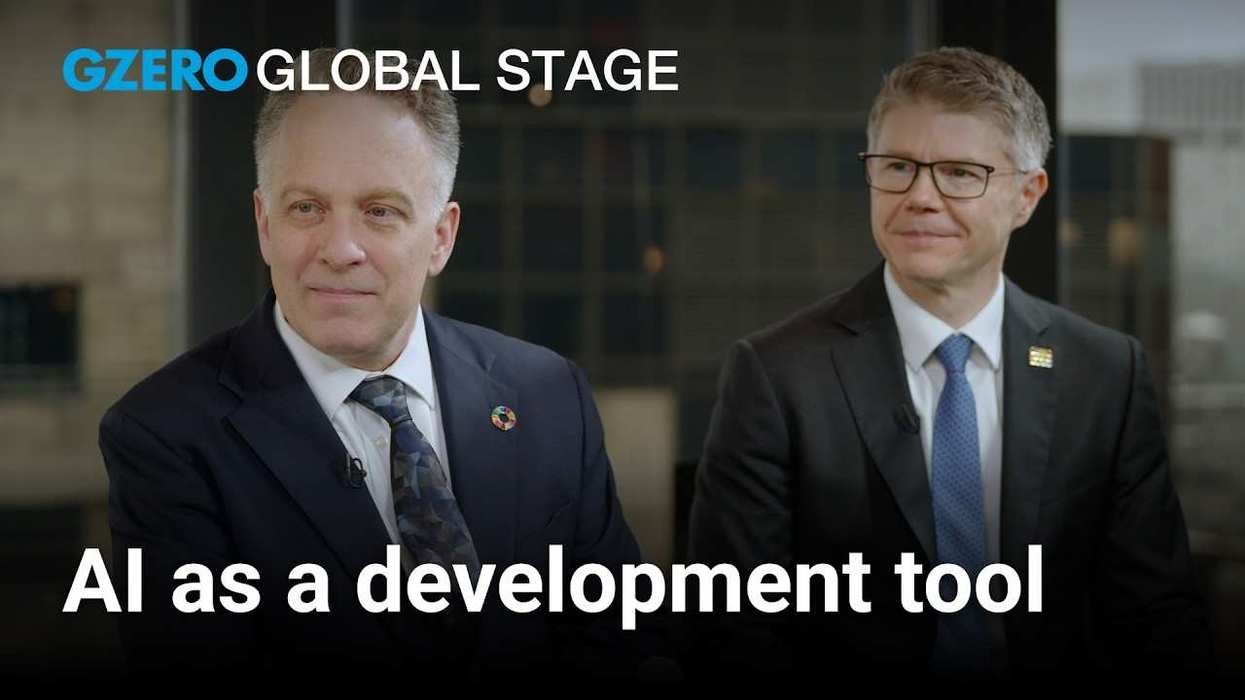
“When energy prices go up, then it causes a cost burden on all sorts of businesses from fertilizer to transportation,” said World Bank President David Malpass during GZERO Media’s Global Stage Livestream on Financing the Future in Washington, DC, on Thursday. “Those are deadweight costs that can’t be recovered.”
“We need to build new supply around the world to take the place of the supply that’s being lost,” Malpass added shortly after speaking with Ukraine’s President Volodymyr Zelensky and finance ministers from 20 countries about the need to adapt and rebuild.
Consider the fallout in Egypt, where food prices – particularly bread – are central to national politics. Import-reliant Egypt buys the most wheat of any country in the world – 85% of it from Russia and Ukraine – and is thus extremely vulnerable to economic shocks in the international market.
In response to food and fuel shortages and rising inflation in recent weeks, Egypt’s central bank raised interest rates and enforced price controls on unsubsidized bread. President Abdel Fattah el-Sisi is doing everything in his power to avoid the mass protests that rocked Egypt in 2011, leading to the ouster of longtime autocrat Hosni Mubarak.
“A month ago, we were having very different discussions about the recovery and the return to tourism,” says Rania al-Mashat, Egypt’s minister of international cooperation. Speaking to GZERO from the World Bank on Thursday, al-Mashat said that though Egypt has strategic wheat stockpiles that will last until September, the government continues to work on “immediate mitigation efforts.”
But if things continue to deteriorate and Egypt needs help from international lenders, the IMF will likely demand that Cairo implement significant reforms – like dropping subsidies – to unlock cash. This sort of arrangement rarely bodes well for governments, particularly in Egypt, where about two-thirds of the population eat subsidized bread. (In 2008, amid a drought-induced food crisis, Mubarak ordered the army and police to bake bread to lower the temperature amid protests.)
Meanwhile, with mounting popular discontent – and double-digit inflation – Sri Lanka has flip-flopped in recent weeks. While Colombo was long reluctant to go to the IMF for help, it's now appealing to the fund for assistance in restructuring its $7 billion in debt and this year’s interest repayments. China, which accounts for 10% of Sri Lanka’s external debt, has notably refused a restructuring request.
The IMF says that talks with Sri Lankan officials will address “public debt that has risen to unsustainable levels, low international reserves, and persistently large financing needs in the coming years.” But with Rajapaksa facing political turmoil at home – and refusing to resign despite losing the support of his own government – it seems unlikely the IMF will offer Sri Lanka much leeway.
This comes as the IMF warns that all countries are going to experience contracted growth this year. Less growth overall will mean less foreign investment in low-income countries, whose currency values will drop and make it more expensive to pay back their debt.This is already playing out with China, which is becoming more cautious with its lending practices, particularly in Africa.
But Malpass warns against pulling back. “I’ve been advocating that advanced economies open their markets more. Recognize that this is a moment to make friends, to help people who don’t have as much, and that means looking at all your trade barriers ... and cut them back.”