You knew it, I knew it, everybody knew it. But now it’s on the record: Donald Trump is officially a crook.
Last Thursday, after two days of deliberations, a jury of his peers unanimously found the former president and 2024 Republican presumptive nominee guilty on all 34 counts of falsifying business records in the hush money criminal case brought by Manhattan District Attorney Alvin Bragg.
Bragg charged Trump with cooking the books to hide a $130,000 payoff to porn star Stormy Daniels – with whom he’d allegedly had an affair – from voters during the 2016 election campaign by disguising it as legal fees to his then-lawyer and fixer Michael Cohen.
Falsifying business records is normally a misdemeanor, but Bragg, an elected Democrat in deep-blue Manhattan, had campaigned on putting Trump in cuffs. To upgrade the charges to felonies, he drew on a controversial legal theory to claim that the records were falsified in an attempt to commit or conceal an underlying federal crime of the jury’s choice. Judging by the outcome, the gambit worked – although it also helped further politicize and delegitimize the case and could make the conviction vulnerable to reversal on appeal.
The verdict marks a watershed moment for American democracy. Trump is the first-ever former American president convicted of a crime. He is also the first major-party candidate to run for the White House as a felon. Of course, these are far from the only unprecedented things happening in the US political system. From Trump’s two impeachments and acquittals to chronic Congressional gridlock to recurring House Speaker succession drama to the Jan. 6 insurrection, we’re living through an era of exceptional yet increasingly normalized political dysfunction that is fraying our social fabric and eroding the legitimacy of our democracy. At some point, something’s going to break, and it’s not going to be pretty.
The legal consequences for Trump will be minimal. He will appeal his conviction. This will probably take years to resolve, and it may well succeed given the dubious legal theory used to prosecute him.
But before an appeal can be filed, Judge Juan Merchan is set to decide on sentencing on July 11. While each count carries a maximum of 4 years in prison, even a single day in jail is probably not in the cards for a first-time nonviolent offender like him, with house arrest or small fines more likely punishments. And even if he were sentenced to prison, he would not be remanded until the last of his appeals were exhausted, which would not happen until well after the election.
Notably, the New York trial was by far the weakest and least serious of all the criminal cases Trump faced. The three that remain – the Fulton County election interference case, the federal election interference case, and the federal classified documents case – are orders of magnitude more consequential, but none is expected to start before September if at all this year. Should he win in November, he won’t be able to pardon himself of the New York convictions, but he will be able to quash the two federal indictments and at least postpone the Georgia trial until he’s out of office.
Odds are that the 34 guilty verdicts will be the only legal accountability Trump will see before the election – and perhaps ever.
What about the impact on the election itself? First things first: The conviction won’t affect Trump’s ability to run for or serve as president, even on the off chance that he was put behind bars. Nor will it stop him from voting (for himself), unless he is incarcerated by Election Day. But will it make it less likely that Trump wins in November? Probably, but only just a little.
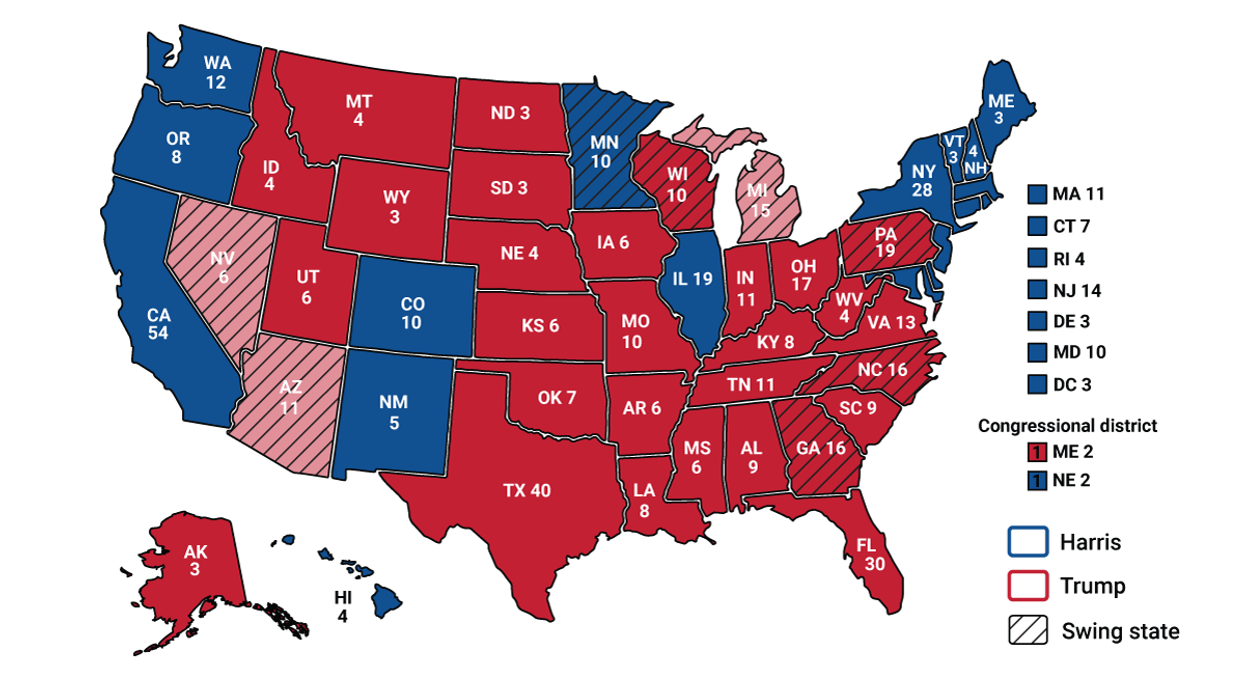
The reason it might dent Trump’s chances at the margin is that a non-negligible share of independent voters had consistently said they would be less likely to vote for Trump if he was convicted of a crime. And presidential elections in our highly polarized country are increasingly decided by a few tens of thousands of them in a handful of states. Even small losses among this group can end up being pivotal.
That said, there are reasons why this may not end up mattering much.
First, the election is still five months away. Think about all that can happen between now and then. If the first half of the year is anything to go by, I suspect the 34 guilty verdicts are going to feel like a distant memory by the time voters go to the ballot.
Second, the conviction will rally Republicans around Trump and mobilize Democrats to some extent (i.e., partisans are gonna partisan), but the number of undecided voters among whom this particular issue will actually move the needle in November is small. Most Americans are more focused on pocketbook issues, immigration, abortion, and President Joe Biden’s age than on Trump’s legal issues or the threat he poses to US democracy. This is true today and will likely be true in November.
Third, independents who were open to voting for Trump before last Thursday will probably learn to grow comfortable with a criminal conviction the same way they got over the Access Hollywood tape, the Stormy Daniels affair, the Charlottesville rally, and the “Stop the Steal” movement. If these Trump-leaning voters were willing to forgive so many sordid transgressions, there’s little reason to believe a guilty verdict on trumped-up white-collar charges is going to be the straw that breaks the camel’s back.
Although the guilty verdicts are bad news for the former president, this remains a very close race that Trump is still slightly favored to win against a historically unpopular incumbent. But in a game of inches, any headwinds could be enough to make a difference.