Search
AI-powered search, human-powered content.
scroll to top arrow or icon

The Graphic Truth: Tracking national climate action
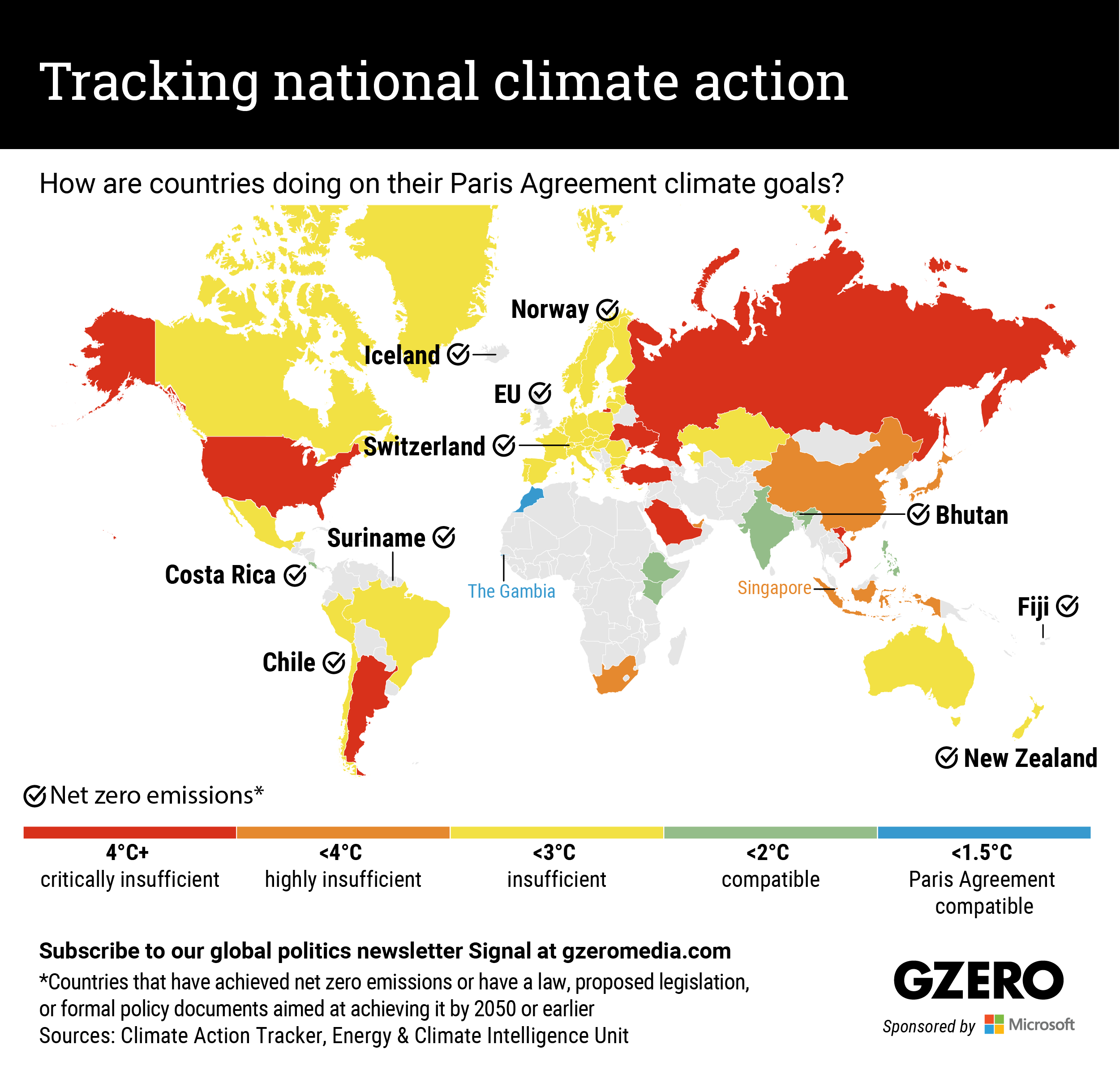
Tracking national climate action: How are countries doing on their Paris Agreement goals?

Under the terms of the 2015 Paris Agreement, signatory countries agreed to make their own commitments to curb greenhouse gas emissions. At next year's UN climate change conference in Glasgow, nations will assess progress to date and (possibly) make bolder commitments, given technological progress and the mounting urgency to take climate action. But for now, only a handful of countries are on pace to limit warming to 2°C above preindustrial levels — let alone to meet the 1.5°C target that most scientists believe will help us avoid heaviest climate impact. A small group of intrepid governments aim to achieve "net zero" emissions in coming decades. We look at how certain nations are performing on climate action, and highlight those with plans to reach net zero.

More from Global Stage

Can we use AI to secure the world's digital future?

How do we ensure AI is safe, available to everyone, and enhancing productivity? It’s a big topic at this year’s UN General Assembly. That’s why GZERO’s Global Stage livestream brought together leading experts at the heart of the action for “Live from the United Nations: Securing our Digital Future,” an event produced in partnership between the Complex Risk Analytics Fund, or CRAF’d, and GZERO Media’s Global Stage series, sponsored by Microsoft.

Is the Europe-US rift leaving us all vulnerable?

As the tense and politically charged 2025 Munich Security Conference draws to a close, GZERO’s Global Stage series presents a conversation about strained relationships between the US and Europe, Ukraine's path ahead, and rising threats in cyberspace.

How AI is revolutionizing weather forecasting

Artificial intelligence is transforming one of humanity's oldest challenges: predicting the weather. Speaking at the 2026 AI for Good Global Summit, World Meteorological Organization Secretary-General Celeste Saulo explains how AI has dramatically accelerated weather forecasting. Tasks that once required a week of computing can now generate multi-day forecasts in just minutes, making advanced forecasting faster, more accessible, and increasingly available beyond the world's largest supercomputers.

Annalena Baerbock: AI can't replace the basics

Artificial intelligence has enormous potential, but only if people can actually access it.
Speaking at the 2026 AI for Good Global Summit, UN General Assembly President Annalena Baerbock argues that AI should not be viewed as a cure-all for global development. Without reliable internet, telecommunications infrastructure, and access to basic technology, even the most advanced AI tools cannot reach the communities that need them most.

How AI speeds up disaster relief efforts

Artificial intelligence is becoming an increasingly powerful tool for disaster preparedness and emergency response.
Speaking at the 2026 AI for Good Global Summit in Geneva, Microsoft Vice Chair and President Brad Smith explains how AI combines predictive modeling, satellite imagery, and public data to help governments identify vulnerable communities before disasters strike and respond more quickly when they do.

Building a safer, more equitable AI future

At the 2026 AI for Good Global Summit in Geneva, ITU Secretary-General Doreen Bogdan-Martin says the future of artificial intelligence depends on putting the right guardrails in place to ensure AI is developed safely, responsibly, and equitably.