How do you know that what you are seeing, hearing, and reading is real?
It’s not an abstract question: Artificial intelligence technology allows anyone with an internet connection and a half-decent laptop to fabricate entirely fictitious video, audio, and text and spread it around the world in the blink of an eye.
The media may be ephemeral, but the threat to governments, journalists, corporations, and you yourself is here to stay. That’s what Julien Pain, journalist and host of Franceinfo, tried to get at during the GZERO Global Stage discussion he moderated live from the 2023 Paris Peace Forum.
In response to a poll that showed 77% of the GZERO audience felt democracies are weakening, Eléonore Caroit, vice president of the French Parliament’s Foreign Affairs Committee, pointed out that the more alarming part is many people around the globe are sufficiently frightened to trade away democratic liberties for the purported stability of unfree governments — a trend authoritarian regimes exploit using AI.
“Democracy is getting weaker, but what does that provoke in you?” she asked. “Do you feel protected in an undemocratic regime? Because that is what worries me, not just that democracy is getting weaker but that fewer people seem to care about it.”
Ian Bremmer, president and founder of the Eurasia Group and GZERO Media, said a lot of that fear stems from an inability to know what to trust or even what is real as fabricated media pervades the internet. The very openness that democratic societies hold as the keystone of their civic structures exacerbates the problem.
“Authoritarian states can tell their citizens what to believe. People know what to believe, the space is made very clear, there are penalties for not believing those things,” Bremmer explained. “In democracies, you increasingly don’t know what to believe. What you believe has become tribalized and makes you insecure.”
Rappler CEO Maria Ressa, who is risking a century-long prison sentence to fight state suppression of the free press in the Philippines, called information chaos in democracies the “core” of the threat.
“Technology has taken over as the gatekeeper to the public sphere,” she said “They have abdicated responsibility when lies spread six times faster than the truth” on social media platforms.
Microsoft vice chair and president Brad Smith offered a poignant example from Canada, in which a pro-Ukraine activist was targeted by Russia with AI-generated audio of a completely fabricated statement. They spliced it into a real TV broadcast and spread the clip across social media to discredit the activist’s work of years within minutes.
The good news, Smith said, is that AI can also be used to help fight disinformation campaigns.
“AI is an extraordinarily powerful tool to identify patterns within data,” he said. “For example, after the fire in Lahaina, we detected the Chinese using an influence network of more than a hundred influencers — all saying the same thing at the same time in more than 30 different languages” to spread a conspiracy theory that the US government deliberately started the blaze.”
All the panelists agreed on one crucial next step: aligning all the stakeholders — many with competing interests and a paucity of mutual trust — to create basic rules of the road on AI and how to punish its misuse, which will help ordinary people rebuild trust and feel safer.
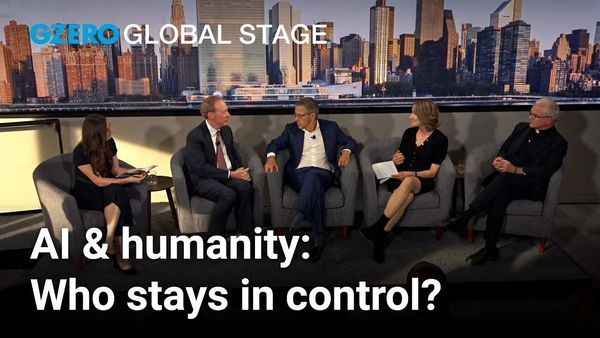
The livestream was part of the Global Stage series, produced by GZERO in partnership with Microsoft. These discussions convene heads of state, business leaders, technology experts from around the world for critical debate about the geopolitical and technology trends shaping our world.
- Stop misinformation blame game — let's do something about it ›
- Christchurch Call had a global impact on tech giants - Microsoft's Brad Smith ›
- What does democracy look like in Modi's India? ›
- Ian Bremmer: How AI may destroy democracy ›
- AI, election integrity, and authoritarianism: Insights from Maria Ressa - GZERO Media ›
- Stop AI disinformation with laws & lawyers: Ian Bremmer & Maria Ressa - GZERO Media ›
- How AI threatens elections - GZERO Media ›
- Paris Peace Forum Director General Justin Vaïsse: Finding common ground - GZERO Media ›
- At the Paris Peace Forum, grassroots activists highlight urgent issues - GZERO Media ›
- UN's Rebeca Grynspan on the world’s debt crisis: Can it be solved? - GZERO Media ›