Americans love free speech, and for all its flaws, the American government does take a lighter hand than many other major democracies. But even in the US, there are limits. So where does misinformation and fabricated imagery and audio generated by AI fit into free speech?
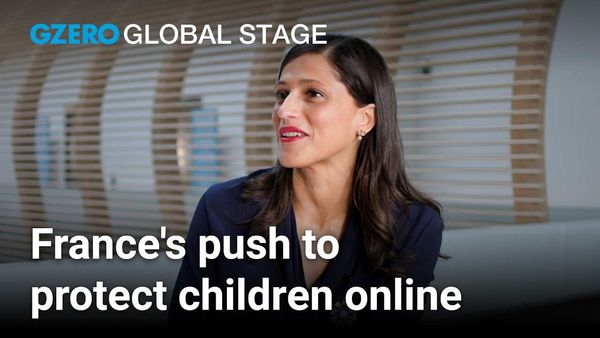
Eléonore Caroit, vice president of the French Parliament’s Foreign Affairs Committee, says she understands the sensitivities around taking down political speech in the US. "In the US, you have the First Amendment, which is so important that anything else could be seen as censorship,” she said, “Whereas, in France, I think we have a higher tolerance to some sort of regulation, which is not going to be seen as censorship as it would in the US.”
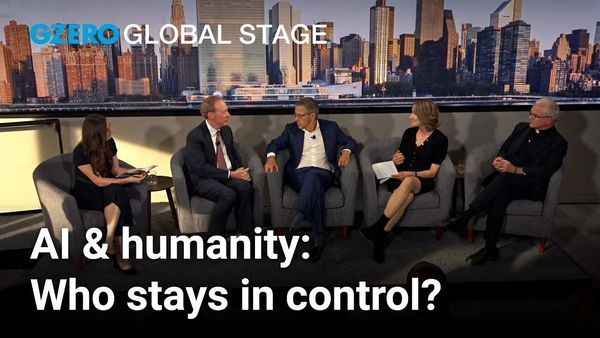
Caroit spoke at a GZERO Global Stage discussion with Ian Bremmer, President and Founder, Eurasia Group & GZERO Media, Rappler CEO Maria Ressa, and Microsoft Vice Chair and President Brad Smith, moderated by Julien Pain, journalist and host of Franceinfo, live from the 2023 Paris Peace Forum.
Where should the line fall between free speech and censorship? If someone, say, publishes a campaign video made with AI that showed misleading images of immigrants rioting to call for hardcore migration policy, would the government be within its rights to force tech companies to remove it from their platforms? Caroit mentioned that in fact, France removed two videos from far-right presidential candidate Eric Zemmour made with AI, and could have struck down his entire YouTube channel if he published a third.
But to rein in out-of-control AI, which can generate mountains of text, audio, and video at the click of a mouse, countries of all persuasions on free speech — even those decidedly “anti” — will need to come to an agreement on basic rules of the road.
Watch the full livestream panel discussion: "Live from the Paris Peace Forum: Embracing technology to protect democracy"
The livestream was part of the Global Stage series, produced by GZERO in partnership with Microsoft. These discussions convene heads of state, business leaders, technology experts from around the world for critical debate about the geopolitical and technology trends shaping our world.
- Rishi Sunak's first-ever UK AI Safety Summit: What to expect ›
- How the EU designed the new iPhone ›
- Regulate AI: Sure, but how? ›
- AI and data regulation in 2023 play a key role in democracy ›
- Ian Bremmer: How AI may destroy democracy ›
- The UN takes on AI ›
- Did the US steal the UK’s AI thunder? ›
- Paris Peace Forum Director General Justin Vaïsse: Finding common ground - GZERO Media ›
- At the Paris Peace Forum, grassroots activists highlight urgent issues - GZERO Media ›
- Is free speech under attack in Europe? Roberta Metsola weighs in - GZERO Media ›