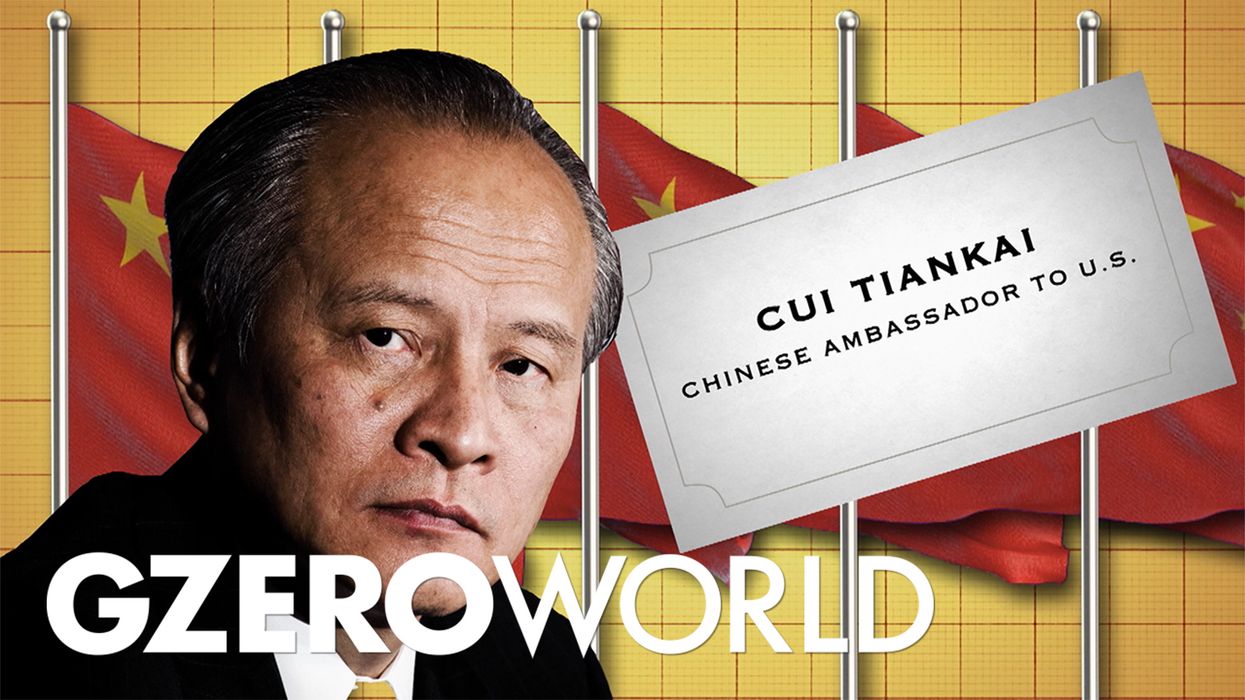
Podcast: An Interview with China’s Ambassador to the United States Cui Tiankai
Listen: Ian Bremmer interviews Cui Tiankai, China's top diplomat in the United States, on a wide range of topics including accusations that China has underreported COVID-19 fatalities, his nation's decision to expel journalists from major U.S. publications, and China's emerging role in global aid and relief efforts.
TRANSCRIPT: An Interview with China’s Ambassador to the United States Cui Tiankai
Cui Tiankai:
You cannot hide the cases with such a very vicious virus.
Ian Bremmer:
Hello and welcome to the GZERO World Podcast. Here you'll find extended versions of the interviews from my show on public television. I'm Ian Bremmer, and today I'm offering a rare insight into a crisis that's left thousands dead, and forced tens of millions into quarantine, a view from the Chinese government. And joining me is China's ambassador to the United States, Cui Tiankai. We'll talk outbreaks strategy, and China's role in a G-Zero world order. Let's get started.
China's ambassador of the United States, Cui Tiankai. Great to be with you.
Cui Tiankai:
So nice to see you again, Mr. Bremmer.
Ian Bremmer:
There's so many things I want to ask you about. Maybe I will start broadly, with the fact that China has, of course, been looking down the barrel of the most serious crisis that we've experienced since World War II. You started with the initial explosion. We are now facing it in the United States, and about to see the kind of numbers that we never thought we would have to. Tell us a little bit, to start, how you think China looks right now.
Cui Tiankai:
I think maybe everybody in the world was caught quite unprepared by this pandemic, by this virus. I don't think anybody knew anything about it just a few months ago. So it was a painful process of discovering more, learning more about this virus, and knowing how to deal with it. I think that this is a challenge for all of us. Of course, we maybe were one of the first to handle this critical situation, and we made tremendous efforts, and at a very high cost. Now, things are getting better in China. We have very few cases.
We still have about 3000 cases, confirmed cases. People still in serious condition to treat, but at least we know how to treat them much better than before. So we are trying very hard to prevent any so-called second wave of the confirmed cases, and we are making our great efforts to restart the economic engine, to restore things to normal economic and social activity. This is a tremendous task, but at the same time, we are fully aware that we cannot succeed all by ourself. We have to contribute to international efforts, international cooperation globally to combat this virus. Because unless we have global success in containing and treating this virus, no country will be safe, including China, including United States. So we are working very hard on all these fronts.
Ian Bremmer:
You have seen President Trump recently say that the Chinese numbers are a little on the light side, and then just recently, most recently, we saw news of a classified US intelligence report that concluded that the Chinese government actually concealed the extent of the virus outbreak. I'm sure you've seen all of these reports, because you're dealing with it. How do you respond to those direct accusations by the US government?
Cui Tiankai:
The fact is we started daily briefings to the press in the very early stage of this crisis. We are still doing daily briefing to the press, announcing all the numbers, all the updates to numbers, the cases treated, the cases confirmed. All these things we're making them public on [a] daily basis. And we're also sharing at very early stage in early January, what we have found out about the germal sequences of the virus. And everything we learned from our own experience, we shared with the world. We even publicized all the possible treatments for the accusation that China is hiding the numbers. Just think about it. We have such a huge population, such a big country. You cannot hide the cases of such a very vicious virus. Because if you have patients, they're just patients. If people are infected, they're just infected. How can you hide them?
Ian Bremmer:
Well, you count them as something else. Russia clearly has been under-counting recently. Iran has been vastly under-counting. When you see the satellite imagery in Iran of these mass graves they've dug, but they're not talking to their people or to the rest of the world about how expansive the cases are. In some cases, you under test. I'm simply saying, if the US intelligence agencies are making a direct accusation, and President Trump is as well, it's important for me to give the opportunity for the chief Chinese diplomat in the US to respond directly to those accusations.
Cui Tiankai:
You see, people are really worried about the possibility of importing the virus again, back to China. But anyway, these are very reasonable precautions people have to take. But anyway, if you look at the media report, people in China are working very hard to restart the economy, to restore economic and social activities. Many of the companies are working again, and also, many of the shops are open again, and we are also, for many of our provinces, schools are open again. So you cannot do all these things if you have no confidence that you are able to contain the virus, and the numbers of affected people is coming down. This is quite clear.
Ian Bremmer:
Obviously, there's been a lot of criticism about the fact that the Chinese government initially was not forthcoming about the explosion of these cases, and particularly this whistleblower, Li Wenliang, the doctor who was exonerated afterwards by the local Chinese officials, but originally was suppressed. Are there any lessons the Chinese government has learned from the early missteps that were made in responding to the coronavirus?
Cui Tiankai:
Now, let me tell you, some of the things that have been reported in the media here, or claimed by politicians here, are just not fact. So let me try to give you some facts. You mentioned this Dr. Li Wenliang. He was a great doctor. He was a great person. It's so unfortunate that he passed away, but he was his profession. He was an eye doctor. He was not a specialist on this kind of virus, you see. Of course, Dr. Li did raise some alarm among his colleagues, among his medical colleagues. He did not intend to make it public, but somehow his message got out. The first reporting was on the 27th of December last year. Then on January the third, we informed the World Health Organization of this particular situation. So it's just within a few days, and it alerted all the member countries of WHO. Then a day after that, the CDCs of our two countries had their first communication.
So you see, I'm not a medical professional. I cannot tell you whether this kind of reporting response is sufficiently clear or good, but I think in terms of the time, it was done within a very short period of time. Then when people came to realize this virus could be transmitted between human beings, even before that, the central government sent groups of experts to Wuhan to look at these suspicious cases. Then when they came to realize that this is transmittable between human beings, then we locked down the whole city of Wuhan, with 10 million people. Then actually, the province of Hubei was also closed down, with 60, 6-0 million people. Then two days after the lockdown of Wuhan, United States evacuated its consulate from Wuhan, together with its citizens. Then in early February, the United States stopped all travelers from China, whether Chinese or foreigners. So a number of measures-
Ian Bremmer:
Which the Chinese government objected to at the time, of course, as you know.
Cui Tiankai:
Yeah. So what I want to say is that the fact is we reported to the WHO in the early days when we saw these suspicious cases. Just within a few days, and everybody was alerted. But whether they have done enough or not, this is not up to me to judge, you see.
Ian Bremmer:
After the lockdown, the mayor of Wuhan was widely quoted as saying some 5 million Chinese from Wuhan were traveling from Wuhan during the period of time where we now know that this virus was starting to explode. Do we know anything about either where they've gone, or how many of them have returned at this point?
Cui Tiankai:
Well, first of all, I don't have the exact number because I was not there. Secondly, even a large number of people left Wuhan before the lockdown. The fact is, I think that the overwhelming majority of them didn't have visa to go to any other country. Because if they left in a hurry, they just didn't have time to apply for any visa. So if they left Wuhan, most of them must have stayed in China. But if you look at the numbers that confirm the cases in other Chinese provinces, even provinces next to Wuhan, the numbers are not very high. That means we have effectively contained the spread of the virus within China. So I don't think that people could put the blame on us for the increasing number in countries far, far away from China. Maybe they're from elsewhere.
Ian Bremmer:
I know you've been worried about a secondary outbreak, and everybody is, obviously, something we clearly want to do together. Some steps the Chinese government has taken, opening some tourist destinations, opening movie theaters, and then quickly closing them down again. Is this because of additional cases in China?
Cui Tiankai:
No, we just want to make sure there will not be a so-called second wave of these cases, and we are very careful and very cautious about any possibility of such. You see, people may be infected, but without symptoms. So if they come in, and how they would pass on the disease to others and so on, we have to be very careful about that. But I think all these measures are based on scientific knowledge, on the medical need.
Ian Bremmer:
The Chinese recently made a decision to take the visas from all of the New York Times, Washington Post, and Wall Street Journal journalists from mainland China, Hong Kong, and Macau. Were you surprised by that decision, and do you think it can be overturned?
Cui Tiankai:
Honestly, I was not surprised. Of course, I have to say the fact is not all of them have their visa terminated. These papers still have some people working in China. Not all of them have their visa terminated. But I'm not really surprised by this decision, because it was all initiated in the United States. Look at how the US government is treating our journalists here in United States. They have driven out about 60, 6-0, Chinese journalists from this country on the basis that they represent or they believe in certain ideology or political system. But as far as I know, you don't make any distinction among the journalists based on their political beliefs. They could have whatever political belief, but they're still journalists by profession. But you see how our journalists are treated here. So what we are doing is in response to what has been done here to our journalists.
Ian Bremmer:
Do you see any space for an opening between the Americans and China? Again, if I look at this, I see the biggest crisis that we've experienced in our lifetimes, and I see several concrete steps by both countries that are not moving to cooperation. They're actually moving towards more confrontation, and these decisions around the media are only one. Do you see any concrete steps, that I'm perhaps not seeing, that imply that the countries are coming together more?
Cui Tiankai:
I certainly don't want to see any escalation of tensions between our two countries anytime, but especially at this critical moment. I certainly don't want to see any further deterioration of relation, and I'm doing my best to prevent this from happening. But what is surprising to me is that how low people could go here sometime for some of the politicians, how low they could go. It was really surprising to me.
Ian Bremmer:
Are you talking about the senator that suggested that this was created in a biolab in Wuhan?
Cui Tiankai:
Well, I don't want to name any names.
Ian Bremmer:
No, because I'm just saying that because the Chinese government, of course, made very similar accusations, and officially so. I just wonder if that's the kind of thing that you say is only coming from the US, or is actually coming from both sides?
Cui Tiankai:
I think that the fact is we do not initiate all this escalation. We do not make the provocations. But if other people choose to do that, we have to respond.
Ian Bremmer:
And what do we do to get out of this cycle?
Cui Tiankai:
Let's concentrate on the positive things. Let's focus on our common interests and mutual need. Let's work together to respond to this global crisis, to save people's lives, to save the future of a global economy, and to save the future of the global community. This is our paramount task.
Ian Bremmer:
Now, President Trump, when he spoke with your president, before that, he was calling the virus the 'China Virus,' and after he spoke with him, he stopped doing that. Was there anything direct in the conversation between the two leaders that gives you reason to believe that our countries are going to move closer together again?
Cui Tiankai:
Well, based on my own experience here, our two leaders have a very good and effective working relationship between them. Their meetings, their phone calls, have been, all of them, constructive, and giving us some guidance about the relations. So hopefully, everybody would work together with us to implement such agreement between the two presidents, and really focus on the constructive things that we really have to do together.
Ian Bremmer:
Did either of them offer anything concrete in terms of ways that we might cooperate? A summit that we might have? Anything that could give some hope? Because again, when you talk to the CEOs, you talk to the decision makers, the people that you and I both know very well, there's not a lot of hope that this relationship is going well.
Cui Tiankai:
Well, I think we need some intellectual guidance from people like you to make people look ahead, have a broader vision, and have a full recognition of the realities, the changing realities of the world in the 21st century, and reject all such Cold War mentality, zero-sum game. All these are thinking from the 19th, or earlier 20th century.
Ian Bremmer:
Now, you've said a few times already, so I understand this is a clear priority for you, that it's a global crisis. We need global cooperation to respond. We don't see a lot of coordination, either political, economic, monetary, or on the healthcare side. We see individual countries responding individually. What do you think concretely the Chinese can do to help facilitate a more international response?
Cui Tiankai:
I think you are right. Of course, we have to recognize that G20 had a good special summit, also a video call, and they have taken a number of good decisions. Now, the task is to implement these decisions. But still, I think the current situation and the current deficiencies in global governance, I hope will make people give more serious thinking to your idea of this 'G-Zero.' We don't have a very good functioning global governance so far, whether for the global economy or for global public health. I think people really have to make serious efforts to think about what kind of a global governance we should be building? What should we aim at?
You see, I think we have had a number of crises in this 21st century, maybe starting with the terrorist attacks, 9/11, then the financial crisis, now this COVID-19 virus, the security challenges, the financial instability, now public health. So I think there's, if we can still call this a wake-up call, I think we should have waked up a long, long time ago. But still, we have to, if we have not started yet, we have to start real efforts to build a good international governance system for the 20th, for the 21st century, for the future. But I think that all would depend on what we aim at. If we will still want to build some international governance system based on the particular political model with the dominance of one or two particular countries, I don't think that we can succeed.
Ian Bremmer:
So ambassador, I understand your point very well, and when you say that institutions, existing institutions, if they're dominated by one or two countries are not going to work as effectively, are you talking specifically about, say, the Bretton Woods institutions, the IMF, the World Bank, the WTO? Is that what you're referring to?
Cui Tiankai:
Well, I think to be fair, all these institutions are making their best efforts to reform and to improve, to catch up with the tremendous changes going on in the world. For instance, since the financial crisis in 2008, the World Bank, IMF, have had major reforms about their quota system, about how they respond to their member states' needs. I think that they are making good efforts. Even at the recent G20 summit, these institutions are offering their contribution. They are ready to play that dual role. Of course, we have to encourage them to do more.
Ian Bremmer:
I guess what I'm asking is, we look ahead three years, five years time, and as you're saying that some of these institutions that have been dominated by one or two countries are not going to be adequate for the task, which is a pretty direct statement. Do you think that these institutions reformed will become adequate, or do you think it's more likely that we need new architecture, some of which will come from China, some of which will come from other places? What's the direction that you think we're more likely heading of those two?
Cui Tiankai:
Well, honestly, I think if all these institutions, if these existing institutions can respond to the needs and aspirations of its member states, when I say member states, it's not just a few of them, but their entire membership. If these institutions can respond in a timely and effective manner, then they can have good reforms. They could make themselves better able to perform their function. If they fail to do that, that might force their member countries to think about the possibility of setting up new structures. But I do hope that we can carry out reform with the existing institutions, just to make them better.
Ian Bremmer:
Now, when we talk about the United States and China, two big countries, obviously have the ability to put stimulus in place to ensure that we get through this economic crisis. You and I both know that there are many countries in the world that don't have that capacity. The IMF is looking to raise a lot of money to help ensure that we don't see emerging markets, developing countries crash. Should we expect that the Chinese are going to do a lot more in terms of, provide a leadership role, and provide a lot more money, to contribute to that process as we start to see some of the worst economic conditions for some of these developing nations around the world?
Cui Tiankai:
Actually, China has been very actively involved in the process, even for the international response to the financial crisis in the last decade or so. We increased our contribution to these institutions. Now we are the second-largest contributor to [the] United Nations budget, second-largest contributor to United Nations peacekeeping operation, the largest contributing country among the Security Council to UN peacekeeping operation. So we are increasing our contribution. We are doing our best to do more for the international community, because we believe we are all part of this community of the nations. We do have a shared destiny. We do have a shared future. But of course, it is very much hoped that the United States will continue to do more.
Ian Bremmer:
Now, these institutions, they were set up as western institutions. If it turns out that the Chinese are doing the lion's share, or much more, in terms of spending and contributions, what kind of conditionality do you think is likely to be attached? Are we talking about, for example, the ability to have much more say in the appointments of key leaders in these organizations? Is it change in voting rights and quotas? Is it the way the loans are repaid and the kind of conditionality attached? How are the Chinese government thinking about this as you play a much larger role on the global stage?
Cui Tiankai:
You see, different organizations have different structures. For instance, for World Bank and IMF, their voting right is based on the distribution of the quotas, on your contribution. So if we contribute more, of course we have bigger voting rights. For the United Nations, it's equality for all the member states, whether they're big or small, strong or weak, rich or poor. So in the United Nations General Assembly, China and the United States, both of us only have one vote as all the other countries. Of course, in security council, it's different. We are permanent members, because we have greater responsibilities. We are really contributing more. But what China wants is not selfish interest. We want the purpose and the principles of a UN charter to be widely observed. If we can have all these principles implemented and respected globally, I don't think that we want anything more for ourselves.
Ian Bremmer:
Do you think... Obviously, we see coming out of this crisis, China's economy is rebounding the fastest, China's critical for the distribution of medical supplies and personnel. Do you see China playing a fundamentally different role on the global stage? Do you see China emerging as a global leader in a way that it hasn't before on the back of this crisis? And if you do, is that an intentional strategy? Do you see this as more of a reactive response, or do you see this as the desire of the Chinese government to say, "This is the moment when China should lead?"
Cui Tiankai:
Well, if we could have our own preference, we certainly don't want to seize this moment, because this is a huge crisis for all of us. So what is driving us, what is our action right now is our understanding that we're all part of the community. We have to help others, because nobody could be safe if others are still threatened. We have a clear understanding of this. So we are doing our best to help others just to save lives. And in a sense, it is also helping ourselves. China cannot be safe from the virus if all the other countries are still struggling. So we are helping others, that's true, but in a sense, we're also helping ourselves by helping others.
And I don't think our aim is to be the so-called the 'leader of the world,' because we never believe that there should be a leader for the world. We believe in equality of all the countries. Of course, some countries are more powerful, more capable of doing things, and should make bigger contributions, and we're ready to do that. But still, what we really want to have is mutual respect, true respect with each other, and full recognition that differences among countries will continue to exist, and we should see these differences as a source of diversity, complementarity, rather than confrontation or conflicts.
Ian Bremmer:
The State Department in the United States has been overwhelmed just with the issue of repatriation of American citizens back to the US. That's probably been the single thing that's taken most of the diplomatic efforts in the past weeks. Is that the single most overwhelming task for you right now is all of the Chinese that are in the United States?
Cui Tiankai:
Well, I think generally speaking, maybe all governments are faced with this tremendous task, how to take care of their situation overseas. So in this regard, I do have sympathy with the State Department. But for us, maybe we have somehow different situation. Because many of the people of the Chinese origin, they have their families here, they have their jobs here, they have their business here. As far as I know, not too many of them are thinking seriously about going back to China. I don't know how things will change even tomorrow, but for so many students, they're so far away from their parents, from their families, and some of them, their visa will end very soon, because normally, American schools will end their semester by May, or sometime around May. And some of them may even no longer have financial support. So they are the priorities for us, honestly.
Ian Bremmer:
Very good to see you, my friend. Thank you much.
Cui Tiankai:
Thank you.
Announcer:
That's it for today's edition of the GZERO World Podcast. Like what you've heard? I hope so. Come check us out at gzeromedia.com and sign up for our newsletter, Signal.