This week, I analyze a world rearming amid rising distrust of American security guarantees, talk to astronaut Chris Hadfield about great power competition in space, and break down the AfD's victory in Saxony-Anhalt. Plus, your weekly rec from my dog Moose.
Let's get to it,
Ian
The world rebuilds its armies... without the US
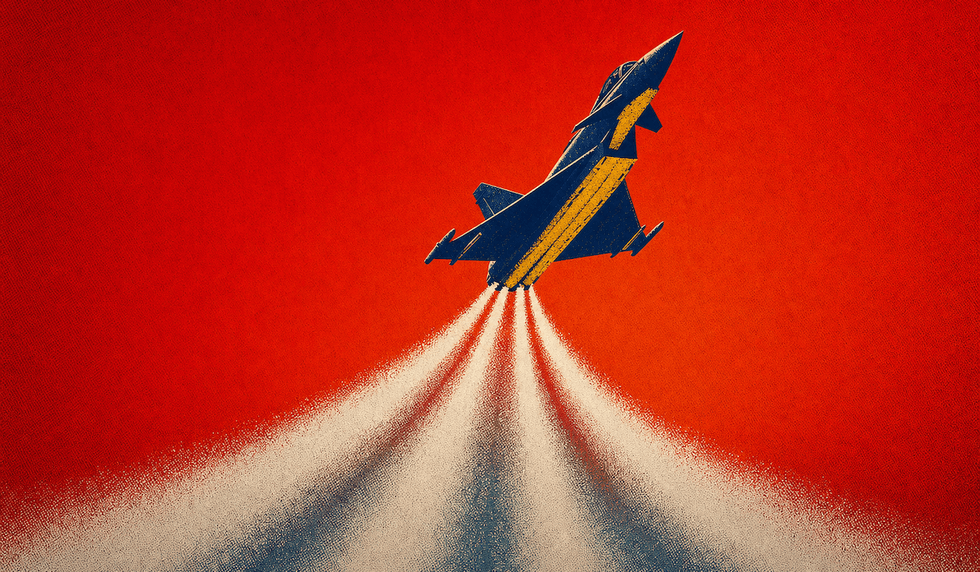
Last month, India's Defense Ministry announced that it was nearing a deal with France to purchase 114 Rafale fighter jets and, even more importantly, to collaborate on the development of the next generation of military aircraft. It's a good deal for India, fulfilling a key supply need in its air force and boosting its domestic defense industry, with most of the Rafale jets being built in India. France wins as well, receiving much-needed financing for its project without taking on a partner who'd rewrite its blueprints. But the way France and India arrived at this deal reveals everything that's dangerous in a g-zero world racing to rearm.
Rewind a year ago: France's plan was to work with Spain and Germany on the next generation of military jets. Their collaboration for the Future Combat Air System (FCAS) fighter was, at that time, evidence of the emerging European consensus on defense. For decades, the Europeans had underinvested in their militaries, confident in NATO's deterrence through the force of the US's undisputed place as the global hegemon. Yet as American power and security guarantees began to feel wobblier and Russia showed a willingness to use military force on bordering states, Europe raced to build a credible deterrent to Putin.
As Germany elected to rebuild its military in the wake of Former Chancellor Olaf Scholz's "Zeitwenwende" (or "turning point") speech, it needed more fighter jets. Hence, the redoubled collaboration with France on the long-gestating FCAS project. And then the infighting started. Germany wanted a fighter able to lead drones into battle. France wanted a more typical fighter, able to carry nuclear weapons (which France has and Germany doesn't). The private sector companies involved, Dassault and Airbus, began warring over how much each company would contribute to the project. European defense cooperation broke down, and France turned to India, while Germany made its own plans. The broader FCAS cooperation will continue, but without its most important component: the fighter.
Why does the breakdown between France and Germany on this deal matter? It captures what's at the heart of the global race to rearm, which has seen previously pacifist Japan vault into the top ten of global military spenders, Poland build the largest army in the European Union, and countries from South Korea to Saudi Arabia develop latent nuclear capacity. Notice a trend? The countries working around-the-clock to rearm are historical American allies who no longer trust that the United States will come to their defense.
And who can blame them? Trump has repeatedly floated the notion of leaving NATO altogether, along with threatening a NATO ally in his saber-rattling around Greenland (a constituent country of Denmark). He's endangered America's Gulf allies with a poorly planned war on Iran. And he's been less than clear on whether the US would come to Taiwan's defense in the event of a Chinese invasion.
But these trends pre-date Trump too. Biden alienated American allies in his rushed withdrawal from Afghanistan – the right (but unilateral) decision to end America's longest war, but a catastrophic failure in planning for what came next (an unexpectedly fast Taliban takeover of Kabul, followed by the US leaving behind many of the Afghans who'd helped them in the course of the war). We can go further back to Colin Powell's testimony at the United Nations that Iraq possessed weapons of mass destruction, which later turned out to be false, seriously eroding international trust of the US. Trump is an accelerant to what was a previously gradual trend: the world realizing that the days of American hegemony are over.
So, countries like Japan and Germany have realized that they need to rebuild their militaries. But in a world with only three true military superpowers – the United States, China, and, in a distant third, Russia – middle powers can't defend themselves without some level of cooperation. Infighting amongst European allies is dangerous because Europe needs to work together to deter Putin – a tall task as nationalistic, Putin-friendly parties gain strength in France and Germany. Just over the weekend, the far-right Alternative for Germany (AfD) won a state election in Saxony-Anhalt: a development with little short-term relevance for Germany's foreign policy but an ominous sign for the 2029 federal elections. Meanwhile, in France, Marine Le Pen is currently atop the polls for next year’s presidential election.
Even beyond deterrence, these countries must rebuild their defense industrial capacities. Right now, few countries can rival the defense production of the US, China, and Russia. A strong German military and a strong French military will improve those countries' security situations, but European defense will not offer a fourth leg to the military superpower stool until Europe can actually produce most of the weapons it needs, rather than buying them from their increasingly unreliable ally in the US.
In the vacuum left by America's retreat, new blocs are emerging as well. Saudi Arabia, Pakistan, and Turkey recently formed the Mecca Joint Defense Agreement, strengthening their deterrence through mutual defense and more greatly integrating their defense markets. Egypt, though wary the agreement could draw it into the Iran War, might soon join as well. It's not a NATO-level alliance, but it reveals the desire of middle powers to find substitutes for the deterrence they previously took as a given from the United States.
What all this amounts to is a world where more countries are arming, new military alliances are emerging, and there's no global superpower with the autonomy, capacity, and willingness to enforce international law. From the United States’ perspective, this is not all bad news – European countries previously free-riding on American military might are finally paying their fair share. Instead of playing global policeman, the US is freed up to pursue other aims, from Iran to Cuba. But this is a real "be careful what you wish for" moment, as countries race to build up militaries in a time of surging nationalism and declining international institutions. Squint your eyes, and it looks more like 1914 than you should be comfortable with.
Luckily, we are not on the brink of world war. International institutions, although weakened, still matter. The United States and China have shown a limited ability to work together in a crisis, and little appetite for direct conflict. But there is no doubt that we are entering an era where the risk of war is heightened, with little ability of the international community to prevent isolated regional conflicts from spiraling into something greater.
_________
🔔 Be sure to subscribe to GZERO Daily to get the world's best global politics newsletter every day on top of my weekly email. Did I mention it's free?
Sleepwalking into a new space race
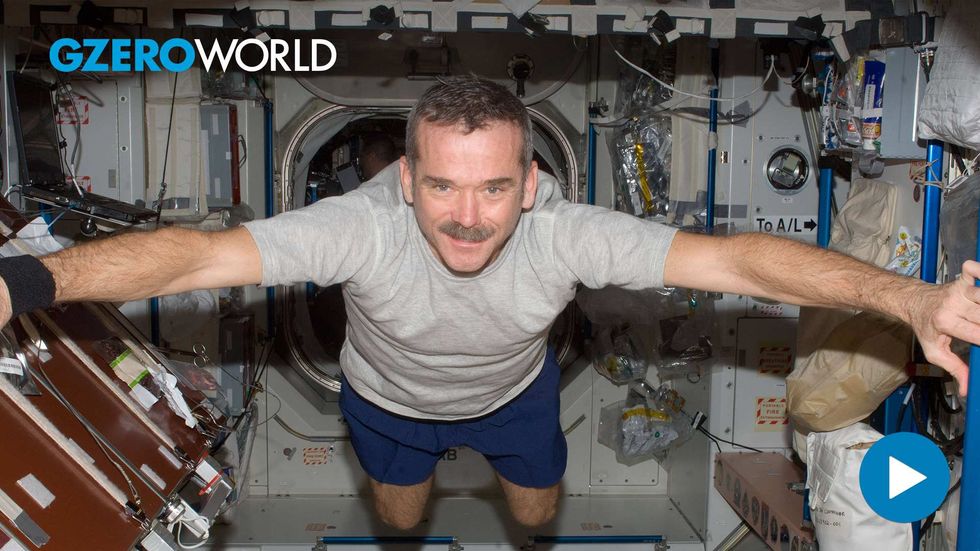
In a recent GZERO World episode, I spoke with astronaut Chris Hadfield about the new space race, the discovery of water on the moon, and groundbreaking advances in engineering. As humanity returns to the moon, we discuss the rise of geopolitical competition in space, especially between the US and China.
In a world where it's never been cheaper to blast off into space and there's little ability of international institutions to rein in great power competition, the race to acquire and find novel uses for lunar resources is on. What does that mean for the future of space exploration? And geopolitics? And, something I’ve always wondered, what's it like to fall asleep in space?
Watch this clip to find out, and catch my full interview with Chris Hadfield on this episode of GZERO World.
The German far-right is surging. What's next?

The AfD – the German far-right party labeled by the government as "extremist" – has won the state election in Saxony-Anhalt. Shy of a full majority, they will now try to peel off a smaller party or enough defectors from their rivals to support them in a coalition government. This marks a seminal moment for Germany, with a party that many have argued evokes Nazi associations attaining power in a system of government explicitly designed to prevent the return of extremist parties. What does it mean for Germany and the world?
Watch me explain in my latest Quick Take.
Moose’s treat of the week

Ordinary Abundance juxtaposes our contemporary lifestyle with what life was like centuries ago. As you follow a nightly routine in a typical apartment today and one from before lightbulbs and clean tap water, it becomes abundantly clear that, despite it all, this is the best time to be alive in human history.
_________
Want to understand the world a little better? Subscribe to GZERO Daily for free to get your daily fix of global politics delivered to your inbox.