November 16, 2026
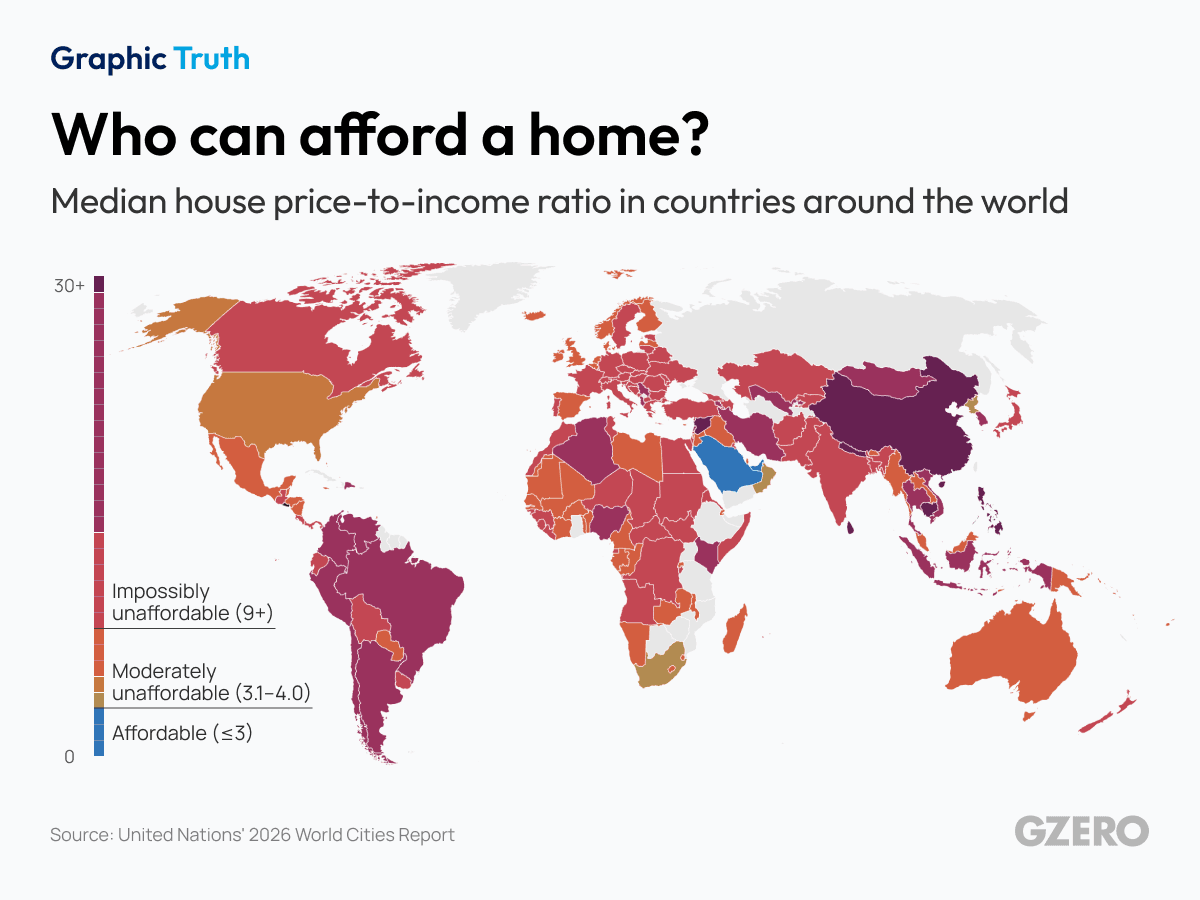
In more than half of the countries in the world, buying a home is now classified as “impossibly unaffordable.” According to the UN’s 2026 World Cities Report, the average house price-to-income ratio – which measures how many years of a median household’s annual income it takes to purchase a median-priced home – rose from 9.3 in 2010 to 11.2 in 2023. Put simply, that means that it now costs more than 11 years’ worth of a household’s income to buy a typical home.
The main driver is rapid urbanization.Forty-five percent of the world now lives in a city, more than double the share since 1950. As more people move to cities, demand for housing rises, along with the costs. Rising construction costs compound this, making it harder to keep housebuilding in line with demand. Wages, meanwhile, are growing but still lag behind rising house prices in much of the world.
Just two countries, Saudi Arabia and the UAE, have price-to-income ratios below 3, the threshold considered affordable. Both wealthy oil states offer generous government support to homebuyers. Saudi Arabia’s Real Estate Development Fund provides subsidies to Saudi nationals looking to buy homes, targeting 70% homeownership by 2030. The country is on track to meet this target, with the rate topping 66% last year. In the UAE, the Sheikh Zayed Housing Program provides Emirati citizens with interest-free loans and even housing grants.
Just six more countries, including South Africa, Oman, and North Korea, fall into the next two categories: moderately and seriously unaffordable.
South and Central Asia, meanwhile, have seen the steepest increase in the price-to-income ratio, going from 9.7 years of income to buy a house in 2010 to 16.8 in 2023. The report finds that a shift towards smaller household sizes drives up housing costs relative to household income, and an increasingly aging population means that more people are competing for housing.
But even wealthy countries are experiencing a housing affordability crisis. Canada and most of Europe are classified as “impossibly unaffordable” – largely due to demographic changes, urbanization, and rising construction costs. However, public investment in housing development across OECD countries also fell by almost two-thirds between 2001 and 2018.
What does it all mean? Housing is an issue on voters’ minds around the world right now. In Spain, housing affordability was at the center of last week’s general strike and Prime Minister Pedro Sánchez’s decision to call a snap election in two weeks. Elsewhere in Europe, people in Portugal have taken to the streets to protest against rising housing costs, and France has seen weeks of demonstrations over high living costs.
More For You
Crowds of protesters seen from the roof and Prague Castle during a rally called Letna against 4:36 - Hands off the media (Letna proti 4:36 in Czech), organized by Million Moments for Democracy (Milion Chvilek pro Demokracii in Czech language) group.
Tomas Tkacik / SOPA Images via Reuters Connect
Protesters took to the streets in Prague and Saudi-backed forces lost control of the Bab el-Mandeb Strait.
Most Popular
A screengrab from CTI video footage obtained November 9, 2026 shows a woman identified by Reuters as Alice Huang after comparison with a photograph obtained separately, attending a dinner with Nvidia CEO Jensen Huang (in black) at a restaurant in Taipei, Taiwan May 22, 2025.
REUTERS
This week’s biggest news story reads like a spy thriller.
Limited progress in Russia-Ukraine talks, South Africa’s AI push, Migrant caravan making its way to the US
Nov 13, 2026
Russian President Vladimir Putin greets US Special Envoy Steve Witkoff and Jared Kushner, US President Donald Trump's son-in-law, during a meeting at the Kremlin in Moscow, Russia, November 12, 2026.
REUTERS
US envoys met with Vladimir Putin in Moscow, while Volodymyr Zelensky huddled with European leaders in Ireland.
Three years into his presidency, Argentina’s eccentric libertarian leader is facing growing political pressure.
© 2025 GZERO Media. All Rights Reserved | A Eurasia Group media company.