November 09, 2026
Several elections next year could bring historic firsts for women in politics. In France, Marine Le Pen leads the polls in the country’s presidential race, while Ilse Aigner is the leading contender to become Germany’s next president. Meanwhile, attention is already turning to the 2028 US presidential race, and former Vice President Kamala Harris is considered a major contender in a field of potential Democratic hopefuls.
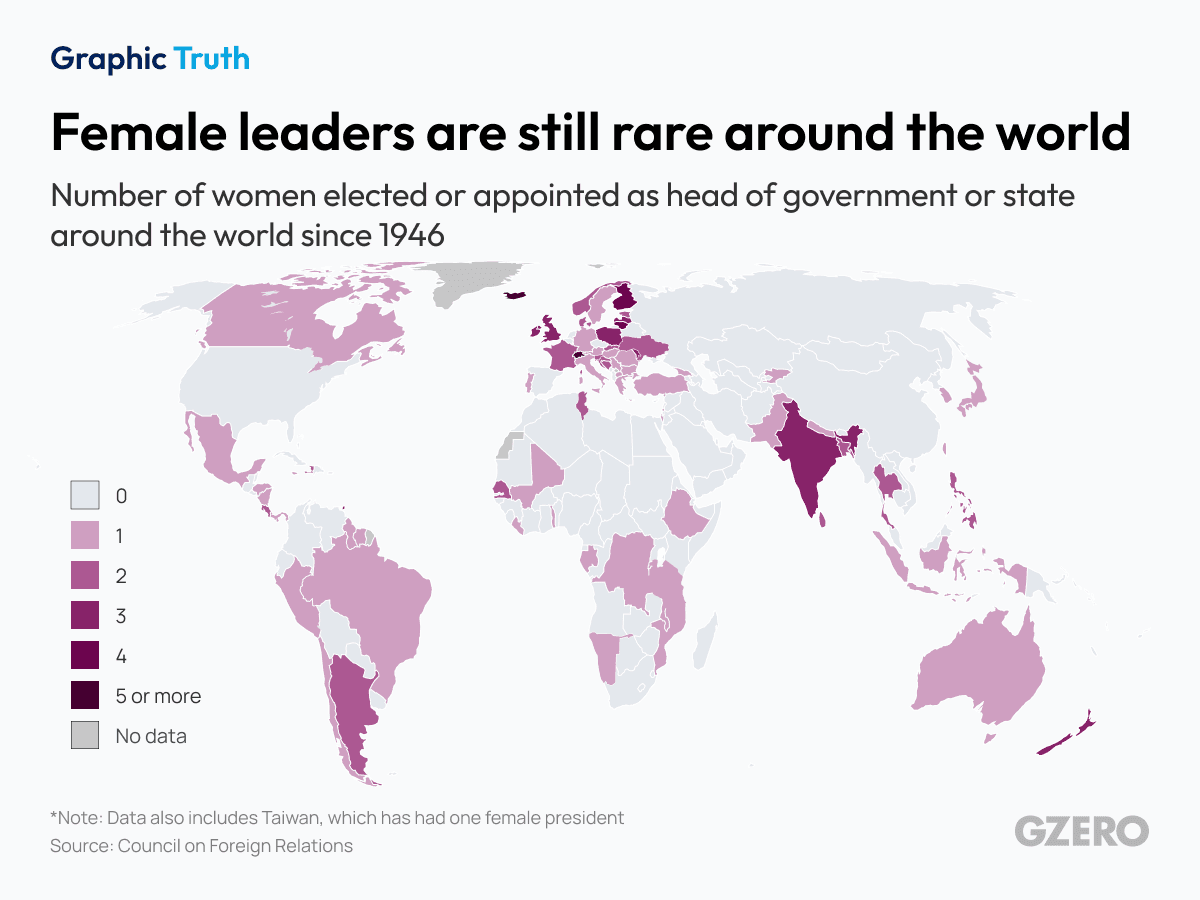
Of the 193 UN member states, only 86 have had a female head of state or government since 1946, according to the Council on Foreign Relations’ Women’s Power Index. Our Graphic Truth today looks at how many female leaders have held power in each of those countries.
The progress is relatively recent. In 1960, Sirimavo Bandaranaike became prime minister of Sri Lanka (then called Ceylon), making her the world’s first female leader of the modern era. The number of women who’ve led countries has climbed steadily since then, reaching 15 in 2010 and 30 in 2023. Several countries, particularly in Europe, have had multiple female leaders, including the UK, Finland, and Poland.
But female leaders remain rare. Of the 15 women leading countries today, 11 are their nations’ first, including Prime Ministers Fatima Ezzahra El Mansouri in Morocco, Sanae Takaichi in Japan, Giorgia Meloni in Italy, and Mia Mottley in Barbados, as well as Mexican President Claudia Sheinbaum. Mottley is also the longest-serving woman currently in office, with over eight years in power.
More For You
- YouTube
Can sovereignty and cooperation go together? Franck Paris, the new director general of the Paris Peace Forum, says sovereignty without cooperation is "just an illusion."
Most Popular
The California governor announced the move on Thursday in an open letter in which he called state-sanctioned killing “incompatible” with the state’s values and morally wrong.
- YouTube
In this GZERO Europe, Carl Bildt looks at the challenges facing Serbia’s Student List following its dramatic election victory over longtime nationalist leader Aleksandar Vučić, who had ruled the country for 14 years.
Think you know what's going on around the world? Here's your chance to prove it.
© 2025 GZERO Media. All Rights Reserved | A Eurasia Group media company.