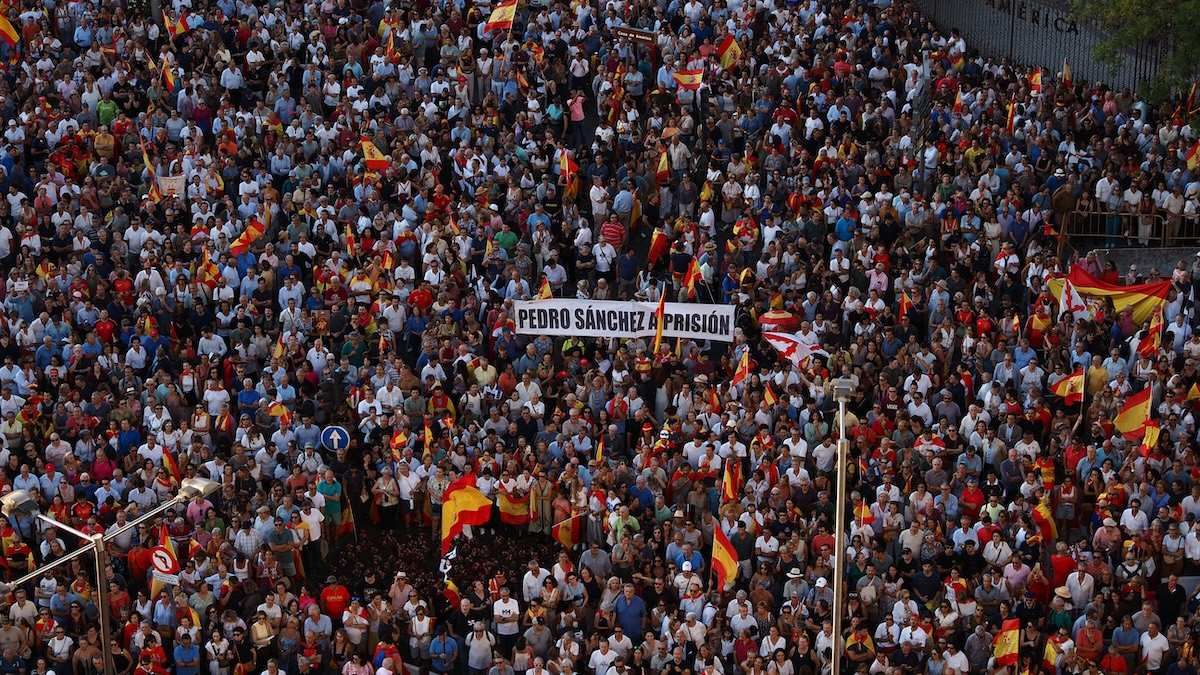
Immigration protests rock Spain
Tens of thousands of people took to the streets across Spain on Wednesday in protest against Prime Minister Pedro Sánchez’s welcoming immigration policy and his handling of the immigration crisis in the North African Spanish enclave of Ceuta. In July, more than 70,000 people crossed into Ceuta from Morocco in the space of 48 hours. At least 100 people died in the rush, and around 5,000 migrants remain stranded in makeshift camps in Ceuta. At the protests, calls for his resignation were accompanied by signs reading “Sánchez to prison” and “Invaders — go home!” Sánchez has deflected criticism for the crisis toward Russia and Israel, which he has suggested, without clear evidence, spread misinformation about Spain’s migration policy in order to encourage the rush. Frustrations over the crisis now put Sánchez, who has adopted a permissive but polarizing approach to immigration, in a tough spot as he faces re-election next year.
Mexico’s murder rate plunges – but questions remain
Mexico’s homicide rate has fallen by 50% since 2020, with a notable decline under President Claudia Sheinbaum who has pushed to curb surging violence among powerful drug cartels since taking office in 2024. Her approach – targeting cartel leadership with policing actions while also seeking to address the underlying factors that draw young people into organized crime – contrasts sharply with other regional leaders who have, following the example of El Salvador’s right-wing president Nayib Bukele, embraced tougher security policies centered on mass arrests and incarceration. But how much credit Sheinbaum deserves is up for debate: Some experts argue that shifting cartel dynamics and rivalries have also helped drive down killings. And while homicides have fallen, “disappearances” remain high and controversial – many argue that those who remain missing are in fact dead but will never make it into the homicide statistics.
Xi Jinping calls for new Middle East order
Chinese president Xi Jinping visited Egypt this week for the first time in a decade, in a trip meant to boost Beijing’s partnership with the Arab world’s most populous country, while also taking a swipe at US missteps in the region. The visit comes amid roiling regional instability, with the US locked in a stalemated war with Iran that has choked off Gulf energy supplies, exposed US allies to retaliatory Iranian strikes, and raised fresh questions about Washington’s role in the region. Standing in Cairo, which is still one of the world’s largest recipients of US military aid, Xi Jinping said the region should take control of its own destiny without “double standards” from “powers outside the region.” But China’s ambition to take on a bigger regional role itself faces an obvious challenge — the US retains a massive military and security presence in the region which China cannot match.