October 19, 2026
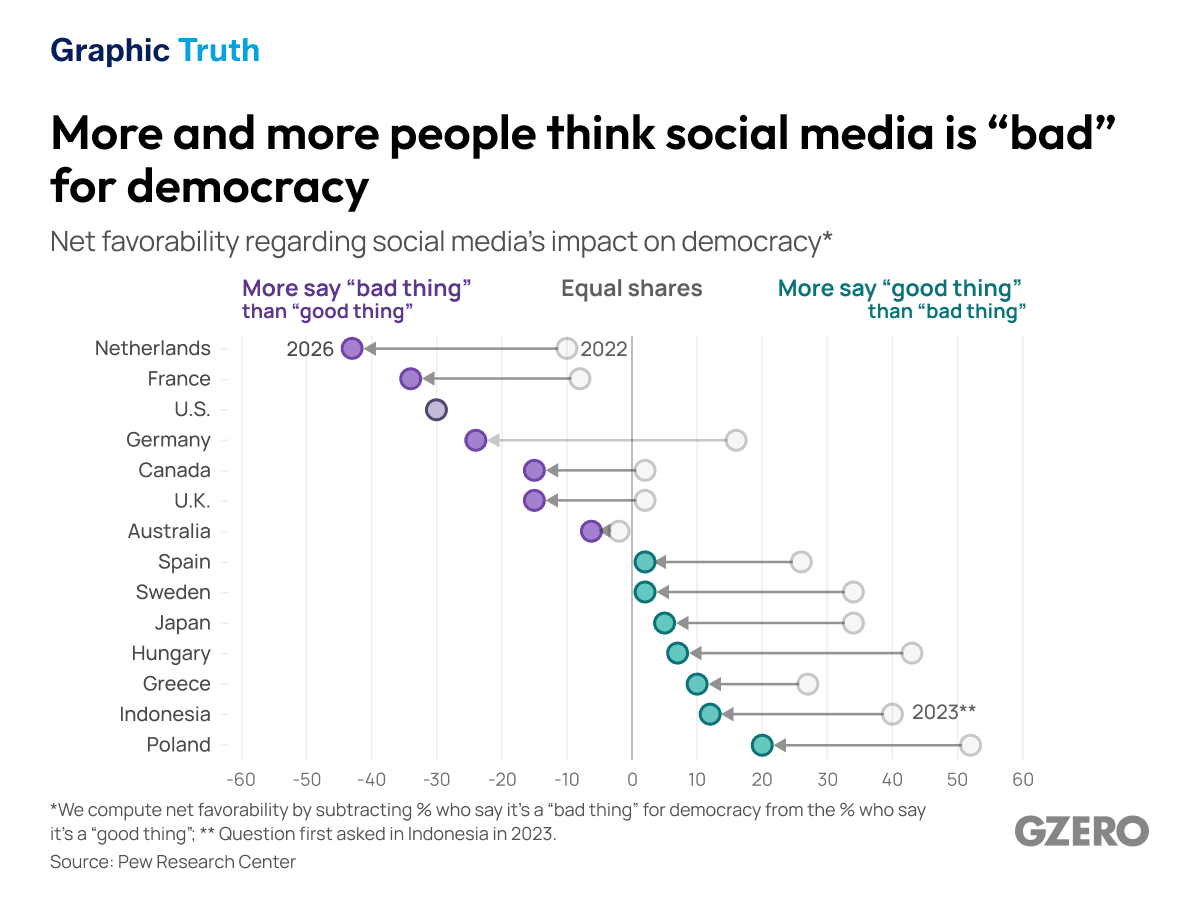
Social media has made news easier to access than ever, but as our Graphic Truth shows, people are increasingly concerned about the technology’s negative impacts on democracy.
Earlier this year, social media platforms overtook news apps and websites to become the most widely used source of online news, according to the Reuters 2026 Digital News Report.
And yet, new polling from Pew Research Center across 37 countries shows that the share of the public who believe social media is a “bad thing” for democracy has increased significantly since 2022: a median of 79% of respondents say social media has made it easier to manipulate people with false information, while 68% say it has made societies more polarized.
Views of social media’s impact on democracy are particularly negative in the US, the Netherlands, France, and Germany, where over 60% of the population say social media harms democracy. In the US, however, those views have remained unchanged since 2022, while opinions in other countries now appear to be converging with Americans’ souring views of the technology.
Meanwhile, in countries like Poland, Indonesia, and Greece, social media is still, on balance, seen as a good thing for democracy — although negative views have grown since 2022.
Generational divide. Young people are more likely to view social media positively. The gap is particularly wide in the UK, where 60% of those aged 18-34 think social media is good for democracy, compared with just 31% of those 50 and older. One reason may be that social media broadens access to political information and voices: a median of 60% of respondents across all ages say access to the internet and social media has improved representation of different views.
Laws that regulate content on social media are increasingly popular. In December 2025, Australia was the first country to ban people under 16 from social media, citing mounting evidence of its negative impacts on young people’s mental health. Other large economies, including France and the UK, have since followed suit.
However, even as countries slowly come to terms with the pros and cons of social media, they’re also having to confront the challenges posed by the next technological leap: 10% of people surveyed now use AI chatbots to get their news, up from 7% the previous year, Reuters found.
More For You
This week, Microsoft launched the Velocity Prize, a global competition designed to give students ages 13–16 an opportunity to demonstrate their computational thinking, coding, and creative problem-solving skills in Minecraft. Supported by Microsoft’s Digital Crimes Unit, the competition encourages students to build digital skills and learn how to use technology responsibly while exploring future opportunities in cybersecurity. By helping equip the next generation with the skills to navigate and shape the digital world, the Velocity Prize is helping build a pipeline of future problem-solvers who can contribute to a safer and more resilient digital ecosystem. Read more here.
Most Popular
Since returning to power in 2025, the Trump administration has drastically changed the answer to this question, pursuing an ‘America First’ philosophy that is dramatically more transactional: the US will give you money, but you must give the US something valuable in return.
People wearing protective masks walk through the street as haze from wildfires shrouds the area in Palangka Raya, Central Kalimantan province, Indonesia, October 14, 2026.
REUTERS/Arief Rahman Septian Prathama
Indonesia’s worst wildfires in a decade are quickly becoming a domestic and international headache for President Prabowo Subianto.
In March the government doubled the maximum prison term for same-sex relations to 10 years.
© 2025 GZERO Media. All Rights Reserved | A Eurasia Group media company.