Ramadan Mubarak and happy Ash Wednesday to those who celebrate. Today, we pull back the curtain on how Puppet Regime is made, explain the EU’s most consequential election this year, and assess the rising level of gloom in the world’s biggest economies.
- The Daily crew
Meet Puppet Regime’s puppet master
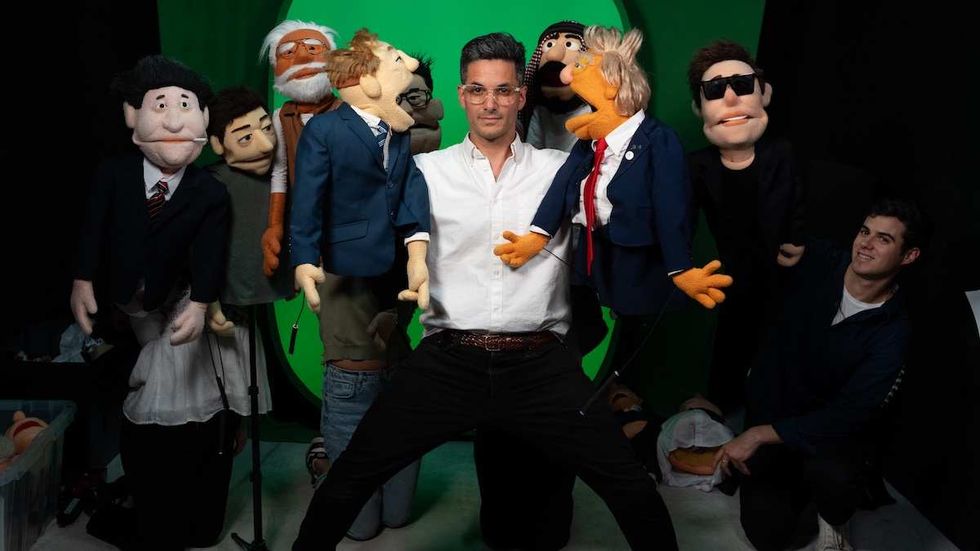
In an era when geopolitics can feel overwhelming and remote, sometimes the best messengers are made of felt and foam. We’re talking, of course, about Puppet Regime, the satirical brainchild of GZERO Media that has been recasting the world’s most powerful leaders with eight fingers and no legs since 2017.
Longtime fans of the Regime will recall skits imagining everything from Donald Trump, Xi Jinping, and Narendra Modi being stuck in high school together, to Vladimir Putin accidentally inviting Volodymyr Zelensky to his holiday party. What began originally as a gag gift – a puppet of Ian Bremmer inspired by his lifelong love of “The Muppet Show” – has evolved into a sharp, comedic lens on a world order that can feel surreal and unmistakably theatrical.
Readers of The New York Times may have spotted Puppet Regime in a recent feature on how the series has taken shape on our PBS-affiliated show GZERO World as well as on Instagram and YouTube. In honor of that recognition, we’re giving GZERO Daily readers a behind-the-scenes look at who’s been pulling the strings since day one: Alex Kliment, the Regime’s master puppeteer. Kliment, who performs most voices himself – including Trump’s “jazz scat”-like cadence – explains that the magic of the regime lies in translating high geopolitics into the often petty, recognizable dramas of human relationships. Our converastion has been edited lightly for context and length.
GZERO: How did Puppet Regime begin?
Kliment: Ian was a huge fan of “The Muppet Show” growing up. At some point, a friend of his learned about this and, as a gag, made a puppet of Ian and then gave it to him. It sat around the office for a couple of years, and no one really knew what to do with it. Then, in 2017, when we decided to start GZERO Media, the public-facing media company of Eurasia Group, Ian came to me and said, “Hey, I have this idea to try and do a puppet satire show.” He knew I had some experience with creative film and music-type things. I said, sure – why not?
It started as a lark of an idea that would be part of the GZERO World with Ian Bremmer show we were pitching to a PBS-affiliate at the time. It grew out of the question: why isn’t there a good, imaginative satire series on global politics? Something that rises above the lowest common denominator, something smart and sharp, which you can learn from while you’re laughing and skewering all the world leaders who need skewering.
What were the biggest pieces of inspiration for the series when it began in 2017?
If you think we’re living in a time of tremendous upheaval and a reordering of how the world works, this is when that period started. 2016 was when Trump was elected, Brexit occurred, and a migration crisis was unfolding in Europe. That was the time when it felt most urgent and opportune to think of a way of both satirizing and explaining a world that suddenly felt like it had been totally turned on its head. And as far as creative influences, I’d point to the classic American edutainment cartoon “Schoolhouse Rock,” the legendary British puppet satire show “Spitting Image,” and “Kukly,” a Russian puppet satire show so scathing that Vladimir Putin cancelled it during his second year in office – something we alluded to in a recent episode on censorship.
Click here to read the rest of the interview, where you can learn more about how an episode of Puppet Regime comes together.
What We’re Watching
REUTERS/Bernadett Szabo/File Photo
Campaign season begins in a pivotal EU election
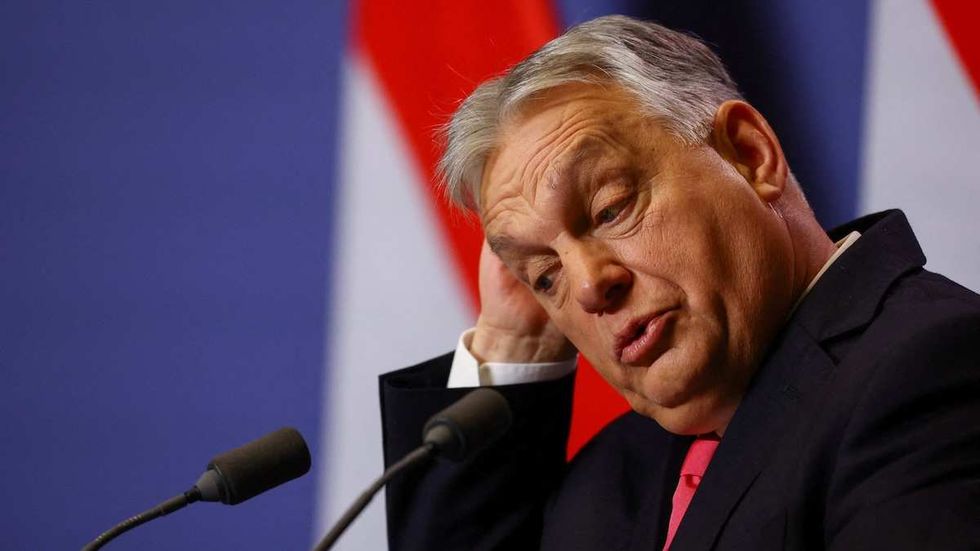
The Hungarian election is off to the races, and nationalist Prime Minister Viktor Orbán is facing his most serious challenger in 16 years. Over the weekend, Orbán and his center-right European Parliament member Péter Magyar launched their campaigns, with polls showing Orbán trailing Magyar and his Tisza party. Orbán, who is close with Russian President Vladimir Putin, has used his power to tighten control over media and courts and Hungary’s veto to stall sanctions on Moscow and Ukraine aid. His Fidesz party has been trying to divide Magyar’s base on culture war issues and to paint him as a puppet of Brussels. A Magyar win wouldn’t mark a liberal U-turn, but could smooth the European Union’s support for Kyiv and rebuke right-wing populism currently on the rise in Europe.
Peru impeaches yet another president
After just four months in office, Peru’s President José Jerí will join the long line of predecessors to be removed. The country’s Congress on Tuesday voted to impeach Jerí after videos released online showed him attending undisclosed meetings with a wealthy Chinese businessman under government scrutiny. Jerí, who only took office after his predecessor was impeached, said the leak was politically motivated ahead of the upcoming presidential elections on April 12. Since 2016, Peru has had seven presidents, and only one made it through their whole term. The legislature will pick an interim leader today. Despite having a revolving door of presidents, Peru has one of the most stable economies in South America, maintaining low inflation and far less turbulence than its regional neighbors like Ecuador and Argentina.
Will Europe’s top banker leave her job early?
European Central Bank President Christine Lagarde, whose eight-year term ends in October 2027, plans to end her term before next year’s French presidential election, according to the Financial Times. Doing so would allow French President Emmanuel Macron and German Chancellor Friedrich Merz, two centrist leaders with large sway over the process, to lead the search for her replacement, and circumvent the risk of a hard-right French leader having a say – a recent poll showed National Rally leader Jordan Bardella winning the 2027 French election. The Wall Street Journal disputed the FT’s piece, reporting that Lagarde hadn’t yet made a decision. Lagarde’s role as ECB president is akin to that of US Federal Reserve Chair Jerome Powell: she manages monetary policy for the euro, a currency used by 27 countries and some 350 million people.Global technology leaders launch Trusted Tech Alliance

Last week, at the Munich Security Conference, a group of global technology providers, including Microsoft, announced the Trusted Tech Alliance — committed to shared, verifiable principles for trusted, transparent, and resilient technology across borders. At a moment of economic volatility and zero-sum technological competition, countries and customers are demanding greater accountability from technology providers. The Alliance addresses this by bringing together companies from across Africa, Asia, Europe, and North America around shared commitments: transparent governance, secure development practices, supply chain oversight, open digital ecosystem, and respect for the rule of law — ensuring the benefits of emerging technologies strengthen public trust while driving job creation and economic growth.
Explore the Trusted Tech Alliance here.
Graphic Truth
Eileen Zhang
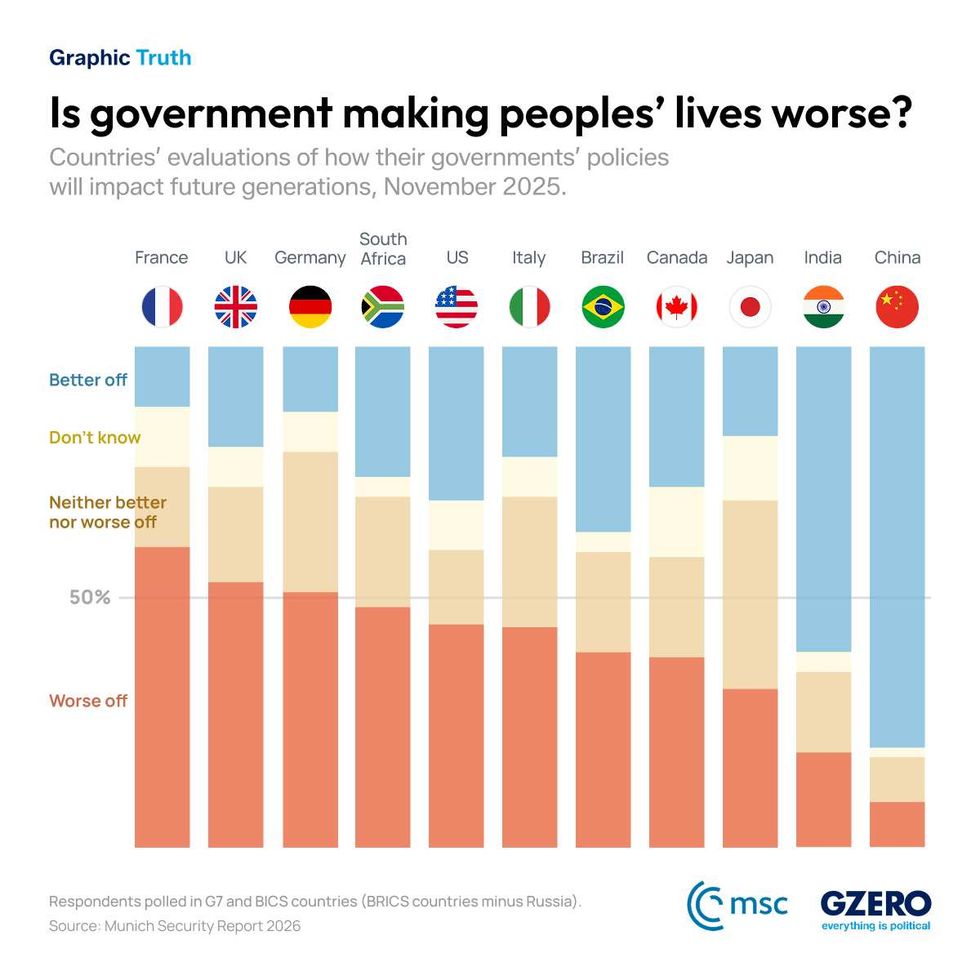
Does skepticism rule the day in politics? Public opinion data collected as part of the Munich Security Conference’s annual report found that large shares of respondents in G7 and several BRICS countries believed their governments’ policies would leave future generations worse off. That sentiment was especially pronounced among citizens in France, the United Kingdom, and Germany where governments entered the year exceedingly unpopular and under siege from the populist right and left – a dynamic Eurasia Group warned of in the 2026 Top Risks report.
Trust in political institutions has been crumbling for decades, but a sense of helplessness in the face of global events has ticked up over the last few years. Across all G7 countries surveyed, that sentiment rose in 2025 and was significantly higher than in 2021. France witnessed the sharpest rise in gloom, with the sentiment increasing by 14 points over that period. Quel dommage.
Hard Numbers: Gabon suspends social media, Bulgaria to hold yet another election, Japan puts some money on the table, Philippine vice president declares presidential run
REUTERS/Luc Gnago
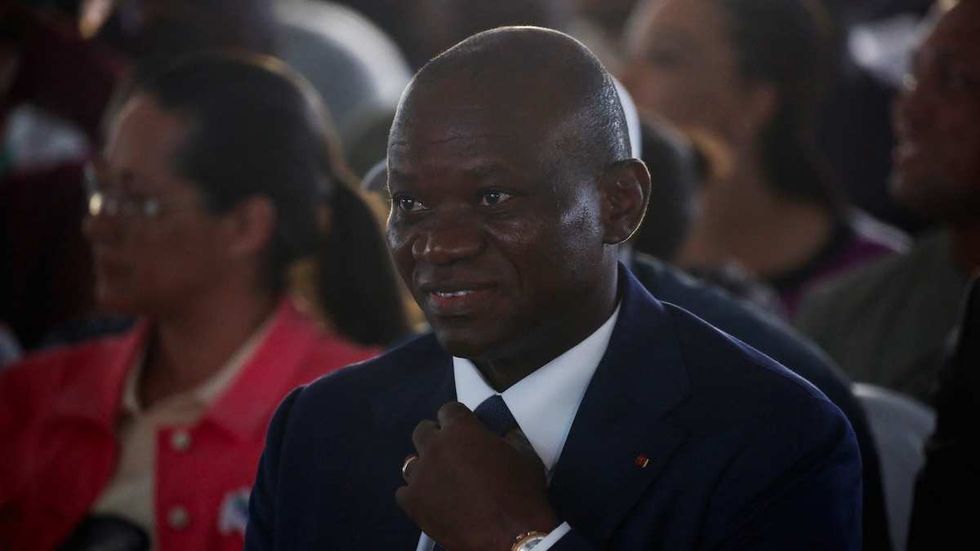
2.5 million: The population of Gabon who can no longer get onto certain social media platforms, like YouTube and TikTok, after the government suspended access on Tuesday. The government said that the platforms were spreading “hateful and abusive” content online, but it comes as the oil-producing African state faces growing protests over high costs of living.
8: The number of parliamentary elections Bulgaria will have held in almost five years once an election takes place on April 19, which the president called for on Wednesday. None of Bulgaria’s elections over the past decade have led to a stable governing alliance, and political infighting has rocked fragile coalitions.
$36 billion: The amount of capital that Japan will provide for a trio of US projects. As part of its trade deal with Washington last year, Tokyo pledged to invest $550 billion in the United States, and this announcement marks the first stage of that agreement. The projects include a natural gas plant in Ohio, a crude oil export facility along the Gulf Coast, and a synthetic diamond manufacturing site in Georgia.
56%: The approval rating of Philippine Vice President Sara Duterte, per a December 2025 poll – Duterte announced on Wednesday that she will run for president in 2028. The daughter of the former president, Duterte is currently in a bitter showdown with the current president Ferdinand “Bongbong” Marcos Jr., whose approval rating was just 34%.
What’s Good Wednesdays™, February 18, 2026
Listen: to Anand Giridharadas on the Ezra Klein Show, taking a big picture view of the Epstein files, how Jeffrey Epstein exploited elites’ vulnerabilities, and what it shows about how power works in the US. It was a fascinating listen. I too want to read the unpublished exposé from Conchita Sarnoff now, someone please publish it. – Riley
Scroll: Need a light cleanser from friends who love flexing about their weird and wild activities – be it professional or personal – then look no further than comedian Tom Nestor’s social media account. Holding a random object as a makeshift phone, Nestor feigns interest and admiration as he pretends to talk to friends after they posted a run on Strava, started a podcast, or moved to Dubai. While we might all strive for success, Nestor reminds us of the silly side of our bold endeavors. – Zac
Watch: “A Knight of the Seven Kingdoms.” This recommendation is for fans of “Game of Thrones” who’ll appreciate another Westorosian spinoff. It has all of the usual trademarks of the acclaimed show – including the gore – but the overall mood of the show is far lighter than its predecessor, making it more of the “Ted Lasso” version of “Game of Thrones,” in my opinion. – Natalie J.
This edition of GZERO Daily was produced by Alex Kliment, Zac Weisz, Riley Callanan, and Natalie Johnson.