
Podcast: The IOC's Dick Pound on how sports and politics should mix
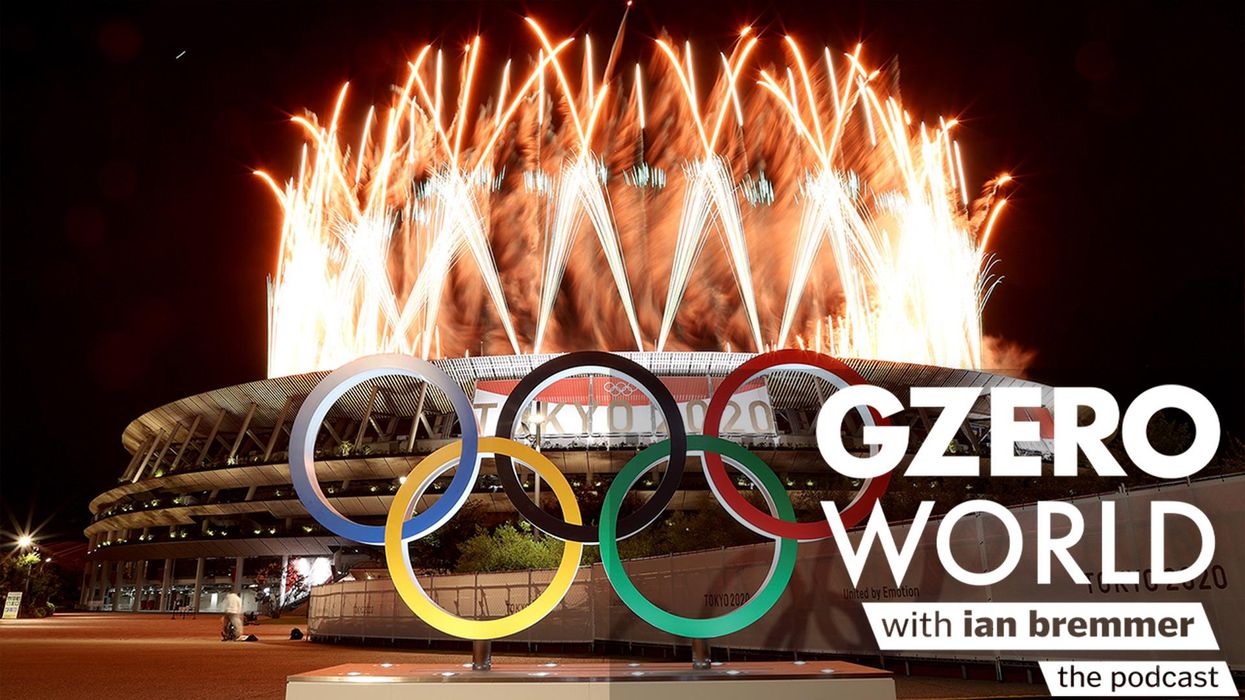
Listen: A look at the long history of protest at the Games with Dick Pound, the longest serving member of the International Olympic Committee and a former Olympic athlete himself. With COVID rates rising globally, this year's Olympics faced some major hurdles. But the pandemic was only part of the picture. The Tokyo Games played out against a backdrop of mounting global tension surrounding gender equality, racism and human rights, leaving many people to examine the place of politics on the playing field and podium.
TRANSCRIPT: The IOC's Dick Pound on how sports and politics should mix
Dick Pound:
The field of play is not an appropriate venue in which to make your protests while a race or game is going on. It's not appropriate in the medal presentations. But in press conferences and interviews and all that sort of thing, athletes are entirely free you to express whatever they like, but we don't think it's appropriate on the field of play to interfere with the field of play.
Ian Bremmer:
Hello and welcome to the GZERO World Podcast. This is where you can find extended versions of my interviews on public television. I'm Ian Bremmer and today we are looking at the role of politics in sports. With COVID rates rising globally, this year's Olympics faced some major hurdles to say the least, and the pandemic was only part of the picture. The Tokyo Games playing out against the backdrop of mounting global tension surrounding gender equality, racism, and human rights, leaving many people to examine the role of politics on the playing field and the podium. I'm talking to Dick Pound, the longest serving member of the International Olympic Committee, founding president of the World Anti-Doping Agency, and a former Olympic athlete himself. Let's get right to it.
Announcer:
The GZERO World Podcast is brought to you by our founding sponsor, First Republic. First Republic, a private bank and wealth management company, understands the value of service, safety, and stability in today's uncertain world. Visit firstrepublic.com to learn more.
GZERO World also has a message for you from our friends at Foreign Policy. Could empowering women in the workplace be the simplest way to boost the global economy? Basically, yes, but how? The Hidden Economics of Remarkable Women is a new limited series podcast from Foreign Policy featured on Apple Podcasts' New & Noteworthy. Listen to The Hidden Economics of Remarkable Women wherever you get your podcasts.
Ian Bremmer:
Dick Pound, thank you so much for joining us on GZERO World.
Dick Pound:
Pleasure.
Ian Bremmer:
Look, you're longest standing member of the IOC right now, and you've never been afraid to speak your mind. Here you are in Tokyo. I would love to hear your unvarnished opinion about how this thing is going. I mean something that I'm not going to read in the press releases.
Dick Pound:
Well, it's actually from an Olympic sport perspective and a broadcasting perspective and all that, it's going normally. The competition is fantastic. The television images going around the world are as fantastic as we thought they would be. It's just on the ground a little bit, the COVID specter is affecting the Japanese public more than we thought. While they're getting into the games, and especially because Japan is having quite a good games, the opposition to the idea of proceeding with the games has gradually dissolved, but there's this overriding concern among the Japanese public that the people coming into the games are in some way responsible for the spreading of the virus, notwithstanding the fact that they're all in very secure bubbles, including the IOC, including the athletes in the village, so there's that tension that still exists, but it's not interfering with the sport which is well-organized, and the athletes are getting the chance that they hoped and prayed for ever since a year ago March when the postponement was announced. In that respect, it's been terrific. My guess is that audiences around the world are enjoying the sport.
Ian Bremmer:
No fans, as you said, I mean, they're all in a bubble. Here in the United States, we've run baseball, we've run basketball, we've run football, we've run the NCAA, starting off with no fans and then quickly with fans and an average day COVID numbers in Japan sounds awesome from an American perspective. I mean, why has this been so problematic on the ground for the Japanese? Why has the Japanese prime minister struggled so mightily with something that so many other parts of the world have had a much easier time with?
Dick Pound:
It's not entirely certain, I must say, and we're having trouble figuring it out, we, the IOC, because there are all kinds of Japanese sports events, their professional baseball league and their sumo contests are going on with spectators in some of the same stadia that are being used for the Olympics in which no spectators are being allowed. There's a disconnect there that we haven't figured out and that hasn't been explained, but I suspect that the root of it all is the relative slowness with which an ordinarily very organized society is rolling out the vaccines and that, I think, is an overriding concern among the Japanese public at large.
Ian Bremmer:
What's the single thing that's surprised you most so far, something you really would've not in any way expected before you actually showed up in Tokyo?
Dick Pound:
I guess it is the growing resistance among the Japanese public, not terribly active opposition, but just a resentment I guess, in some respect of the additional risk that they perceive coming from the outsiders, even though the tests and the statistics show that it's simply not a viable concern.
Ian Bremmer:
I want to move to an issue that's becoming much more challenging, this Article 50 that's talking about neutrality in sports and not having any political displays or demonstrations by athletes at all. There's been a lot of that, of course, in Tokyo this time around. Tell me a little bit about how you are thinking about that, how you're addressing the topic.
Dick Pound:
Certainly, it's been overplayed in the media with respect to the freedom of speech of athletes. They're free, frankly, to say whatever they want within legal limits and so forth. What we've said is, "Look, the field of play is not an appropriate venue in which to make your protests while a race or game is going on. It's not appropriate in the medal presentations. But in press conferences and interviews and all that sort of thing, athletes are entirely free to express whatever they like, but we don't think it's appropriate on the field of play to interfere with the field of play."
I mean, frankly, I've always thought you're at the Olympics to demonstrate that it is possible for 206 countries to be together peacefully compete in accordance with agreed upon rules and so on. It's kind of an oasis in the middle of an increasingly tense world. We shouldn't be spoiling that by pointing out the obvious, which is that there are social and political problems that exist in the world and the world is not perfect.
Ian Bremmer:
At a time when conflict and polarization and tribalism is becoming so much greater, it seems like the Olympics are one of the only places where we get to celebrate common humanity as opposed to demonize it.
Dick Pound:
I mean, I remember back in the day before you were born, in Rome, it was at the nadir of the Cold War of the day, the Soviets were these two-dimensional ogres that we all read about in the papers. But when you're there, and I was a swimmer, and you see Russian swimmers, and they're just as nervous as we were, some of them are nervous enough that they go and throw up before their races, and so they were real people. If you did a certain time, you knew what went into that performance for yourself, and if somebody has done the same thing, you know that he went through, that sort of thing, too, so you share this kind of a common unspoken bond of respect for the efforts. We're trying to beat each other in the races, but it's different from beating a Soviet.
Ian Bremmer:
No, the Soviets throw up just like the Canadians. I mean, surely we can hug it out after that.
Dick Pound:
You'd think. All of that is a broadening of one's experience, a broadening of one's appreciation for how people can make the impossible look easy.
Ian Bremmer:
The next Olympics, of course, are becoming enormously politically heated in Beijing this coming winter. Of course, when Beijing first hosted the Olympics, this was a milestone. This was them coming out on the global stage. Today, China's position is very different. How do you think China's going to handle these games at this point? I mean, I know they haven't even made an announcement about whether or not they're going to have fans. Where do you think that's going to go?
Dick Pound:
Well, I think like everyone, China's waiting to see how the pandemic plays out, and I think they would certainly like to have fans, but in a country the size of China, you've got to be careful that a pandemic does not really take hold, so they'll be watching that pretty carefully. I hope that there will be fans. It looks like there will be certainly some political agitation around the edges from the rest of the world. I think it's pretty clear that there's no appetite to prevent athletes from going and participating. The issue is, how are governments going to express their disapproval of a number of Chinese government policies? Governments have their ways of sending signals. For example, you could make sure that if we're talking about the United States that no US government official accepts any invitation to go there during the games.
Ian Bremmer:
The Chinese government could preempt that if they just said, "We'll let Chinese fans, but we're not going to bring in international community," and then there's no call for diplomatic boycott, and they say it's because of COVID, but in reality, it saves everybody the embarrassment of having to make a tough decision about whether or not any of your leaders are going to show up.
Dick Pound:
Well, normally the political leaders are invited by the government of the host country, they're not Olympic guests, and so if China chose not to invite anyone, that would be its decision. It would save probably a lot of angst on the part of the other governments, although if they're excluded, that's probably a cause for complaint. I think there's no win-win here for either side.
Ian Bremmer:
Canada, of course, is in the middle of this. On the one hand, Canada hits way above its weight in terms of its importance in the Winter Olympics, the role of its athletes. On the other hand, we have this extremely painful diplomatic problem with the two Michaels who are being held illegally and now for quite some time by the Chinese government.
Speaker 4:
It's been over two years since Michael Spavor and Michael Kovrig were arbitrarily detained in China following the arrest of Huawei CFO Meng Wanzhou. They sit in Chinese prisons as she remains under house arrest in Vancouver, awaiting an extradition ruling. Immigration officials in Canada gave permission for her family to travel here. Meanwhile, the two Michaels only have limited consular access. This week, the Biden administration called upon China again to release the two men. Huawei currently wants to get its 5G network into Canada, but there are concerns about the company's ties to the Chinese government and allegations of complicity in human rights violations.
Ian Bremmer:
What do you think the Canadian response should be, assuming that this situation persists?
Dick Pound:
Well, my guess is that Canada would be very reluctant to send any government officials in the circumstances. I mean, I think they know this is a tit-for-tat, but I don't think the Canadian government will go so far as to say in effect to China, "We are so angry with your abrogation of the civil rights of segments of your society that we are going to show how mad we are by taking away all the civil rights of our athletes and preventing them from participating." We tried that in Moscow. It didn't work and everyone knows that it doesn't work. There will be no conduct change as a result of an Olympic boycott, so my guess is that our athletes will go and our officials probably will not go.
Ian Bremmer:
Whenever you talk about the Olympics, of course, one, there's always a series of headlines about how much it costs, about the extraordinary cost overruns that have bedeviled pretty much every Olympics, and so many infrastructure projects, definitely. What do you think is for those that have really taken it on the chin economically, and you've seen so many of these, you have any advice for how to get it, if not right, at least better as a host country?
Dick Pound:
Well, I think to use a sport analogy, the backswing is really an important part of any sport move and so figure out what you need for your country before you start the planning. I must say that if you have all of the facilities in place, you can host the Olympic Games without any impact on your tax budget in the host countries. Between television and sponsorships and tickets, you can organize Olympic Games.
Ian Bremmer:
I note that the latest award of an Olympics went to Brisbane and they set off some fireworks, but it was uncontested. When I was growing up, I mean, a bid for the Olympics was something that the cities would hotly contest and were really excited about. How could it be that only one city would compete for an Olympics bid?
Dick Pound:
Well, I think one of the difficulties is that in the developed democracies, as you know, and it's the same in my country and yours, 25% of the people are against everything all the time, and so if you're trying to put together an Olympic candidacy, if you go to the remaining public and you have a two-to-one success rate, you're still only back to 50/50, so we said, "Let's turn this into a conversation of how can we help you maximize the benefit for your country while still being able to put on the games?" That is a dialogue that has started with a number of countries. It happened at Australia, was pretty quick out of the blocks with a very, very good candidate, and that scared away the others, or not scared away, but just said, "Well, listen, we're not quite ready yet." There's actually quite a lot of interest out there, an appetite for the Olympics, but you need to start earlier and work far more closely with the institutions within each country to make sure that they understand what's involved rather than simply a figure that nobody really understands and which sounds very high.
Ian Bremmer:
Tell me the one city, and it can't be in Canada, that has never hosted an Olympics before that most should and why?
Dick Pound:
I've always thought Istanbul would be a fantastic Olympic city. I remember one of their first mottos I thought was one of the best I've ever heard is they say, "Let's meet where the continents meet," and that certainly resonated with me. There are lots of countries out there that could do this, but there are also lots of countries that really cannot realistically hope to be a Olympic host, Honduras or Guatemala or countries like that. They simply don't have the infrastructure. It's a balance of picking countries that can actually do what's necessary to organize the games.
Now, London, Paris, Los Angeles all had the games, or will have had the games three times. This is the second time for Tokyo. In 1964, they amazed the world with the emergence of Japan as a modern nation, and I think had we been able to proceed in 2020, there would've been a new Olympic paradigm because the organizational level in Japan for these games has just been, yeah, fantastic. Imagine being able to stop your 747 in mid-flight for a year and then continue the way they have this year. I don't know that there's another country in the world that could have done that. I think there remains an appetite for the Olympics, but I think it has to be approached differently so that the general people in prospective host countries understand what it means and what's involved and what the benefits are.
Ian Bremmer:
Dick Pound of the IOC, thanks for joining us today from Tokyo. Really appreciate it.
Dick Pound:
Nice to be with you. Thank you.
Ian Bremmer:
That's it for today's edition of the GZERO World Podcast. Like what you've heard? Come check us out at gzeromedia.com and sign up for our newsletter, Signal.
Announcer:
The GZERO World Podcast is brought to you by our founding sponsor, First Republic. First Republic, a private bank and wealth management company understands the value of service, safety, and stability in today's uncertain world. Visit firstrepublic.com to learn more.
GZERO World also has a message for you from our friends at Foreign Policy. Could empowering women in the workplace be the simplest way to boost the global economy? Basically, yes, but how? The Hidden Economics of Remarkable Women is a new limited series podcast from foreign policy featured on Apple Podcasts' New & Noteworthy. Listen to The Hidden Economics of Remarkable Women wherever you get your podcasts.
Subscribe to the GZERO World Podcast on Apple Podcasts, Spotify, Stitcher, or your preferred podcast platform to receive new episodes as soon as they're published.