
Podcast: Gene editing tech risks and rewards: Dr. Jennifer Doudna's perspective
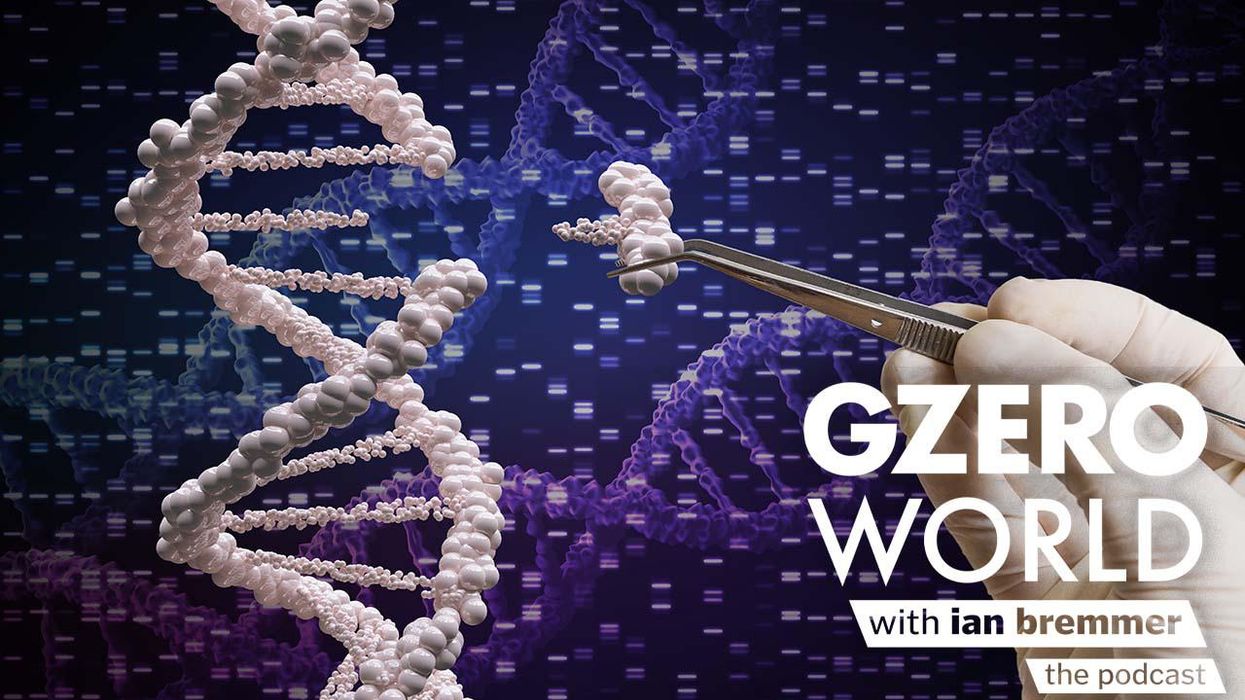
Listen: In a wide-ranging interview with Ian Bremmer, Nobel Prize-winning scientist Jennifer Doudna discusses her groundbreaking work on the revolutionary gene-editing technology known as CRISPR. In their conversation she explains what CRISPR is and why it has the potential to cure diseases and fend off viruses. She also talks about the limits of this technology and advocates for a global policy consensus on what limitations there should be around gene editing. Policymakers must also factor in income inequality, Doudna argues, given how expensive CRISPR currently is and the potential it has to change so many lives.
TRANSCRIPT: Gene editing tech risks and rewards: Dr. Jennifer Doudna's perspective
Jennifer Doudna:
Imagine that we could eventually use genome editing to protect people from getting certain forms of dementia that might otherwise they would succumb to because of their genetics. I think that would be an incredible advance.
Ian Bremmer:
Hello and welcome to the GZERO World Podcast. This is where you can find extended versions of my interviews on public television. I'm Ian Bremmer. And today a look at whether gene editing could improve life on Earth or lead us to the same kind of dystopia nightmare outlined in Blade Runner.
From curating the perfect crop to eradicating deadly diseases, visiting your local geneticist could soon become as routine as visiting the dentist. I'm talking to scientist Jennifer Doudna, whose work in the field led her to win the 2020 Nobel Prize for chemistry. Let's get right to it.
Announcer:
The GZERO World Podcast is brought to you by our founding sponsor, First Republic. First Republic, a private bank and wealth management company, places clients' needs first by providing responsive, relevant, and customized solutions. Visit firstrepublic.com to learn more.
Ian Bremmer:
Jennifer Doudna, so lovely to see you. Thanks for joining on GZERO World.
Jennifer Doudna:
Thanks for inviting me, Ian. Great to be here.
Ian Bremmer:
I have to start, of course, congratulations for winning the 2020 Nobel in chemistry. At what point did you first realize that you had discovered something life-changing?
Jennifer Doudna:
I think I would have to say it came in stages. There was the feeling of anticipation when I started a collaboration with Emmanuelle Charpentier back in 2011.
Ian Bremmer:
Who won the Nobel with you. Yeah.
Jennifer Doudna:
Right, for our collaborative work. And then there was the exciting results from the lab that came about over the next few months. And then I think really with the publication of our work in the summer of 2012, there was a sense that we were on the cusp of kind of a revolution in biology and in genomics where it would be possible to use the CRISPR technology to manipulate DNA in such a powerful way that it was going to open the door to lots of opportunities. That's certainly been true, but that took a while later, of course, over the next few months to really see just how big a revolution it was going to be.
Ian Bremmer:
But also, do you feel like you need to be more cautious in what you say, more responsible for what you say, not just the fact that your platform is bigger, but that the technology that's itself is going to be used in so many ways that will change society?
Jennifer Doudna:
Well, I think you're right, Ian, that at some level there's a sense that there's a lot of excitement but also caution around genome editing and where it's headed. I am aware that when I give an interview like this one or things that I might write about could be interpreted in different ways. So I have to be thoughtful about the way that I'm communicating our science and not just thinking about how a scientist will think about it, but also how people who are not specialists might interpret it.
Ian Bremmer:
Let me ask you a little bit about the science, just for the audience that isn't immersed in CRISPR. Explain for those that have only seen a headline or two, what CRISPR is and does?
Jennifer Doudna:
Well, yeah, so I think it's important to address why do we care? What's exciting here? What's the breakthrough? In a nutshell, it's a technology that allows scientists to make precise targeted changes to DNA in cells. The reason that's important is that for the first time, we now have the ability to alter very tiny all the way up to very large segments of the code of life, the code that makes us who we are, that makes dogs and cats and mice and rice and wheat. Every living thing relies on a DNA code.
Because we now have a technology that allows that code to be precisely altered, we can not only study the functions of genes in ways that were previously very hard, if not impossible to do, but we can also make changes to DNA that will have real world implications in the near future. For example, correcting disease-causing mutations at their source. That's just a really profound sort of advance in biological research.
Ian Bremmer:
Ending blindness, for example.
Jennifer Doudna:
For example, yeah.
Ian Bremmer:
I mean, these enormous ailments, disabilities, what is a disability and an ailment, and what is something that's a personal preference? How do you think about that?
Jennifer Doudna:
Well, my own view is that a disability is something that someone considers to be inhibiting to them in some way. I've discovered in my conversations over the last decade or so that different people interpret that differently. I've had people tell me that they don't consider deafness to be a disability for them. For them personally, it's not because they have found an extraordinary life as a deaf person that they wouldn't have found possible with their hearing present.
I think for each person, at some level that answer might be different. But to me, if there is a condition that is causing suffering in some way, then that is a condition that we should be seeking to mitigate.
Ian Bremmer:
That's a pretty expansive view. I mean, I could describe being 5'8" as inhibiting, and certainly I know that in many decisions historically, men that are taller tend to do better. Did you intend for me to be able to take it that broadly?
Jennifer Doudna:
No, but I can see how you might take it there. Certainly I think an argument could be made, I'm not making it, but one could imagine an argument being made that some physical characteristics are inhibitory to a person's professional intentions or something like that.
Should we be using genome editing to address this? I would say no, but I think we're in a world now where increasingly that kind of choice may become possible. And so it's something that we as a society will have to grapple with.
Ian Bremmer:
Are there areas of research in just understanding how the stuff works, not applying it, that you would say, this is too dangerous, scientists shouldn't go there? Or is your view the scientists are going to discover, they have to discover, progress is the human condition, and then society has to come together and make the rules, let the chips fall where they may?
Jennifer Doudna:
Well, maybe it's a little of both for me. I think that certainly science and we've seen over and over that the importance of fundamental research to discovery is can't really be overstated. That being said, are there places where we shouldn't go? I would say that certainly things like working with human embryos, especially with the intent of implanting them to create a pregnancy, that's an area where we need a lot of regulation and caution because there are obvious ethical and societal implications of that kind of work.
Same with environmental applications of something like genome editing. If you're going to be releasing insects into the environment that have been edited, and especially if they have the ability to pass their genetic traits onto others in their population that might affect the whole population, I think that's again, something that needs to be handled with appropriate caution.
Ian Bremmer:
Because you're beta testing the ecosystem at that point.
Jennifer Doudna:
Right, yeah. The potential to do incredible things and make incredible advances that will be beneficial to our society, but hand in hand with that goes these large risks. So week by week, I find that my field is changing, the technology is advancing rapidly. So that's one thing, obviously hard even as a scientist to keep up with it much less if you're a policymaker. Secondly, how do you regulate this?
Ian Bremmer:
Look, a lot of policymakers will watch this. I mean, if you were able to say, "You've got your eye off the ball on this one thing, I'd really like to see this set of regulations in place in the United States and it's not right now," what would it be?
Jennifer Doudna:
I don't really have an obvious answer to that I guess. I'm heartened that I think regulation in the US around agricultural uses of genome editing has been actually pretty progressive in the sense that I think there's an appreciation that there's real value in using genome editing in plants that overrides what I think are frankly just misguided concerns about GMO plants. I've been pleased that the US has been out in front on that issue in many ways.
However, on the flip side, I would say that the US has been behind the times in terms of thinking about human heritable genome editing and how to appropriately regulate that. Right now, for example, it's not legal to use federal funding for any kind of embryo research, and that would include using CRISPR in embryos. That just kind of closes off that whole line of research for people in the US unless they have access to private funding.
Ian Bremmer:
Does that have the potential to make the Americans less competitive when other countries around the world don't have those restrictions?
Jennifer Doudna:
It could do that, and it could also create more inequities because it does set up a situation where if people have access to private funding, they can proceed. So that comes with its own set of risks.
Ian Bremmer:
What are the few things that you've seen so far that you're most excited about in terms of realtime transformations now that matter to human lives, whether it's on the ag side or it's on the dealing with infirmity and disease? Where are we? Give me this the Dr. Doudna state of play?
Jennifer Doudna:
Well, gosh, there's so many exciting advances, but I'll just mention a couple that I think are truly extraordinary. In addition to the tremendous progress with sickle cell disease and thalassemia, which are well known genetic blood diseases that have now been effectively cured using CRISPR, and this is work that's been done over the last couple of years both in the US and in Europe, and has, I think really shown the world and certainly our field demonstrated that this is going to be an effective way to cure genetic disease using CRISPR. That's been very exciting.
And then more recently, there was an announcement from another commercial entity that they're using CRISPR now in patients that have a liver disease. The reason this was so exciting was that it was the first example of a whole body delivery of CRISPR that was able to cure a disease by editing cells that were primarily in one tissue type in the liver.
And so that again, is an example of I think what's coming in the future where we're going to have increasingly, I think, opportunities to use CRISPR to treat specific diseases that affect our organs, whether it's the brain or the heart or our muscles, our lungs. And that's just, wow. I feel like we're on the cusp of a new world in that regard.
Where I think we're going to see a broader impact fastest with CRISPR is the development of plants that are drought tolerant. That is so important for dealing with the impacts of climate change.
Ian Bremmer:
It sounds like you're saying there are these momentous applications that we've already seen, but it sounds like you really believe that the big ones that cause the greatest amount of death, early premature death in the human population, heart disease, cancers across the body, you think this will be meaningful for all of those in the fairly near future?
Jennifer Doudna:
I mean, I'm not an optimist, but I'm trying to be appropriately cautious here. But that I do think that's coming. I really do. I think there are some important technological advances that need to happen to make that possible. The big one there really is what I call delivery. It's how you get the genome editing molecules into the cells where they're needed. That's actually a pretty big challenge.
But that being said, a lot of progress is being made, and there's a lot of motivation right now because we know fundamentally the editing approach works. So there's a lot of motivation to see it applied for diseases that will affect many of us, maybe most of us, including dementias, cardiovascular disease, infectious disease, and cancers, of course. I mean, these are all diseases that, boy, if you had a strategy that was capable of sort of boosting the immune response to solid tumors, for example, I mean, that would be hugely impactful.
I think realistically, however, for the foreseeable future, it will continue to be the case that in most situations we're going to want to use CRISPR in individuals not to create heritable changes in the DNA, but really to treat an individual. I'm anticipating a time when it will be possible, for example, to protect people from diseases that they might otherwise be susceptible to. For example, imagine that we could eventually use genome editing to protect people from getting certain forms of dementia that might otherwise they would succumb to because of their genetics. I think that would be an incredible advance.
Ian Bremmer:
Well, because we talk about healthcare, but of course in reality what we're spending most of our money on is sick care. It's response to people that already have maladies. And what you are saying is the ability to create these immunities to build up the ability of human bodies on an individual basis to resist these kinds of diseases, that's what CRISPR's going to be most effective at.
Jennifer Doudna:
That's right. Exactly.
Ian Bremmer:
The reason I went down that path is of course, in part because of this fellow Dr. He in China, who I know that and created all of this controversy because he had a delivery system that was supposed to be editing out the likelihood of catching HIV. Again, I know that there were all sorts of ethical issues there and other ways that could have been brought about in the case of that child, but he did it.
Now, what I thought was interesting is he's in jail now, right?
Jennifer Doudna:
Yeah.
Ian Bremmer:
And so here's one where the Chinese government seems to have agreed with the international scientific community. This is way beyond the pale.
Jennifer Doudna:
Yeah, I think that was a very interesting case because when that announcement was first made about using CRISPR in human embryos that were implanted and those babies were actually born, there was, I would say, an international outcry really. There was really a negative reaction from across the globe.
I think that really did have an impact on the way that that work was perceived and pursued in China. It really shows that there truly is an international community of scientists who value each other's respect and intellectual contributions. And so when there's an event like that where there's negative feedback from that community, it has real impact.
Ian Bremmer:
I'm wondering if there are uses of CRISPR that we actually could get true international cooperation. There's so few areas that we see governments working together to collaborate and cooperate. Is this one that you think that we should be optimistic about?
Jennifer Doudna:
I don't know if I'm optimistic. Look, I am. I'm actually on a committee right now that's organizing a meeting on genome editing, and we're going to have a specific focus on human genome editing. I think what's been very interesting with this, and as the topic has continued to be discussed and presented in these international meetings and reports have been written that have kind of come out with various kinds of guidelines and criteria around that type of science, it's been very interesting to see how the international community actually has largely coalesced around a set of standards that we all agree are appropriate.
Now, does that mean that governments would honor that in the legal system? It's hard to say, but I certainly think that from the perspective of using the scientific community to regulate, if you will, the kind of science that happens, it's been actually very effective, I would say.
Ian Bremmer:
This is, I assume, a group of the leading scientists from all over the world that are working on this issue. And what you're telling me is there's actually been a lot more willingness to agree on topics that would be pretty controversial than you would've expected going into these three meetings so far.
Jennifer Doudna:
Absolutely. Yeah. Well, I'm just guessing here, but I think part of it is that for biological systems, and especially if we're talking about the human body, each of us feels very personally invested in that. We've each got a body, we have families, we have loved ones that might be affected by things that affect our bodies. And so I think there's just a very visceral kind of interaction, a feeling that we're kind of all in this together and it's very much a realtime effort.
These things are going to affect us, and so we need to pay attention to them, versus, and here I'm just guessing, I don't know how somebody working in the AI field would think about it, but I'm wondering if at least for some people can feel a bit more removed. They're not quite sure how that impacts them personally, and there's lots of other things to worry about. So maybe it isn't something they need to engage with.
Ian Bremmer:
Is there that sense of inevitability that, I mean, we're just going to be quote, unquote "playing God," we're going to be creating, adapting life as humanity, and the only question is how long it takes us to get there?
Jennifer Doudna:
Yes, I would say absolutely. I think that all of us that have been actively working on these, whether it's these international summits or the World Health Organization report, or there's lots of venues where people have been involved in crafting the language around how genome editing will be deployed in the future. I think across the board, at least in those scientific circles, there's the sense that you just said basically that this will happen. It's a matter of time. And so the important thing to do now is to try to make sure that it happens in the most ethical and responsible fashion.
Ian Bremmer:
We know that inequality in the world is growing for lots of reasons, economic reasons, climate related reasons. As you have the ability to make all of these changes that will affect lifespan, that will affect quality of life, that will affect capabilities in life, I mean, certainly parents are going to want the best for their kids. Some of these things are going to be expensive. What do we need to do to minimize or at least reduce the level of disenfranchisement that come from some people having access or earlier access to this kind of life-changing technology?
Jennifer Doudna:
Well, certainly the first step is just acknowledging what you just said. I think we have to acknowledge that that is one of the really big challenges, frankly, with any new technology, but certainly with what we're talking about here with CRISPR, because it is a technology that, at least in the early stages, is going to be very expensive.
For example, the therapy based on CRISPR that's being used right now to treat sickle cell patients is be costing between $1 and $2 million a patient. That's clearly just not a price point that will make it affordable and available to everyone globally who can benefit from it. What do we do about that?
That's the question I ask myself the most, I would say. I really think about this a lot. And especially being at a public institution, we have a unique opportunity to focus our work around that question in the sense that when we do the science that we're doing, we're doing it from the standpoint of how do I think about making this technology affordable and available to people in the future?
One of the big ones is we're working on ways that we can deliver the CRISPR molecules much less expensively into patients in the future. I think that will be one of the ways that we can help mitigate costs. And then of course, there's also going to be the scale of this. Right now, this is being used in just a handful of patients for good reasons. It's still in a testing phase, but eventually if it is proven to be safe and effective for people, then I think we're going to want to work as quickly as possible to scale it to a point where that also helps bring down the cost.
Ian Bremmer:
Jennifer, thank you so much for joining us on GZERO. I wish you the best with your research. I hope you'll come back and tell us about where it's going.
Jennifer Doudna:
Thanks so much for inviting me, Ian.
Ian Bremmer:
That's it for today's edition of the GZERO World podcast. Like what you've heard? Come check us out at gzeromedia.com and sign up for our newsletter, Signal.
Announcer:
The GZERO World podcast is brought to you by our founding sponsor, First Republic. First Republic, a private bank and wealth management company, places clients' needs first by providing responsive, relevant, and customized solutions. Visit firstrepublic.com to learn more.
Subscribe to the GZERO World Podcast on Apple Podcasts, Spotify, Stitcher, or your preferred podcast platform to receive new episodes as soon as they're published.