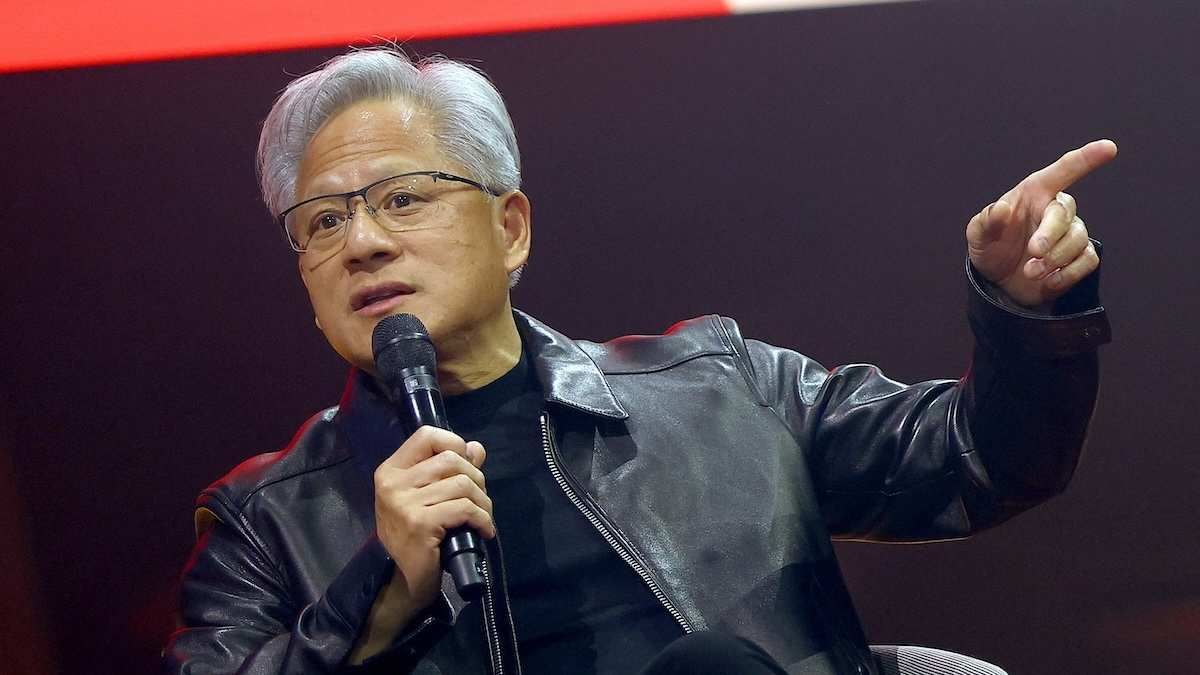
US national security and the Nvidia honeypot scandal
Over the weekend, Jensen Huang, CEO of the $4 trillion US microchip manufacturer Nvidia, admitted to an affair with a woman thought to be a Chinese spy. Three immediate questions arise, each with huge implications for US national security, the shape of the “AI race,” and US-China relations. First, did Huang’s paramour influence his long-standing efforts to lobby Donald Trump (so far unsuccessfully) to loosen restrictions on advanced microchip exports to China? Second, did she access any sensitive trade secrets or other national security information? And lastly, what did the US government know and when? US officials reportedlyvoiced concern about Huang’s affair months ago, but no overt action was taken. Adding to the drama — Trump is set for his next high-stakes meeting with Chinese President Xi Jinping next week. Trump has so far publicly stood behind Huang. Beijing denies that Huang’s lover was a spy.
Israeli president taps Netanyahu rival to form government
Israeli President Isaac Herzoggave former IDF chief Gadi Eisenkot the first chance to form a new government after elections last month left neither him nor current Prime Minister Benjamin Netanyahu with a clear path to power. Eisenkot now has up to six weeks to secure the support of at least 61 lawmakers in the 120-seat Knesset before the task passes to Netanyahu. Building a coalition won’t be easy. Three of the four Jewish parties Eisenkot depends on oppose the inclusion of Arab parties, whom Eisenkot also needs to form a government. These Arab-led parties won a record 19 seats, making them the election’s unlikely kingmakers. But while he needs their support, Eisenkot has his own conditions for Arab parties he invites to join his coalition, including explicitly labeling Hamas as a terrorist group – which at least one Arab party, Ra’am, has declined to do.
Myanmar to hold special elections
Myanmar’s military government announced plans to hold special elections in April to fill parliamentary seats left vacant after fighting prevented 67 of the country’s 330 townships from participating in last year’s election. Myanmar has been gripped by civil war since 2021, when the military junta overthrew the country’s first democratically elected government. But the April elections aren’t likely to be free or fair, as the military government has banned all opposition parties. Last year, the military-backed Union Solidarity and Development Party won more than 90% of parliamentary seats. The latest vote is another attempt by the junta to bolster its legitimacy on the world stage. And the strategy may be working. Several regional governments have hosted leader Min Aung Hlaing since he was elected as president last year, and the United States has expressed interest in deepening ties with Myanmar, partly to gain access to the country’s rare earth deposits.