
Skip to content
Search

Latest Stories

The United States will no longer play global policeman, and no one else wants the job. This is not a G-7 or a G-20 world. Welcome to the GZERO, a world made volatile by an intensifying international battle for power and influence. Every week on this podcast, Ian Bremmer will interview the world leaders and the thought leaders shaping our GZERO World.

Presented by

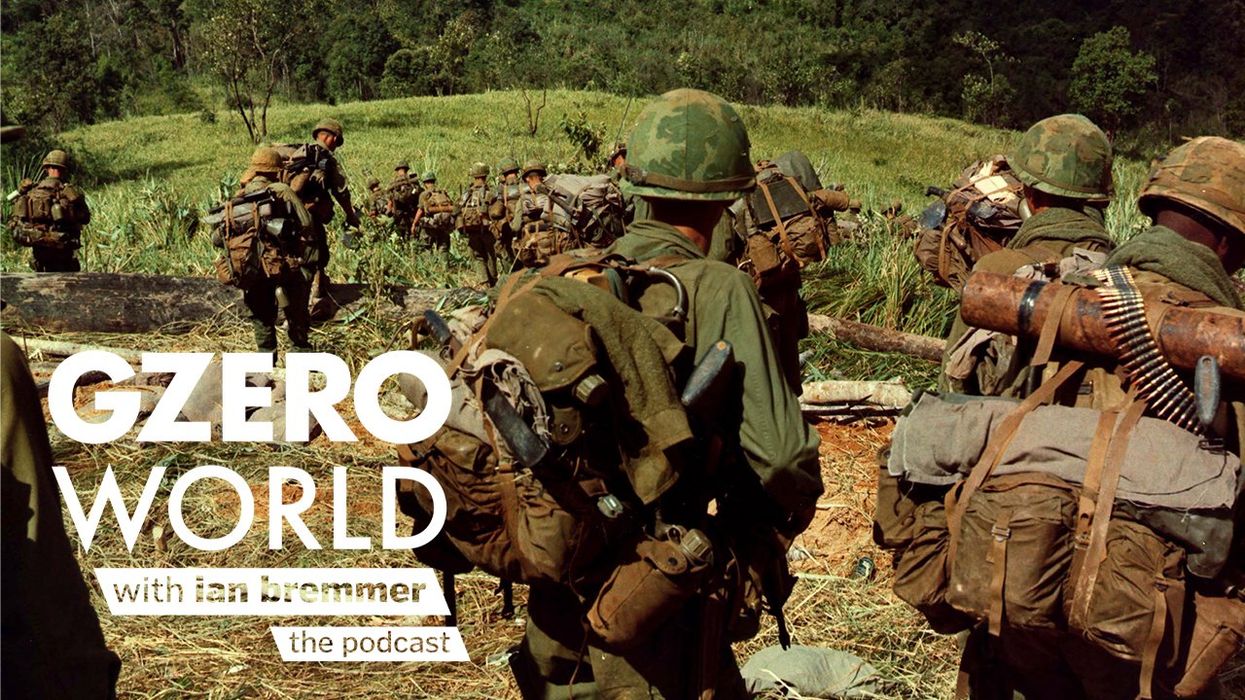
American soldiers trek through dense jungle terrain during the Vietnam War, carrying heavy packs and weapons. Text art reads "GZERO World with Ian Bremmer – the podcast."

Revisiting the Vietnam War 50 years later, with novelist Viet Thanh Nguyen and author Mai Elliott

Listen: Two authors with personal ties to the Vietnam War reflect on its enduring legacy and Vietnam’s remarkable rise as a modern geopolitical player.

Transcript

Listen: It’s been 50 years since the fall of Saigon, but the impact of the Vietnam War still reverberates across generations and continents. On the GZERO World podcast, Ian Bremmer speaks with Pulitzer Prize-winning author Viet Thanh Nguyen and historian Mai Elliott—two writers whose lives were shaped by the conflict. Nguyen, author of the bestselling book and TV series "The Sympathizer," recounts growing up in a tight-knit refugee community in California, where “melancholy, rage, anger, bitterness, sadness—the whole gamut of emotions” defined the postwar experience. Elliott, who interviewed insurgents during the war, came to see its human cost up close, saying, “I didn’t care who won the war by the end of it—I just wanted it to stop.”


But the episode is not just about the past. It’s also about Vietnam’s present and future. The country has become one of Asia’s fastest-growing economies and most strategically important players, carefully navigating a relationship with China and the United States. “If Vietnam gets too close to China, it could lose its country,” Elliott explains. “Too close to the US, and it could lose its regime,” Nguyen adds that while tensions remain between the Vietnamese state and its diaspora, Vietnam’s diplomatic pragmatism is rooted in a thousand-year history of resisting Chinese domination while embracing growth opportunities.

As Washington and Beijing compete for influence in Southeast Asia, Vietnam is charting its path—one shaped by memory, resilience, and the long shadows of war.

Subscribe to the GZERO World Podcast on Apple Podcasts, Spotify, Stitcher, or your preferred podcast platform, to receive new episodes as soon as they're published.
Next Page

listen on:

More from GZERO World Podcast

The UK a decade after Brexit, with Rory Stewart

Ten years ago, Britain voted to leave the European Union in one of the most consequential political decisions of the 21st century. Supporters promised greater sovereignty, stronger economic growth, and a more independent future. Instead, Brexit ushered in a decade of political upheaval, economic uncertainty, and a fundamental rethinking of Britain's role in the world.

Keep reading... Show less

Ten years after Brexit, former UK cabinet minister Rory Stewart joins Ian Bremmer to examine the referendum's lasting impact on Britain's economy, politics, and place in the world—and why the UK is... More >

Lebanon's best chance for peace, with Kim Ghattas


While the world’s attention has focused on the Strait of Hormuz and the escalating conflict between the United States and Iran, another potentially transformative front has opened in Lebanon. Israeli attacks against the Iranian-backed group Hezbollah have left more than 4,000 people dead and displaced over a million. Now, a fragile ceasefire has raised a question diplomats have struggled with for decades: Can Hezbollah actually be disarmed?

Keep reading... Show less

As Hezbollah’s power weakens and Israel occupies parts of southern Lebanon, could the country finally reclaim its sovereignty? Or is it headed toward another war? Journalist Kim Ghattas joins Ian... More >

Inside Ukraine's strategy to pressure Putin, with Dmytro Kuleba

For more than four years, Russia has wagered that it can outlast Ukraine. The Kremlin has more troops, more resources, and a greater tolerance for casualties, betting that Kyiv — and its Western allies — will eventually lose the will to keep fighting.

But that assumption is being tested. Ukraine is carrying out increasingly sophisticated strikes deep inside Russian territory, forcing Moscow to defend military bases, energy infrastructure, and even symbolic strongholds like Crimea. At the same time, NATO support has strengthened, Europe is expanding its defense cooperation with Kyiv, and President Donald Trump has struck a noticeably warmer tone toward Ukraine than he did just months ago.

Keep reading... Show less

Ukraine is bringing the war to Russia, challenging one of the conflict's biggest assumptions: that time is on Vladimir Putin's side. Former Ukrainian Foreign Minister Dmytro Kuleba joins Ian Bremmer... More >

The human cost of Iran's war, with Yeganeh Torbati

Iran’s government emerged from the war with a powerful new story to tell: it withstood attacks from the United States and Israel, kept its grip on power, and gained fresh leverage in the region. But that is not how the conflict looks from inside the country.

For ordinary Iranians, the conflict has brought more fear, deeper economic pain, and little sign that the political change many hoped for is any closer. The protest movement that shook the country has been pushed underground by a brutal crackdown, while the government uses internet restrictions to make it harder for people to organize, communicate, and show the world what is happening.

On the latest episode of the GZERO World podcast, Ian Bremmer speaks with New York Times Iran correspondent Yeganeh Torbati about life inside Iran during the war. They discuss why Tehran feels more emboldened, how ordinary people are navigating repression and a worsening economy, why some Iranians feel betrayed by Donald Trump’s promises of support, and whether the frustrations that drove millions into the streets could eventually erupt again.

Iran’s regime has survived the war, but ordinary Iranians are still living with fear, repression, and a collapsing economy. Yeganeh Torbati joins Ian Bremmer to explain what comes next for the people... More >

GZERO Podcasts

Ten years after Brexit, former UK cabinet minister Rory Stewart joins Ian Bremmer to examine the referendum's lasting impact on Britain's economy, politics, and place in the world—and why the UK is... More >

Listen: What does global energy transition look like in a time of major geopolitical change, including rebalancing of trade? In this special episode of "Energized: The Future of Energy,” host JJ... More >

Creating artificial human retinas in zero gravity. Mining rare minerals on the moon. There seems to be no limit to what could be possible if we continue to take our more important industries to... More >

Saudi Arabia, Turkey, and Pakistan on a Friday signed a joint defense agreement that characterizes an attack on one as an attack on all.... More >

In this episode of The Ripple Effect: Investing in Life Sciences, host Dan Riskin speaks with Patrick Horber, President of Novartis International, and David Gluckman, Vice Chairman of Investment... More >