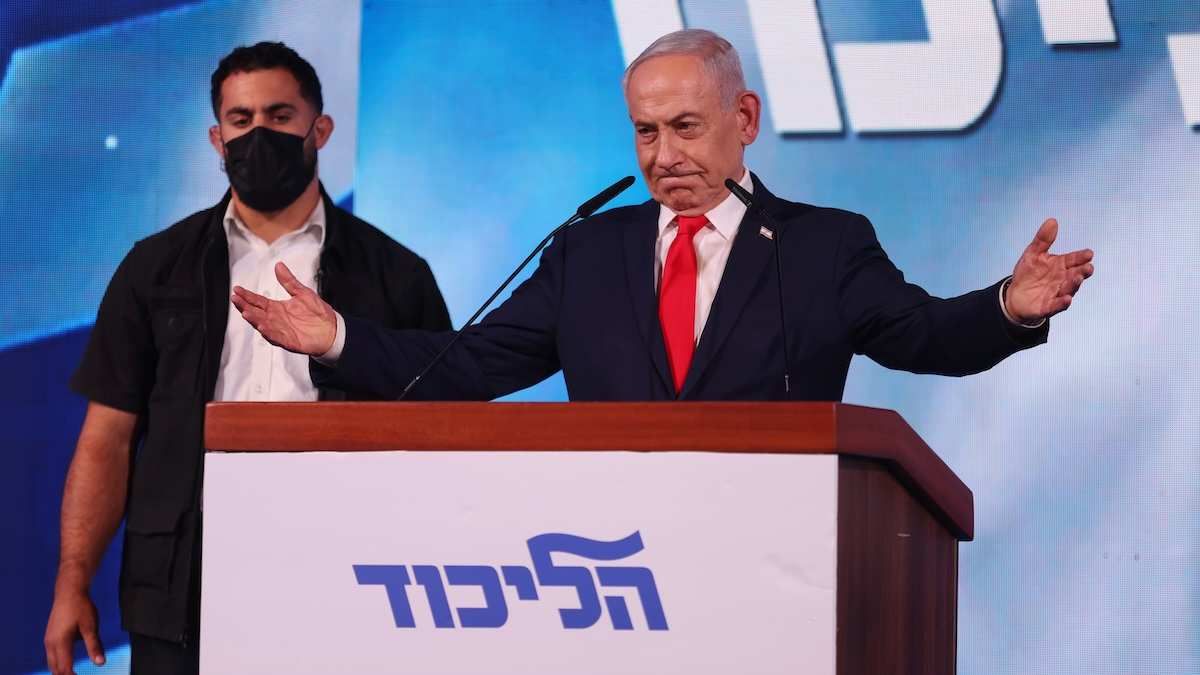
Israelis turned out in droves on Tuesday for an election billed as one of the most consequential in the country’s history – and they still don’t know who won.
About 77% of Israel’s eligible voters cast ballots, the highest in more than two decades, to decide whether to give Prime Minister Benjamin Netanyahu and his coalition another term or hand power to a loosely organized opposition led by former IDF chief Gadi Eisenkot.
Most votes are counted, and no clear winner has emerged. As it stands, results show that Netanyahu’s bloc will likely win about 54 seats, Eisenkot’s about 48, and the two Arab parties are expected to win the remaining 18 or 19 seats. With no clear winner, Israel looks to be in political gridlock.
What happens next? First, more vote counting. Official results will likely not be complete until Friday. But then comes the complex task of forming a government.
In Israel’s political system, a party needs support from at least 61 lawmakers to govern. Once the results are finalized, the Israeli president will task the candidate most likely to command a majority with forming a government. But both Netanyahu and Eisenkot face hurdles to creating a majority. They need agreements – and potentially to make significant policy concessions – with other parties, but deep ideological differences make that difficult.
That could leave Arab parties with a pivotal role. Arab citizens make up roughly a fifth of Israel’s population, and they turned out in record numbers on Tuesday, with turnout in most Arab-majority cities up five percentage points from 2022. The two main Arab-led parties, Ra’am, a conservative Islamist party, and the Joint List, a broad alliance of center and center-left Arab parties, could win a potential record 19 seats, up from 10 in the outgoing parliament.
But neither Netanyahu nor Eisenkot is eager to work with them. For Netanyahu, Arab party leaders rallied supporters to oust him, and joining forces with them would risk alienating his far-right coalition partners. For Eisenkot, he would likely have to compromise on security, foreign policy, and policing in Arab cities to gain their support, potentially driving away his own allies.
“There is a bold scenario where Eisenkot will present a minority government to get a vote of confidence in the Knesset,” says Arie Kacowicz, professor of international relations at Hebrew University of Jerusalem. “But he needs the active support of at least one, if not two, Arab parties.”
If neither side forms a majority, Israel could head to another election, with Netanyahu remaining in power as a caretaker prime minister in the meantime. It wouldn’t be unprecedented: Israel held five elections between 2019 and 2022 because of a similar deadlock.
What does this mean beyond Israel?A prolonged political stalemate could complicate Israel’s response to its foreign policy challenges – from Iran, to Hezbollah in Lebanon, to Hamas in Gaza. Netanyahu might remain in office, but as a caretaker prime minister with limited authority and certainly no mandate to govern. That could make major diplomatic and security decisions harder, particularly as Israel tries to repair strained relationships abroad with Europe and other former allies. Regardless of who, if anyone, forms a government, they might be distracted by domestic politics and worried their coalition might fall apart.
For now, Israelis have cast their ballots. But they may have to wait a while to learn who will lead them.