

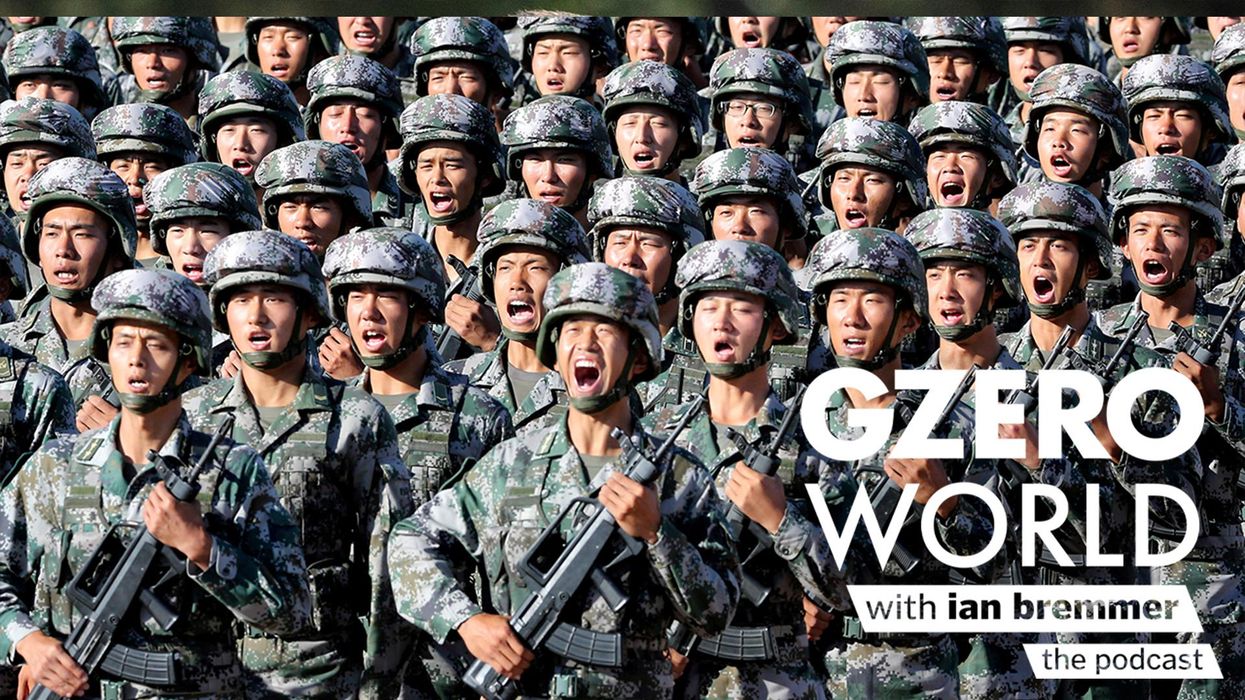
Podcast: How a US-China war could happen: Warning from ret. admiral James Stavridis
Listen: How close is the world to all-out-war breaking out between United States and China? According to US Admiral James Stavridis (Ret.), who served as Supreme Allied Commander to NATO, those odds are higher than many would like to admit. In fact, Stavridis says, the US risks losing its military dominance in the coming years to China.
TRANSCRIPT: How a US-China war could happen: Warning from ret. admiral James Stavridis
Jim Stavridis:
I feel the United States waking up to this, if you will, looming tower of losing military superiority, which we still enjoy. I think if we pay attention to the challenges that are coming, if we understand how determined China is, we have time to maintain our military edge.
Ian Bremmer:
Hello and welcome to the GZERO World podcast. Here you'll find extended versions of the interviews from my show on public television. I'm Ian Bremmer, and today we're talking about the likelihood of a military conflict between the United States and China.
My guest today says it may happen sooner than you think, and he's worried about America's chances. But what does he know? He's just a retired four star admiral and the former supreme allied commander of NATO. Jim Stavridis joins the show. His new best-selling novel "2034," depicts an all-out war between the United States and China in the year, you guessed it, 2034. The book more five-alarm-fire than cautionary tale. Let's get to it.
Announcer:
The GZERO World podcast is brought to you by our founding sponsor, First Republic. First Republic, a private bank and wealth management company, places clients' needs first by providing responsive, relevant, and customized solutions. Visit firstrepublic.com to learn more.
Ian Bremmer:
Admiral Jim Stavridis. He is former supreme commander of NATO and his new book "2034" on the New York Times bestseller list, number six. Congratulations to you, Jim.
Jim Stavridis:
Thanks, Ian. In fiction, you can really splash some paint all around the canvas. It's kind of fun.
Ian Bremmer:
You do that. You say that we're heading to a war between the United States and China and that we've basically lost military dominance in the world by 2034. How likely do you think that really is?
Jim Stavridis:
First of all, people say to me sometimes, oh Admiral, you've written this book of predictive fiction. No, this is a book of caution. It is a cautionary tale. To answer the question, I think, I feel, the United States waking up to this, if you will, looming tower of losing military superiority, which we still enjoy. And I think if we pay attention to the challenges that are coming, if we understand how determined China is, we have time to maintain our military edge. I think in all probability we will maintain that edge, but I worry about it. Hence, "2034" is a cautionary tale in that regard.
Ian Bremmer:
I get the sense that what you're really saying is that unaddressed, the present trajectory is one where 2034, if it doesn't become reality, still, it will probably define the balance of power.
Jim Stavridis:
That is absolutely correct and a principal reason for that, and you know this well Ian, is that the Chinese are spending very intelligently in their defense budget. They're very focused on offensive cyber, on militarizing space, on using quantum computing, which is moving quickly and will readdress the whole idea of cybersecurity, on hypersonic cruise missiles. The list goes on and on. They are spending cleverly. It is integrated with their overall geo-economic strategy, one belt, one road. They are formidable and they will continue to be so.
Ian Bremmer:
Now, I mean there's some pretty scary stuff in this book. You've got sunken battleships, you've got tactical nukes going off. Talk a little bit about how in your book, the Chinese government both achieves and exploits profound military unipolar advantage in a near future world.
Jim Stavridis:
First of all, a number of our mutual friends have said to me, Ian, "Oh, Stavridis, you wrote a really good book. You only got one thing wrong, and it's the date." This is coming sooner, that the potential for a war is actually nearer than 2034. Let's hope not. The way that China will move forward is the old-fashioned way. They'll educate. They're pumping out huge numbers of people with advanced degrees. They're investing government resources into the kind of research, the R&D that we should be doing more of here in the United States.
They are seeking further collaboration with Russia, which is a prime high-end military technical nation. So they're doing all the things I would do if I were in their position to increase their capability, and here's the big advantage they have. They're a streamlined, shall we say, system of government. When they want to direct resources, they're not in a huge argument with a parliament or a congress about where things are going to go. We need to wake up to this and frankly, I'm encouraged by some of what I'm seeing on Capitol Hill. This is increasingly a fairly bipartisan issue to look at the kinds of things we need to do if we're going to continue to compete with China.
Ian Bremmer:
How obsolete is our military becoming every day compared to what the Chinese are spending on?
Jim Stavridis:
This is not an on and off switch. It's not a simple bipolar moment. In other words, the choices are not, let's just continue to build huge legacy platforms or let's stop building those completely and just go after the new, if you will, high-tech things China's doing. Think of it as a rheostat, like the dimmer in your dining room, and right now you are correct.
I would say in really broad strokes, 75% to 80% of the R&D procurement is still going to legacy systems, big land armies, tanks, aircraft carriers, and there are scenarios in which those have real facility, but we better start moving that rheostat, we better start moving that dial toward the higher end technologies we spoke about a moment ago because I assure you China has already done so. See paragraph one where we started this conversation about a streamlined system. They get to make decisions and move out in ways that we are retarded from doing by the messiness, as wonderful as it is, of our democratic system.
Ian Bremmer:
Now, if it's 75 or 80 total spending the world's largest defense budget by far in the United States on legacy systems. If you could snap your fingers, if you were looking at, if you were China and you're saying here's what America should be doing, what percentage should that be today?
Jim Stavridis:
Let me clarify one point, it's an important one. 75% to 80% of the budget, the 700 billion as you well know, goes to personnel and they're very expensive because we have an all volunteer force. Sometimes when people want to compare US budget, 700 billion to China's budget, probably 300 billion, don't forget they don't pay those huge personnel costs.
Ian Bremmer:
And their labor costs are rather low compared to those the US, yes.
Jim Stavridis:
Precisely my point. It really is apples to apples here, and to answer your question of that disposable part of our budget, 75% to 80% of R&D and procurement, the things we buy, the stuff, the military kit, that's still going to legacy systems. I think I would throw that dial to 50/50 like today, and I think over time you're going to want to move it toward 70% on these advanced and emerging systems, Ian.
Ian Bremmer:
We talked about the fact that the United States government is messy and not streamlined/ authoritarian, but beyond that, some of the greatest advances in all of these new technologies is the private sector, right? If the United States were truly to address this in the next 15 years, what does that mean for the role of the most important tech companies in the United States?
Jim Stavridis:
Think of an iceberg. The government is the little tip of the iceberg up there. The mass of the iceberg, the capability of America is down there in the private sector. We're going to have to incentivize, we're going to have to cajole. We need thought leaders from both sides. It'll be an effort to do this.
What will help crystallize this, I think in the minds of Americans over time, is watching China, watching what they're doing on the international scene. From cracking down on Hong Kong, to imprisoning Uyghurs, to pressurizing Taiwan, to, in the high Himalayas, going after borders and boundaries of India, pressuring our allies like Australia on trade relations. The list goes on and on. It's a looming tower. We better wake up.
Ian Bremmer:
Now to go back to what that means for the tech companies. I mean, does that mean for you that a company like Apple, which is presently making a big piece of the iPhone in mainland China, Tesla, which is doing a lot of its advanced electric battery development with a Chinese company, does that mean that those models are just not going to work in a decade's time?
Jim Stavridis:
I don't know, and I don't think anybody does, but I will tell you this. We need a very hard, fast look at what are the critical supply chains, where are they located, which ones absolutely must be onshored or at least redundancy created? By the way, you mentioned tech appropriately. I'd say medical supplies, biotech is another area that would benefit from some scrutiny.
But you and I have had this conversation. I think it would be a mistake to simply break relations with China and walk away and create, in effect, a bipolar world. That's not what we need. The way I think of it, Ian, is we need to bend the relationship with China on some of the topics I mentioned a moment ago, including their claim of ownership of the South China Sea. We're going to have to bend it, but we want to avoid breaking it all together because down that path doth a war lie.
Ian Bremmer:
Now, on the other side of how much we need to do on the tech front, you have also called recently for the primitivization of US defenses. Explain a little bit what you mean by that.
Jim Stavridis:
Let me put it in nautical terms again. When I came out of the Naval Academy 1.2 million years ago in the early eighties, I was quite good with a sextant and I knew how to use a nautical almanac and use paper charts and navigate my ship. By the time I was in the middle of my career, Ian, commanding destroyers, being the commodore of a destroyer, like the scene that opens "2034," the novel. By that time, we didn't pay much attention with that. Nobody really used sextants. We were all GPS, like we all drive our cars around today.
Today, the Navy is going back to ensuring every officer who stands a bridge watch knows how to use a sextant. It's a long way of saying we need a plan B because these exquisite systems upon which we have come to rely so deeply, because they were invulnerable fighting the Taliban or fighting Al-Qaeda, they're not invulnerable anymore. We need still those exquisite systems, but we need a plan for when and if they are attacked. What's plan B?
And in the novel, it's no coincidence, the first aircraft you encounter is a sixth generation joint strike fighter, which is forced down over Iran mysteriously. By the end of the novel, you're watching an old F/A 18 Hornet, a pretty simple aircraft conducting the defense of the nation, so we need a plan B.
Ian Bremmer:
I want to push you on this because of course, when we talked about the Soviets in the day, we didn't do, in a sense, a plan B. We didn't do a missile defense shield that would be effective against nukes because we knew that there was no way to engage in mutual deterrents when you had that level of extraordinary offensive firepower from a nuclear perspective. We had mutually assured destruction.
Now, when we talk about the Chinese, when we talk about offensive cyber capabilities in the US and China and Russia to a degree dominating those capabilities for which there really are no defenses, why don't we want to lean into that? Why don't we want a mutually assured cyber destruction where both sides are so capable that we know that shipping out some sextants is not going to actually do it?
Jim Stavridis:
We 100% want to, as you put it, lean into this, and we ought to look back at the history of the Cold War and re-engineer how we got from nukes going off in Nagasaki and Hiroshima to the very finely tuned systems and norms of international law and treaties dealing with nuclear weapons. There's an entire story there, a narrative that I believe, I suspect you believe could be profitably applied in the world of cyber. Because these systems are beginning to approach that level of capability.
So that's if you will, Ian, the strategic track, and that I think is work that is underway to some degree in think tanks and in policy papers, but it's got nowhere in the real world, and I would put that pretty high on my list in terms of US, China, and Russia relations.
There is also a tactical side to this, which gets us back to sextants and old Hornets that can be pulled out of the boneyard if necessary. That is different than the Cold War. We didn't have that because we didn't have the level of risk to the command and control networks that we do now. The Soviets could jam a little bit. They didn't have the ability, however, to really go after command and control the way that China can today. There's a strategic side and a tactical side.
Ian Bremmer:
There are tactical nukes going off in "2034" and the ultimate taboo, thankfully something we haven't had to deal with since the end of World War II. What was going on in your mind when you said I'm actually, I'm going there in this book.
Jim Stavridis:
First and foremost, it's the ultimate cautionary tale, right? Is to make the point that these nukes, tactical nukes are in hand. Secondly, based on a lifetime in the military, and as a very senior officer, it is not inconceivable to military planners that, at one point or another, we might use a tactical nuke. As you well know, during the Cold War, there were always war plans that included use of tactical nuclear weapons.
The worrying strain, in my view, between the US and China in this conversation is that one side or the other may decide that we absolutely need it because we're over-matched and we'll use it at sea. And that will be a kind of barrier, a kind of cap in the ladder of escalation. It is very hard to control the ladder of escalation, especially when you pull a nuclear weapon out of the holster.
Ian Bremmer:
Where do you think we are closest to major military confrontation right now?
Jim Stavridis:
Taiwan, and I think that it is increasingly a concern, and don't take my word for it. How about an active duty four star admiral, who is the combatant commander for Indo-Pacific command in charge of all US military forces, army, navy, air force, marines, coast guard, etc. through that vast space. His name is Phil Davidson. He is very concerned about the possibility of a Chinese attack, an invasion if you will, of Taiwan in the next six years.
Phil Davidson:
What you're seeing China do in the region, some of the malign military actions they've taken in and around Taiwan are indicative that China's pace is quickening and we need to be postured to prevent that quickening from happening.
Jim Stavridis:
He's looking at all the high-grade intelligence imaginable. He wakes up every morning trying to figure out what China's doing, and he's testifying in open source that he's very concerned about something as soon as the next six years. That was quite remarkable to me and syncs with my own thinking.
Ian Bremmer:
If you were to think about what a trip wire in Taiwan looks like, take us through that.
Jim Stavridis:
If China decided that they wanted to move now against Taiwan, one aspect of that perhaps would be their feeling that, well, the US is very distracted. We're coming off this terrible 6th January event. Our Congress is split right down the middle. I think it would be a miscalculation on the part of the Chinese, but they may calculate that now is the moment. If they did it, here's how I think they would do it.
First of all, I would guess there are significant, if you will, sleeper cells already embedded in Taiwanese society. They would link up with a Chinese special forces. They would take control of airfields. They would have an airlift that would literally leap over the Taiwanese defenses in sea and air. They would flood the zone with ships and submarines on the far side of Taiwan, presuming that we would try and come in and assist Taiwan. All of this would be a miscalculation, but I think it is not impossible to conceive of that over the next few years.
Ian Bremmer:
It's Admiral Jim Stavridis, his new book "2034." Thanks so much, Jim.
Jim Stavridis:
Thanks, Ian.
Announcer 2:
That's it for today's edition of the GZERO World podcast. Like what you've heard, come check us out at gzeromedia.com and sign up for our newsletter Signal.
Announcer 1:
The GZERO World podcast is brought to you by our founding sponsor, First Republic. First Republic, a private bank and wealth management company, places clients' needs first by providing responsive, relevant, and customized solutions. Visit firstrepublic.com to learn more.
Subscribe to the GZERO World Podcast on Apple Podcasts, Spotify, Stitcher, or your preferred podcast platform to receive new episodes as soon as they're published.