For nearly 80 years, two establishment parties have dominated/monopolized Germany's electoral politics.
Since 1949, the center-left Social Democratic Party (SPD) and a conservative coalition uniting the Christian Democratic Union and the Christian Social Union (CDU/CSU) have anchored every single government – first in West Germany, and then in post-1989 reunified Germany. They currently govern in an awkward coalition.
But over the past three decades their power has slipped remarkably. In 1994, the CDU-CSU and the SPD won nearly 80% of the vote. By 2025, their combined share fell below 50%.
Trends across Europe. The same story has played out across Europe since the mid-1990s.
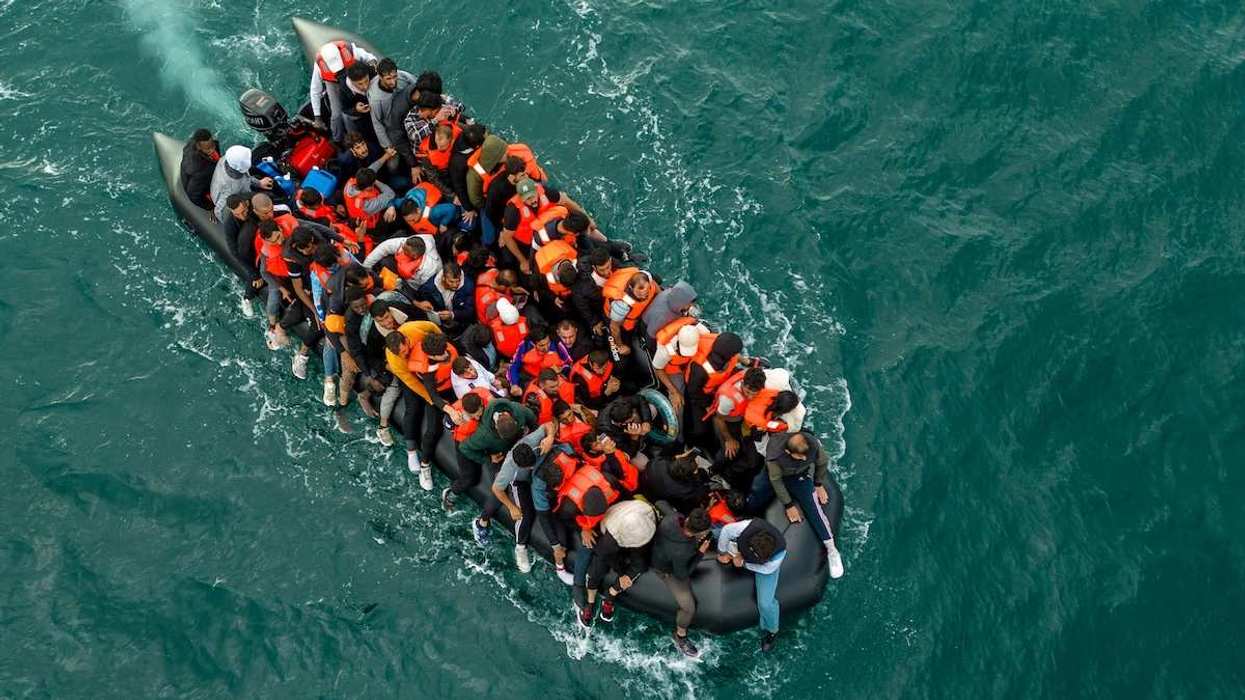
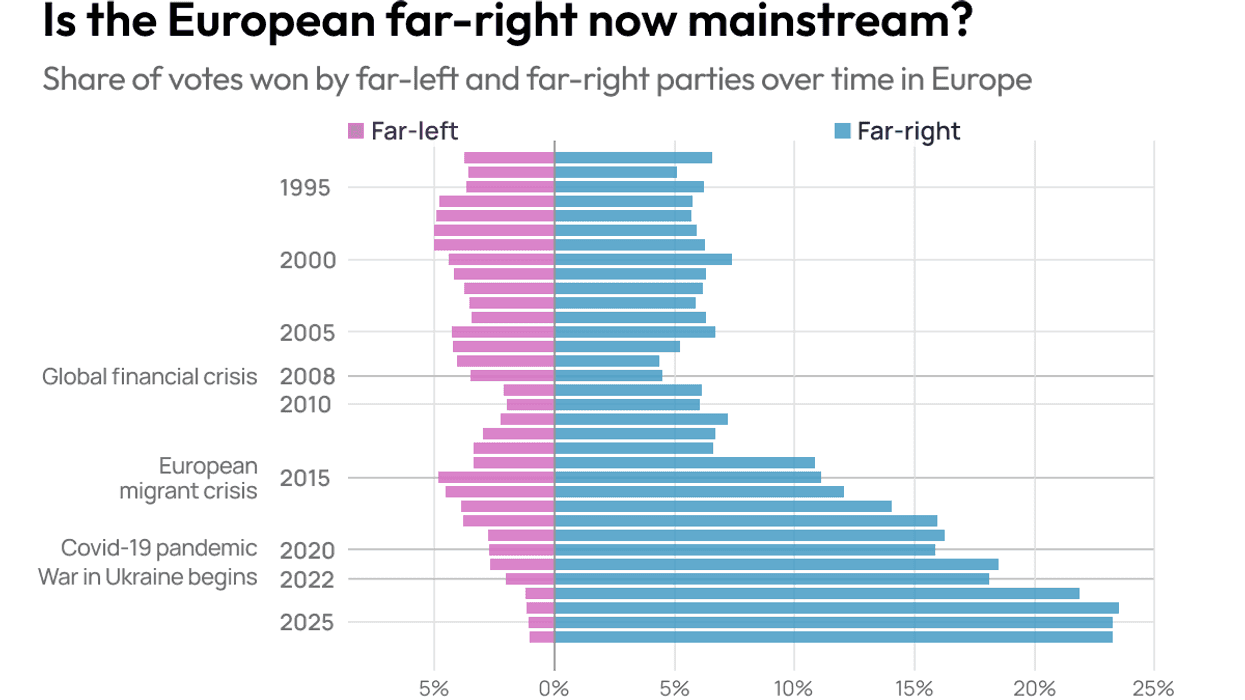
In France and the UK, centrist parties have lost roughly 30% since then. And in Austria, the Netherlands, and Sweden, centrist parties have lost support by double digits. Meanwhile, populist parties, particularly on the far-right, are surging. As we showed in our Graphic Truth last week, far-right parties won less than 7% of the vote across the continent twenty years ago, but now take home close to a quarter. Economic malaise, backlash over immigration after the 2015 migration crisis, deindustrialization, and a widening divide between urban elites and everyone else have fragmented the political landscape.
As Eurasia Group, GZERO’s parent company, noted in its 2026 Top Risks report, “the hollowing out of Europe’s political center has been a decade in the making.”
But the collapse of the center is particularly striking in Germany, Europe’s largest economy. The far-right populist party, Alternative for Germany, has exploded from a five percent share of the vote since its founding in 2013 to over 20% last year. Much of it has to do with anger over immigration. In 2015, for example, Germany opened its doors to 1 million refugees from the Middle East.
But Germany also faces slowing growth, high fuel prices, and a rising cost of living. The war in Ukraine and manufacturing competition from China have also strained the economy. And as the AfD notches victories in state elections, more Germans now say they’d rather support the party than the CDU.
The political center has also gotten crushed from the left. In liberal-leaning Berlin last month, the far-left Die Linke, which advocates for expanding social welfare and wealth distribution, finished with nearly 26%, tapping into young Germans’ disillusionment with the establishment. The CDU trailed with 19%.
What does it mean in the long run? State election results don’t directly affect Germany’s foreign policy – at least not yet. Merz won’t face a leadership challenge until at least 2027, and federal elections aren’t due until 2029. But the results weaken Merz’ government in the meantime, while giving the AfD more time to push its platform – large-scale deportations of migrants, closer ties with Russia, ending support for Ukraine, and skepticism of the EU. They also put pressure on Germany’s longstanding “firewall,” under which mainstream parties refuse to work with the AfD.
“You are going to have a period of weaker and weaker German governance,” Ian Bremmer predicted in a recent Quick Take.
That matters outside of Germany too. Germany is taking a larger role in Europe’s defense as fears grow around Russian aggression toward NATO. Meanwhile, France faces its own political fragmentation, with Marine Le Pen’s far-right National Rally supporting a hard line against immigration, more sovereignty from the EU, and ending aid to Ukraine, and leading polls ahead of the 2027 election. In Italy, Giorgia Meloni – elected on a hard-right platform – has lost ground to a challenger from even further to the right who has attacked her pragmatic relationship with the EU and her support for Ukraine.
Germany’s political center is in free fall. Other centrist parties and coalitions in Europe are not far behind. What comes next may be something the EU and Ukraine can’t afford.