This week, I explain why the Iran war is more likely to escalate than de-escalate, talk to Rahm Emanuel about whether Trump can end it without losing the Gulf, and answer your question on how Americans feel about the conflict. Plus, your weekly rec from my dog Moose.
Let’s get to it,
- Ian
Trump's Iran climbdown wasn't an offramp
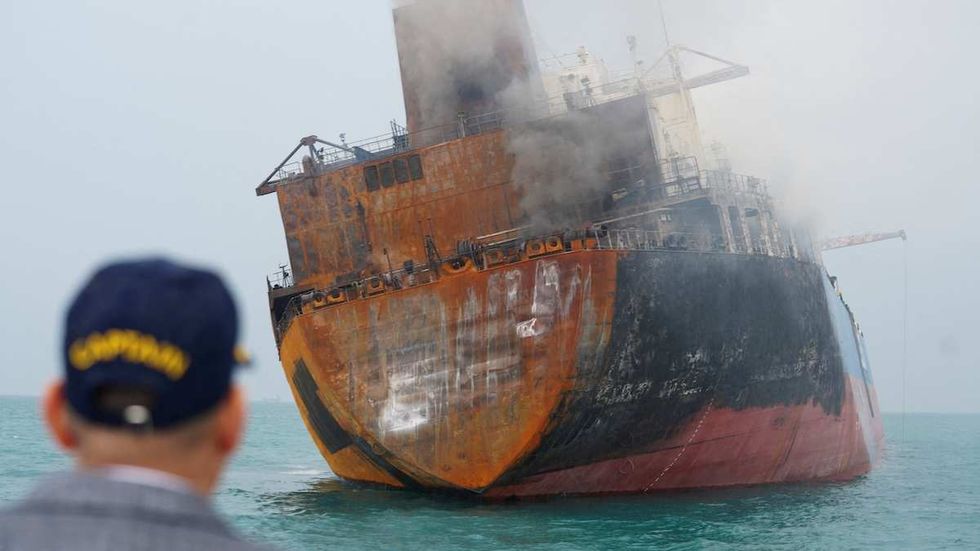
REUTERS/Mohammed Aty
Four weeks into a war nobody planned to still be fighting, President Donald Trump issued Iran an ultimatum: reopen the Strait of Hormuz within 48 hours or watch your power grid get obliterated. Iran said no and threatened to retaliate against desalination plants and other civilian infrastructure in Gulf countries. Trump must have found this credible because on Monday morning, he announced a five-day extension of his self-imposed deadline, citing "very good and productive" talks that Iran categorically denied had taken place.
Everyone rushed to interpret this as the much-awaited TACO moment – a vintage instance of Trump chickening out. Markets rallied accordingly and oil prices dropped sharply. (Traders who somehow knew Trump's climbdown was coming placed $580 million in oil bets moments before he posted it on Truth Social and netted over $100 million in profit within 20 minutes. So much for draining the swamp.)
But TACO was the wrong read. Trump didn't call off the war. He backed down on his Saturday threat because he never intended to make good on it, as following through would have unleashed hell on his Gulf allies. Trump's own advisers had been telling him for weeks not to issue time-bound ultimatums he couldn't enforce. He issued one anyway, and Iran called his bluff. The indirect channels – Jared Kushner and Steve Witkoff talking to Iranian Foreign Minister Abbas Araghchi, maybe some back-and-forth with parliament speaker Mohammad Bagher Ghalibaf – gave him cover to justify backing away from what was a genuinely awful idea. But there wasn't any there there to the talks and no movement toward a breakthrough agreement.
So the climbdown was good news. The bad news is that nothing else has changed.
The war continues. Israel and the US are still bombing Iran. Iran is still firing missiles and drones at Israel, Gulf states, and even the USS Abraham Lincoln on Wednesday. The Strait of Hormuz is still disrupted, even if Iran is allowing the passage of a small number of “nonhostile vessels.” And the US is deploying roughly 7,000 additional ground troops to the region – 2,000 paratroopers from the 82nd Airborne plus two Marine Expeditionary Units – set to arrive in the next few days and weeks.
Which brings us to the big question: Where does this go from here?
The decision is President Trump’s alone. He could stay the course – keep the bombing campaign going and hope that the regime will collapse or cave as its capabilities are destroyed further. But the fundamental problem remains: Iran won’t capitulate anytime soon – they have the firepower and the pain tolerance to stay in the fight for longer, and their whole strategy hinges on keeping pressure on the global economy until Trump is forced to de-escalate. The US and Israel have devastated its conventional military – killed much of its leadership, sunk its navy, cratered its missile production – but Iran retains control over Hormuz with asymmetric leverage that’s cheap to maintain and hard to counter. It doesn’t need battleships or even missiles to keep the strait under threat and markets spooked – just the occasional drone strike on a tanker, well within its capability even with its forces being degraded around the clock.
In fact, with oil near $100 and the US waiving sanctions on some Iranian crude, Tehran is making more money now than it has in a long time. India’s Reliance just bought 5 million barrels of Iranian crude at a $7 premium. Meanwhile, Trump is hemorrhaging politically. Gas prices are up roughly a third. Food costs are spiking thanks to fertilizer shortages. The number of American casualties can only go up. This is a war of attrition, and time is on Iran’s side: the longer it drags on, the worse it gets for Trump.
There are some people in the administration who recognize how economically damaging and politically unpopular this war is, and who fear the costs will only increase if it continues and casualties mount. There's real and growing pressure within the Republican Party and Trump's inner circle for this ultimatum’s five-day postponement to morph into a military pause and eventually a negotiated ceasefire.
This path is more plausible than it was a week ago. Indirect channels and direct backchannels are open, Pakistan is live as a potential venue for talks this week, and the US even sent Tehran a 15-point peace plan via Islamabad – the same nuclear, ballistic, and proxy concessions Washington was demanding before the war, plus new ones on reopening the Strait. Iran rejected the terms outright.
To say the two sides are far apart understates the problem. Trump wants zero enrichment, curbs on the missile program, proxies ended, and the strait reopened. Iran wants guarantees against future attack, reparations, and recognition of its right to enrich. Neither side is offering what the other demands, and neither trusts the other is serious about negotiations. Having been attacked twice before while talks were underway, the Iranians see the US troop buildup as proof that Trump's peace push is “just a ruse.” Trump’s camp rejects the accusation and insists the military option is just there to raise the cost of diplomatic failure. The problem is once you've already killed their leadership and bombed their military to bits, additional threats lose their leverage.
And from Tehran's perspective, why give in now, after they’ve already survived a month of war? The Iranians have shown they can wield their Hormuz leverage, and they believe time is on their side. The regime is weaker militarily but more emboldened and more certain than ever that it needs a nuclear deterrent. They have no reason to offer concessions today they wouldn't have made in February.
Trump could simply declare victory and go home. He’s done it before: last June, he claimed Iran's nuclear program had been "obliterated," then spent months calling it a threat. He could announce that Iran's navy is sunk, its missile factories in ruins, mission accomplished. Give the oil price shock seven months to fade before the midterms and move on to the next thing (Cuba?). Except this would mean abandoning half a century of US policy guaranteeing the free flow of oil through the Gulf. Iran’s regime would stay in place and retain the ability to threaten traffic through the strait, with Iranian officials already musing publicly about charging fees on tanker traffic. A weakened but more defiant and militarized Tehran would still have drones, missiles, 440 kilograms of highly-enriched uranium, and more motivation than ever to dash for a bomb. This “victory” would be hard to swallow and hard to sell – to Gulf states, to Israel, and to the American people.
Or he could escalate big in search of a decisive victory, deploying the ground forces that are currently en route to the region to try to reopen the strait by force. That could include seizing Kharg Island, Iran's main oil export terminal (you heard it here first), and striking or holding coastal positions along the strait. Forget the power plants – go directly for Iran's ability to export energy and threaten shipping. If Trump can't get the full Venezuela – a puppet regime – in the near term, maybe he can get a similar outcome in the long term by physically seizing control of the waterway and taking Iran’s oil.
This is the riskiest option by far. Iran's strike on Ras Laffan, the world’s biggest LNG plant in Qatar, already caused damage that will take 3-5 years to repair, bringing roughly 3% of global LNG supply. Iran fired a ballistic missile at Diego Garcia, 4,000 kilometers away. A Kharg seizure is the scenario most likely to push Iran toward targeting desalination plants and energy infrastructure across the Gulf in earnest. The expat populations that make the UAE function wouldn’t stick around for that. And there's no guarantee it would force Iranian capitulation. Marines seize the island, then what? If Iran refuses to negotiate, you're holding territory under constant drone attack with no exit plan.
Notably, the Gulf states are pushing Trump to escalate, even though they bear the greatest cost from Iranian retaliation. They didn't want a regime change war against Iran to begin with, fearing exactly the fierce response Trump claimed nobody expected. But now that the US has broken the geopolitical status quo, Saudi Arabia and the UAE want Washington to finish the job. That tells you how terrified they are of the alternative: a weakened but emboldened Iran with permanent leverage over the one chokepoint and value proposition – security – their entire economic model depends on. They're betting on short-term risk for long-term survival.
President Trump has never been a fan of boots on the ground, for good reason. But if the president becomes convinced the midterms are already lost – and the trajectory on immigration, affordability, and now this war all point in that direction – then what does he personally have to lose by escalating anymore? Most Americans want the war to end, but the MAGA base wants the war to be won. In that context, the managed retreat looks like weakness and delivers nothing politically. The dramatic gamble at least offers him the possibility of a decisive narrative win. It may not be in the national interest, but a risk-acceptant, legacy-maximizing lame duck like Trump has more to gain from rolling the dice than from cutting his losses.
Which is what makes escalation more likely than de-escalation, Monday’s climbdown notwithstanding. The continued bombing campaign, the carrier groups and 7,000 troops being deployed, the $200 billion in funding requested from Congress – everything Trump is actually doing, rather than what he's saying, suggests he’s building toward something bigger, not winding down. We won’t know for sure until all the additional ground forces arrive in early April, and he could change his mind at any moment. But the signs point in that direction.
So by all means, take the relief that Trump avoided disaster this week. But don't mistake the postponed ultimatum for an offramp. He may have backed away from one terrible decision, but it looks like he’s preparing to make a much more dangerous one.
_________
🔔 Be sure to subscribe to GZERO Daily to get the world's best global politics newsletter every day on top of my weekly email. Did I mention it's free?
Walmart’s $1 billion investment is strengthening associate careers

Chris, an Army veteran, started his Walmart journey over 25 years ago as an hourly associate. Today, he manages a Distribution Center and serves as a mentor, helping others navigate their own paths to success. At Walmart, associates have the opportunity to take advantage of the pathways, perks, and pay that come with the job — with or without a college degree. In fact, more than 75% of Walmart management started as hourly associates. Learn more about how over 130,000 associates were promoted into roles of greater responsibility and higher pay in FY25.
Can Trump end the Iran war without losing the Gulf?
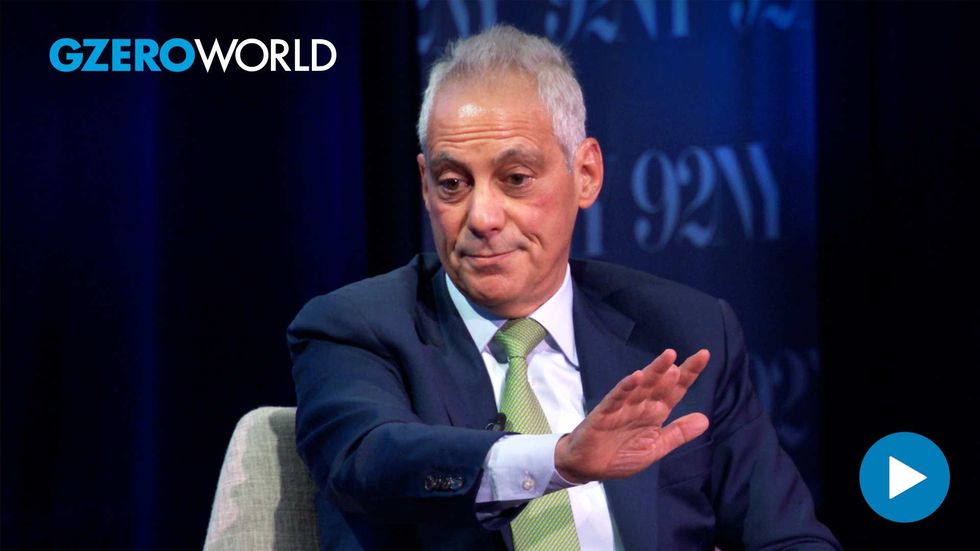
The Iran threat has shifted. Once limited to nuclear weapons, ballistic missiles, and support for regional proxies, Tehran now also holds veto power over the Strait of Hormuz, the world's most critical energy chokepoint. And that changes everything.
Politician and diplomat Rahm Emanuel joined me on stage at the 92nd Street Y in New York for a live taping of GZERO World to unpack the strategic mess Trump’s war has created in the Middle East. The Israelis instigated it, and they want the US to keep going. The Gulf states didn't want this fight in the first place. As Rahm put it, they were thriving under order and serenity – until they got sidelined. "You got a Qatari jet. We invested in all your family's different businesses and our voices are nothing," he said, channeling their frustration. The Israeli Prime Minister walks in, gets what he wants, and the Gulf doesn’t have a say.
But now that Iran’s been unleashed, those same Gulf countries are telling Washington: You started this, you ignored us, you have to finish it. But what does finishing it actually mean? For Rahm, it's simple and non-negotiable: "The Iranians cannot have a veto over the Strait of Hormuz. It's unacceptable." The question is whether Trump can pull that off.
Watch the clip here and catch my full interview with Emanuel in the latest episode of “GZERO World with Ian Bremmer,” also airing on your local public television station.
You ask, I answer

This week, you asked: How do Americans feel about the Iran war?
Here's my answer, in three bullets:
- Trump built his brand on ending wars. He ran twice on being the president of peace – he ended Afghanistan, pulled back on Ukraine, kept interventions small and tactical. That's what Americans voted for. Now he's asking for $200 billion, deploying thousands of troops to the Persian Gulf, and doubling down on a war of choice that's already costing US consumers. It's not what his voters signed up for.
- Iran wasn’t an imminent threat to the US. Trump's whole pitch has been that allies should do most of the lifting and foot most of the bill. That's the message on Ukraine, on Taiwan, on everything. But with Iran, we're spending the money, putting troops in harm's way, and taking much of the risk, even though this was fundamentally Israel's fight, not ours. The double standard is obvious.
- The politics are ugly, and they'll get worse. Trump's been good at reading where Americans actually are on the border, on trade, on making allies pay more. But a long, expensive war with American boots on the ground is a slap in the face to people who voted for him. If he doesn't find an offramp fast and declare victory, it's going to show up in the polls and at the ballot box.
Moose’s treat of the week

“Give a Little Whistle”by This American Life, a first-hand account from two ICE lawyers of how dysfunction and inadequate training have driven the chaos following ICE deployments at an agency that’s expanded by 120% in just four months. Worth a listen as ICE moves to rescue US airports from staffing shortages.
_________
Want to understand the world a little better? Subscribe to GZERO Daily for free to get your daily fix of global politics delivered to your inbox.