Video
Ian Bremmer: Coronavirus Global Developments & Outlook
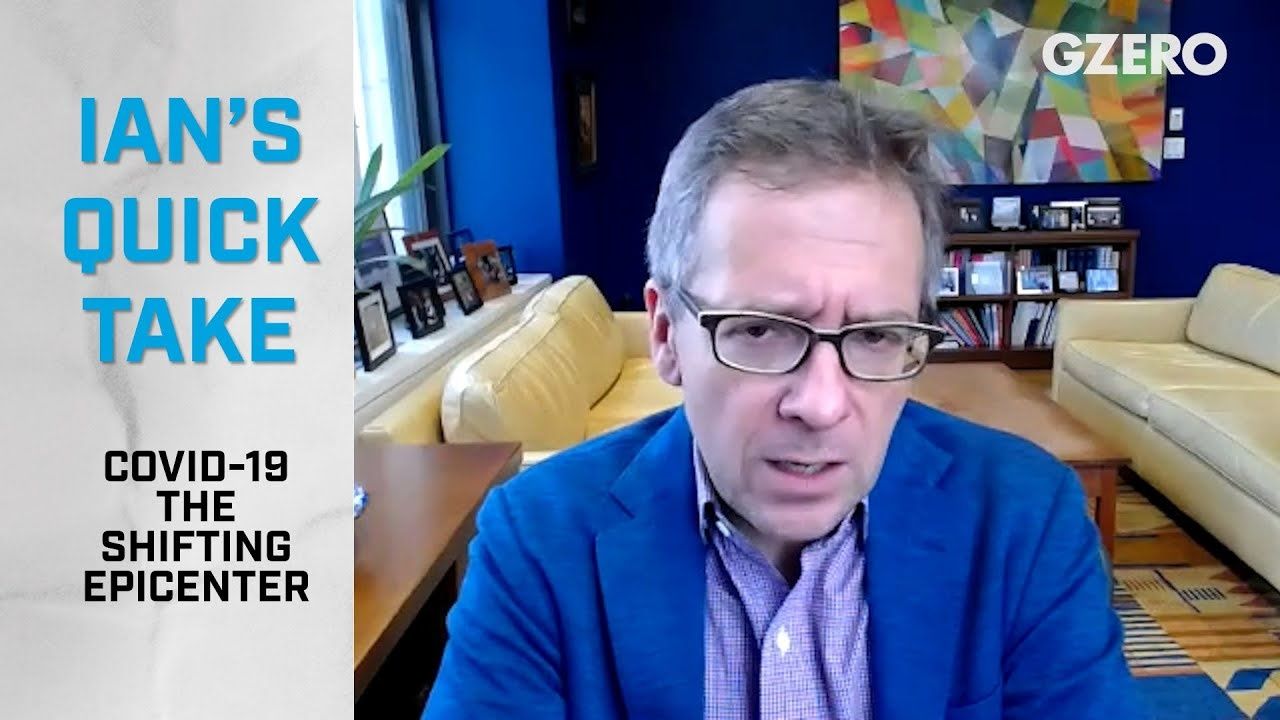
Ian Bremmer: Coronavirus Global Developments & Outlook | US, EU, Developing World | GZERO Media
This week began with a staggering Trump press conference. Doctors Fauci & Birx giving an expectation of 100,000 to 240,000 deaths in the US, presuming nationwide social distancing by the end of this week and hospitals don't get overwhelmed. You will be personally affected, with personal knowledge of people in hospital, killed by this disease.
Does the US end up more like Italy or more like South Korea? Washington State responding quickly with lockdown, improving health care capabilities is like South Korea. Parts of the US not under lockdown. Many states on the "periphery" of the mainline US economy. Some had later breakout of coronavirus. Some did not have political leadership.
Here in New York City, response was late. Had resources to attract federal, global support, buying critical equipment, pharmaceuticals and medical supplies to improve infrastructure. I expect 4 to 5X daily cases in NY, the next several weeks. The NY medical system may not have to triage patients away from ICU care. Unlikely for parts of southern FL, New Orleans, Georgia, other states. Some of US will feel like Italy, and other parts like South Korea.
Record levels of inequality not seen since the Gilded Age, before the Great Depression, grow dramatically. 10 million new unemployment claims in just 2 weeks. Reflected in broad expectations of US unemployment by the middle of this year. If we're roughly at 10% now, may get to 13% - 17%. Staggering numbers, priced into markets. Economic relief from the US government is adequate for the next 3 months, more money is likely.
This is where you give the highest marks for the US. Steve Mnuchin, the Secretary of Treasury, and Nancy Pelosi, Speaker of the House, worked together on an economic package allowing the US to effectively respond to the biggest economic shock of our lifetimes. If Obama and a Republican House, you would not have expected faster or better, on the fiscal side.
Health care response lacking coordination in the US, with governors bidding against each other to get ventilators and masks. What does that mean? Those with money, international connections, better bureaucracies get more. This should be nationally coordinated. It's not.
Europe? Same problem, lack capacity or coordination. It's worse. In some cases, active refusal to engage in social distancing, several countries with vertical separation of at-risk populations. In Sweden, the Netherlands, the UK. It has failed. European countries are not getting necessary medical personnel or equipment to surge. In Spain and France, medical systems are overwhelmed, as in northern Italy. Other countries, Germany, doing well. You're not seeing coordination.
Absence of coordination globally makes optimism harder. Some areas may functionally control outbreaks in the next 8 weeks - end of May, beginning of June, in parts of the US, could release some of the present lockdown. Getting to work, data on who is and is not already gotten the disease, has immunity. Scaled, random testing. Coordination is lacking, requiring more stringent border controls; supply chains will be ineffective.
In the developing world, you lack coordination. In some parts, governance is horrible. Implementation isn't there. Health care systems aren't up to speed. Economic support, if not domestic, will not be there internationally. If they need 10% of GDP in relief, but can only pay 1%-2% percent, where's the rest of the money going to come from? There will be some international relief, but not massive humanitarian support.
China sending lots of medical personnel and equipment. It's nowhere close to what the Americans or Europeans would be capable of. The developing world is going to be really short, late. This will spread like wildfire. Upside for emerging markets: populations are younger, so mortality should be lower. Restarting the global economy will take longer. Supply chain and travel will take a hit.
Think about the global economy. Think about humanity as one common humanity. This global crisis lacks coordinated response. The US won't be the epicenter. The developing world can't do social distancing because people are on top of each other & don't have basic sanitation. We're going to give them less money, they'll have less capacity. The human impact is going to be greater.
In his latest Quick Take, Ian Bremmer examines the stability of US-China relations and why he believes the period of relative calm between the two countries may be coming to an end.
Prime Minister Anutin Charnvirakul quickly responded by vowing tougher gun-control legislation and a renewed crackdown on illegal weapons.
Check out the latest swag from the official Puppet Regime merchandise store! Browse an array of products that will show the world you are a devoted subject of the Regime, including: A big, beautiful mug for drinking coffee very strongly, A handsome tote bag to carry your favorite classified documents, Collectible stickers, Stylish t-shirts and hoodies – now also available in pink. We ship worldwide! Shop now at shop.puppetregime.tv!
US-backed negotiations are opening a possible path to democratic elections in Venezuela – even as the country’s most popular opposition leader remains outside the room.