
Podcast: An active US Supreme Court overturns "settled law" on abortion. What's next?
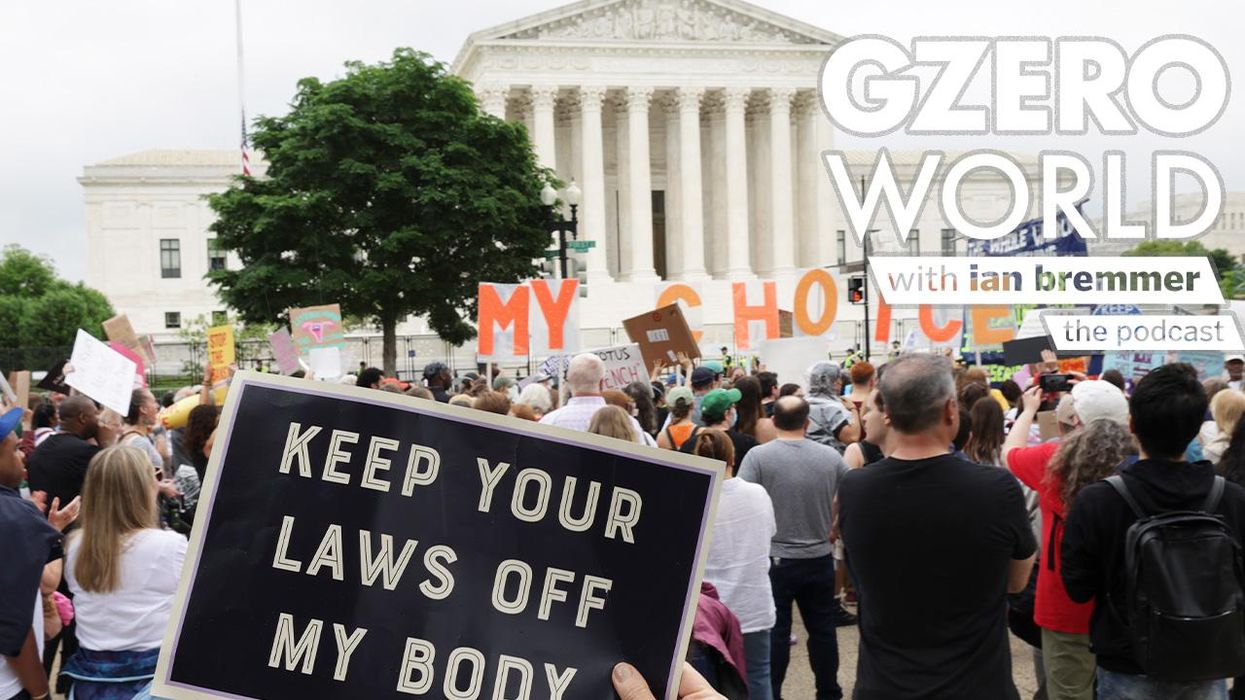
Listen: Americans now live in a much more divided country — as has been on full display after the US Supreme Court overturned Roe v. Wade and removed the constitutional right to an abortion, while the rest of the world - including largely Catholic countries in Latin America and Europe - is moving in the opposite direction. But the SCOTUS ruling is already making waves around the world. On GZERO World, Ian Bremmer speaks to New York Times columnist and senior research fellow at Yale Law School, Emily Bazelon, who knows a thing or two about abortion law.
TRANSCRIPT: An active US Supreme Court overturns "settled law" on abortion. What's next?
Emily Bazelon: Everything depends on where you draw the line. It will be really different if we live in a country where half the states completely ban abortion than a country where most of those states allow first trimester abortions, and then people have to travel out of state for second trimester abortions.
Ian Bremmer: Hello, and welcome to the GZERO World Podcast. This is where you'll find extended versions of my interviews on public television. I'm Ian Bremmer, and on this week's show, a seismic Supreme Court ruling has overturned Roe v. Wade, eliminating the constitutional right to an abortion after nearly 50 years, and changing America overnight. How will this ruling reshape American life, not just for abortion, but also the right to contraception, same-sex marriage, not to mention the wedge driven into an already deeply divided nation. I'm joined by Yale Law School legal expert, New York Times Magazine columnist and co-host of the Slate Political Gabfest, Emily Bazelon. Here's our conversation.
Announcer: The GZERO World Podcast is brought to you by our founding sponsor, First Republic. First Republic, a private bank and wealth management company, places clients' needs first by providing responsive, relevant, and customized solutions. Visit firstrepublic.com to learn more. The GZERO World Podcast is also brought to you by Foreign Policy. The next time you order some calamari, stop for a minute and think; where does this actually come from? In The Catch, a new podcast from our friends at Foreign Policy, get a behind-the-scenes look at the state of global fishing, by tracking squid, from the waters off the coast of Peru to the processing plants, all the way to restaurants, and finally, your plate. Follow and listen to The Catch wherever you get your podcasts.
Ian Bremmer: Emily Bazelon, thanks for joining us on GZERO World.
Emily Bazelon: Thanks so much for having me.
Ian Bremmer: So start big picture, what would you say this ruling means for you and means for the country?
Emily Bazelon: What it means for the country is much restricted access to abortion, probably in many states, maybe something like half the states. What it means for me personally is that this right that I think many women, many people, have depended on for my whole life is now not enshrined in the Constitution anymore. It is really up for grabs, and there are going to be all kinds of repercussions from that, and we really are sailing into uncharted water.
Ian Bremmer: Why do you think that happened? I mean, we're talking about 50 years of "settled law" and indeed some of the conservative members of the Court that decided to vote to overturn have said before in public and private testimony that they considered Roe v. Wade to be settled law.
Emily Bazelon: Well, they said it was settled law at the time they were speaking, that was a factual statement. They didn't say or promise that they intended to keep it as "settled law." And the person they were really talking to at the time was Senator Susan Collins of Maine, who was a swing vote. She found those statements reassuring, but I think a lot of close observers at the time wondered what they really meant because they didn't make a promise into the future.
Ian Bremmer: You say that as if you were one of those close observers, Emily.
Emily Bazelon: Right. Well, I just never understood why it was so reassuring for people in the present tense to say something obvious, which was that Roe v. Wade was the law of the land, without saying that they intended to keep it that way. And that was always missing from the statements that Justice Barrett and Justice Kavanaugh and Justice Gorsuch made during their hearings.
Ian Bremmer: Now, what were the early alarm bells for you that this was possible/ likely coming down the pike?
Emily Bazelon: The Federalist Society and other conservative organizations have been working for decades to overturn Roe, to enshrine conservative judges throughout the federal courts, really to reshape American law. And they've been very successful. And I think many people, including me, have watched for years as abortion in particular really moved conservative voters, got people to the polls, made elections seem simple, like a simple moral choice. Whereas I think among liberals who support the right to abortion access, there was a sense that it was safe and some amount of complacency. It really didn't drive voters to the same degree. And so when you see that uneven political ramification, you wonder, even though the polls show that most Americans supported Roe, support a right to abortion, you wonder whether the people who care the most are going to triumph in the end.
Ian Bremmer: Yeah, well, I mean there's a bit of that. I mean, for me, this feels a little bit like, on the left, issues like critical race theory, transgender rights, where the far left has hijacked the agenda for the average Democrat. And I wonder if the Republicans are about to get themselves in the same trouble, where an issue that really isn't popular among rank and file. I mean, a large majority of Americans do not want Roe v. Wade overturned, but now Republicans are going to have to be pulled into positions that are going to be very challenging for them.
Emily Bazelon: Yeah, that's possible. What we saw after Justice Samuel Alito's majority opinion leaked a little while ago was a pretty smart play by major abortion opponents. They were saying things like, "A 15-week ban, sure, we support that. A 6-week ban, we'll support that too." They were not insisting that every single state take a purity test and completely ban abortion. And if you're thinking politically, I think for the right, that is a smart play right now, that you would allow some states to have some access to abortion, you're still going to really eliminate or change access for many, many women, but you're not necessarily going to be driven to such a political extreme that you alienate the swing voters in your own state.
Ian Bremmer: Because the position that unites all of Americans, and there aren't many, is that abortion should be legal in some circumstances and illegal in others. And it's really just about where you draw that line.
Emily Bazelon: Yes, that's right. Everything depends on where you draw the line. The most important line just in terms of numbers of people terminating pregnancies is the end of the first trimester. We have something like 90% of abortions occurring before 12 weeks.
Ian Bremmer: Yeah.
Emily Bazelon: And so that is a really big deal. It will be really different if we live in a country where half the states completely ban abortion than a country where most of those states allow first trimester abortions, and then people have to travel out of state for second trimester abortions.
Ian Bremmer: Now, which of those outcomes is more likely? I mean, if you were to put your crystal ball out there and say, in 2024 Election Day America, is abortion banned in a large number of states or is it actually closer to the significant restrictions but we're not looking at a ban?
Emily Bazelon: I think abortion is banned in many states, but which states and where and how many matters a lot. So for example, take the state of Florida, if Florida allows first-trimester abortions, which seems possible, people who are pregnant in lots of the South will have a much easier time traveling to Florida than if Florida disappears from the map. And then the other part of this that's very important is access to abortion pills through telemedicine. Right now, there are 19 states, red states, that ban or severely restrict telemedicine access, and there's going to be a big question about how to enforce those laws, how many abortion by pills, by mail, they're really able to prevent and what happens in that whole area, which is going to turn into a big legal battle.
Ian Bremmer: Now, I've seen a statement from Merrick Garland saying you actually cannot ban abortion pills because they are FDA approved. Is this something that is going to inevitably end up in the Supreme Court as well?
Emily Bazelon: Yes, and I think what Attorney General Garland is trying to say is that because the FDA regulates the pills that preempt state law. And that's a pretty basic principle, federal regulation gets to Trump, essentially, state regulation. But yes, I think that that question is going to wind up in front of the Supreme Court. And even sometimes when rules seem like they generally apply, they can look different in the context of abortion, especially with this conservative court.
Ian Bremmer: Now, the leaking of the initial Alito opinion, which was itself unprecedented, and clearly led to a lot of political pressure, led to a fair amount of violence also against those that were providing pro-life counseling, for those considering abortions, already 30 cases that we've seen across the nation. For the actual opinion that was released, how different was it from the Alito release?
Emily Bazelon: I didn't see that much difference. I mean, I haven't gone and done a line-by-line comparison, but the passages I remembered are all there. And that's pretty striking because that draft was from February, and it seemed possible that whoever leaked it was trying to shake the majority in some way. And so if that's the case, and we really don't know, it was unsuccessful.
Ian Bremmer: We saw in an opinion that was released alongside by Justice Thomas that he said that we should be reconsidering, the court should be reconsidering same-sex marriage, contraception. How many cases do you think are suddenly going to be up for grabs as a consequence of this?
Emily Bazelon: Alito's opinion says that at least for now, that abortion is different than all these other precedents. Justice Thomas, you're right, says, "No, no, it's time to get rid of this conception of liberty which has allowed for this expansion of constitutional rights, including contraception and same-sex marriage." And so we just have to wait and see what happens next. We don't know how many of the other justices would vote with Justice Thomas in such a future ruling because we haven't seen that case yet.
Ian Bremmer: Now, we've also seen, almost the same day, a release of a decision where actually states don't get to make decisions about concealed carry gun laws. And a lot of analysts are suggesting, well, this is inconsistent because in one it's about state's rights and the other it's not. Surely that's not the way the justices see it. What's the argument here that leads to that ruling?
Emily Bazelon: Right. So there is this amazing crossing that is happening in American life, where the individual right to bear arms now looms very large and has struck down some state gun control laws, and may very well strike down more. And meanwhile, the right to access abortion, which was rooted in the Fourteenth Amendment, is gone. So there is no question that that is a huge sea change. The justices think that the Second Amendment text means that the right to bear arms is individual. And what they said in the case about New York's gun safety law is that unless a state regulation is firmly rooted in the nation's history and tradition, it's going to be struck down. And then the justices in the abortion case said, "Well, abortion is not rooted in the nation's history and tradition." And that's really the only question that matters here because it's not in the text of the Constitution. So that's how the justices square these two decisions.
Ian Bremmer: Do you think these justices are being honest? Are they actually being rooted in broader principles of jurisprudence or are they just playing politics?
Emily Bazelon: Well, I mean, I think, let's see... I think whether you think they are being consistent begins with whether you think the interpretation of the Second Amendment that they claim is rooted in the nation's history and tradition is actually correct. So when the first big Second Amendment decision came down a decade ago, there was a big fight over the historical meaning of the Second Amendment, and whether the individual right to bear arms really was there versus a militia-based right. And a lot of constitutional historians think that the dissent by Justice Stevens had the better of that historical argument, but it was Justice Scalia who had five votes. So I find that argument against the individual right to bear arms pretty persuasive. And that means that, to me, this new decision about New York's law looks pretty shaky.
When you look at Roe and Casey, the abortion decisions that we're talking about today, it really depends on what you think of the idea that abortion is fundamental to women's liberty and equality. And that is a question that has less to do, I think, with the actual text of the Constitution, and more to do with how we interpret these capacious phrases about equal protection and liberty, and whether we think that their meanings evolve over time.
Ian Bremmer: Now, of course, it's disturbing that views of the legitimacy of the Supreme Court are presently at historic lows, but you would expect that simply given how divided the country presently is politically and the parties. Beyond that, do you see the Supreme Court today as more ideological? Do you see it as less capable? Do you see the people that populate it as less willing to actually do the legitimate business of the country's top judicial institution?
Emily Bazelon: I think this conservative majority is pretty maximalist. They have shown this with the New York gun case and the Mississippi abortion case by being willing to issue really sweeping rulings that change the lives of many Americans. So then the question becomes; is that conservative majority enough in tune with the American people that they can be said to, in some way, be carrying out the will of the people as well as making rulings that are consistent with the Constitution? Because in the end, even though the justices are not elected, that they're not democratically accountable in the same way, they are still supposed to be in line with the country's values. There's some notion, some connection there. Otherwise, they really risk delegitimizing themselves and they risk the kinds of discussions we've been having about changing the whole shape of the court. So that's what I'm looking at, this question of if the court lurches far from public opinion, what, if anything, reigns it back in?
Ian Bremmer: Now, I mean, I hate to say this, but if the country is more polarized, more divided, more fraught and more anxious, I mean, certainly this Supreme Court does reflect the country more effectively.
Emily Bazelon: Well, that's interesting if you just think of it as reflecting polarization. I suppose that that's correct. I think though that we have looked to the Court in some points of American history, we have looked to the court to be a more far-seeing even unifying body. At its high moments like Brown v. Board, it was able to issue rulings that really gave the country a different new vision of itself, and I don't think we are seeing that today.
Ian Bremmer: Now, outside of the Court itself, we do have two other branches of government. What do you think, if any, the reactions will be from the President in terms of executive orders? And here, again, I'm talking about Roe v. Wade specifically and it's overturning, and from Congress and the potential to enshrine some rights into law.
Emily Bazelon: Well, I think when you start with the Biden administration, the fact that Attorney General Garland was talking about federal regulation of abortion pills preempting state law, that is important. There are more things the federal government could do to make it easier for abortion providers to provide those pills. So I think people will be watching to see if there are further executive orders in that direction. Congress, of course, could pass a national law providing for a right to abortion. Congress could also ban abortion nationally. At the moment, I think the Democrats are probably going to be paralyzed over the filibuster, the way that they have been over other big ideas. And then the issue will be what happens in the next Congress and the one after that, and whether, if Republicans gain control, we see an effort to nationally restrict or ban abortion, which would be a huge deal politically.
Ian Bremmer: And you think that's plausible? Again, you wouldn't expect that in a lot of states. You talked about Florida and why going towards a ban would not make sense. If I were reading you on that, I would be very skeptical that a Republican-majority House and Senate would move towards a nationwide ban.
Emily Bazelon: I think you're right, that the politics probably don't play out in favor of that outcome. However, we see all kinds of outcomes in the American Congress that don't necessarily track the will of the majority, that don't necessarily track the polls. It will depend how much hold Republicans have on Congress, whether they've really been able to enshrine a Republican-based minority rule in a way that makes them feel less at risk in elections.
Ian Bremmer: Emily Bazelon, thanks so much for joining us today.
Emily Bazelon: Thanks for having me.
Ian Bremmer: That's it for today's edition of the GZERO World Podcast. Like what you've heard? Come check us out at gzeromedia.com and sign up for our newsletter, Signal.
Announcer: The GZERO World Podcast is brought to you by our founding sponsor, First Republic. First Republic, a private bank and wealth management company, places clients' needs first by providing responsive, relevant, and customized solutions. Visit firstrepublic.com to learn more. The GZERO World Podcast is also brought to you by Foreign Policy. The next time you order some calamari, stop for a minute and think; where does this actually come from? In The Catch, a new podcast from our friends at Foreign Policy, get a behind-the-scenes look at the state of global fishing by tracking squid, from the waters off the coast of Peru to the processing plants, all the way to restaurants, and finally, your plate. Follow and listen to The Catch wherever you get your podcasts.
Subscribe to the GZERO World Podcast on Apple Podcasts, Spotify, Stitcher, or your preferred podcast platform, to receive new episodes as soon as they're published.'