Hi all,
This Tuesday, we look at what comes next in Venezuela, preview the Trump/Kim summit, and tussle with some wild boars.
Bonus question: how many people in the world today are citizens of no country at all?
Send us your love/hate, and give a friend the Signal here.
– Alex Kliment (@saosasha)
VENEZUELA: GUAIDO’S FAILED GAMBIT
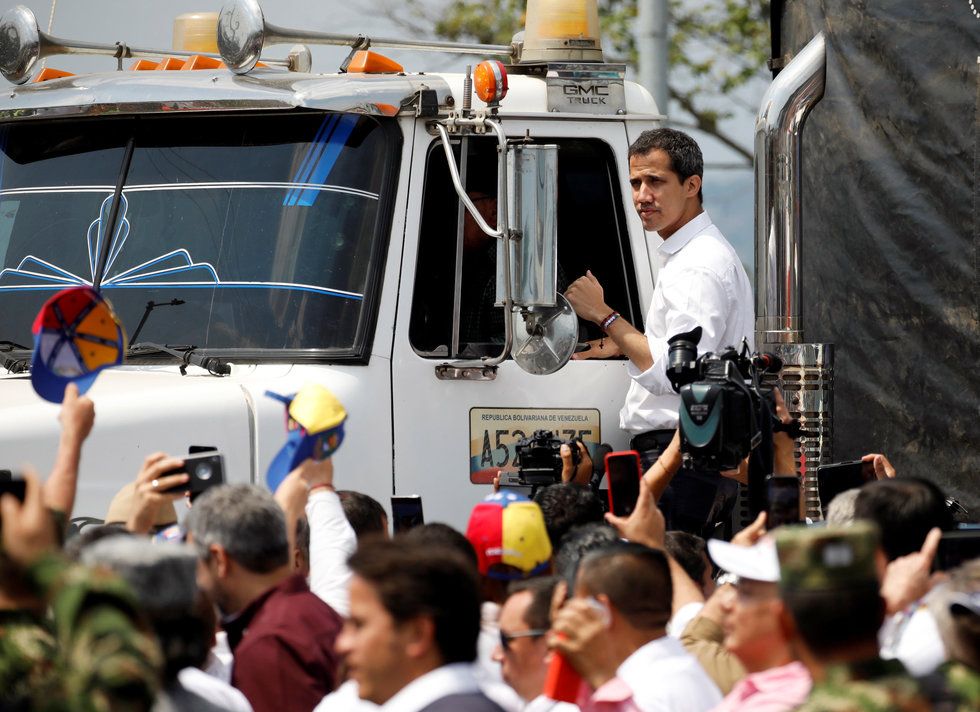
As a US-backed humanitarian aid convoy approached the Venezuelan border under the direction of Venezuelan opposition leader Juan Guaido last weekend, the big question was: would Maduro's soldiers stand aside to allow food and medicine to reach an increasingly desperate population – or would they shoot?
In the end, they shot. While more than 150 Venezuelan soldiers reportedly defected across the border, the vast majority stood pat. Following Maduro's orders to repel an aid convoy that he said was a trojan horse for US invasion, his men launched volleys of tear gas, rubber bullets, and live rounds. Hundreds of people were wounded and several were killed. Just one aid truck managed to scramble across the border.
The aid on the trucks was only a drop in the bucket for a country suffering the kind of humanitarian crisis that most see only in wartime. But the symbolism was stark: despite leading his country into economic ruin, Nicolas Maduro still commands the loyalty of his army and, as a result, he still runs Venezuela.
This setback raises a basic question for Mr. Guaido and the more than 50 countries that recognize him as the interim president of the country: what next?
Economic pressure: Yesterday, US Vice President Mike Pence met with Mr. Guaido and other regional leaders in Colombia, and announced additional US sanctions on members of the Venezuelan government. The US has already put sanctions on Venezuela's cash cow national oil company PDVSA, and is trying to get other countries to go along too. It figures that squeezing the regime's cash flow makes it more likely that top generals will defect (if they can get amnesty for their crimes). But sanctions also serve to deepen the anguish of Venezuela's people as the government has less money to pay for imported food and medicine.
The military option? One of Mr. Guaido's main advisers has explicitly called for a US-backed invasion, an option that the Trump administration has long said is at least "on the table." Over the weekend, US Senator Marco Rubio, an outspoken Venezuela hawk, ominously tweeted a photo of Libyan dictator Muammar Qaddafi, who was beaten to death by a mob after the US helped topple his government.
But the American public is war-weary, and most Latin Americans, mindful of Washington's sordid history of regional meddling, don't want the yanquis showing up in tanks again either. Not surprisingly, the US's main regional allies in Chile, Colombia, and Brazil have all said they oppose an intervention. Polls taken before the aid standoff showed a majority of Venezuelans agree.
None of this means that it's all roses for Maduro, of course. As his cash flow slows to a trickle, he wakes up every morning wondering if his generals will join him for dinner or serve him for lunch. Millions of his people are starving. His opponent has strong support both at home and abroad, and those humanitarian aid trucks (and ships) are still idling at Venezuela's borders.
But for now, Maduro continues to cling to power, and he has improbably forced the ball back into Mr. Guaido's court.
GRAPHIC TRUTH: US MEDDLING IN THE AMERICAS
Top US officials and lawmakers have hinted that military intervention in Venezuela is an option. It certainly wouldn't be the first time that Uncle Sam has sent troops south of the border. Since 1898, the US has effected, directly or indirectly, 41 changes of regime in more than a dozen Latin American countries, according to a Harvard study. That includes 17 instances of overt military or CIA action and 24 murkier interventions: here's a map of the meddling. Note: since you are about to ask, no the Bay of Pigs invasion is not counted, because it failed to overthrow the Castro regime.
Trump-Kim: Round 2 in Vietnam
Eight months after their historic summit in Singapore, US President Donald Trump and North Korean leader Kim Jong-un will get together again in Hanoi for two days, starting tomorrow.
What's changed since Singapore?
North Korea has taken a number of positive steps since last June. It moved to dismantle missile and nuclear test sites and return the remains of US soldiers killed in the Korean War. Most importantly, it didn't test a single ballistic missile in 2018, after launching a record 27 in 2017.
That said, all signs suggest that North Korea's production of nuclear weapons continues apace, and it has refused to allow outside monitors to visit its facilities.
What's on the agenda for round 2?
Trump's task this week is to turn the warm feelings that came out of Singapore into concrete results. Maximal progress would be to get Chairman Kim to agree to a detailed denuclearization roadmap, which would entail North Korea dismantling its nuclear arsenal in exchange for a loosening of economic sanctions and a gradual drawdown of America's military presence in South Korea. The danger is that Trump, wanting to gain global recognition for his achievements, gives away too much with little to show for it.
Mr. Kim, for his part, is keen to exploit Mr. Trump's tendency to shoot from the hip and his evident desire for a newsworthy accomplishment, which allows the North Korean leader to dictate the pace and sequencing of negotiations. He's hoping to coax concessions out of the US president once they are alone without advisors and to avoid a detailed program that involves. his core weapons program.
Who else is tuning in?
While the focus this week will be on Messrs. Trump and Kim, other regional powers have interests at stake to.
Here's what others will be watching in Hanoi:
Japan has mostly been locked out of the diplomatic process with North Korea so far. Prime Minister Shinzo Abe has asked for the return of 12 nationals currently being held in the North. But Japan's main concern is that Mr. Trump could do a deal that gets Kim to give up long range missiles that can hit the US, but keep shorter range weapons that can still hit Japan.
South Korea arguably has more on the line in Hanoi than anyone else. Over the past year, President Moon Jae-in has pursued a substantial diplomatic opening with the North, in part to deepen economic ties that can help his own country. So far that goal has proven elusive. He wants a deal that would allow trade and investment to grow, but he also understandably worries that to get such a deal Mr. Trump could decide to gamble away the US troop presence in South Korea. After the Singapore summit, the US president surprised many by announcing the temporary suspension of US-South Korea military exercises.
China likes current pace of negotiations and doesn't want to see a "grand bargain" this week. President Xi Jinping and Mr. Kim have been coordinating carefully in advance of the Hanoi summit, according to Sun Yun of the Stimson Center. The North Korean's sense of insecurity is China's biggest point of leverage, she told us. So long as Pyongyang remains mistrustful of the Americans, the Chinese remain in a strong position.
The bottom line: The Singapore summit was just a warm up. This week, we'll really see how strong the relationship is between President Trump and Mr. Kim and what it can achieve.
Trump-Kim: Round 2 in Vietnam
Eight months after their historic summit in Singapore, US President Donald Trump and North Korean leader Kim Jong-un will get together again in Hanoi for two days, starting tomorrow.
What's changed since Singapore?
North Korea has taken a number of positive steps since last June. It moved to dismantle missile and nuclear test sites and return the remains of US soldiers killed in the Korean War. Most importantly, it didn't test a single ballistic missile in 2018, after launching a record 27 in 2017.
That said, all signs suggest that North Korea's production of nuclear weapons continues apace, and it has refused to allow outside monitors to visit its facilities.
What's on the agenda for round 2?
Trump's task this week is to turn the warm feelings that came out of Singapore into concrete results. Maximal progress would be to get Chairman Kim to agree to a detailed denuclearization roadmap, which would entail North Korea dismantling its nuclear arsenal in exchange for a loosening of economic sanctions and a gradual drawdown of America's military presence in South Korea. The danger is that Trump, wanting to gain global recognition for his achievements, gives away too much with little to show for it.
Mr. Kim, for his part, is keen to exploit Mr. Trump's tendency to shoot from the hip and his evident desire for a newsworthy accomplishment, which allows the North Korean leader to dictate the pace and sequencing of negotiations. He's hoping to coax concessions out of the US president once they are alone without advisors and to avoid a detailed program that involves. his core weapons program.
Who else is tuning in?
While the focus this week will be on Messrs. Trump and Kim, other regional powers have interests at stake to.
Here's what others will be watching in Hanoi:
Japan has mostly been locked out of the diplomatic process with North Korea so far. Prime Minister Shinzo Abe has asked for the return of 12 nationals currently being held in the North. But Japan's main concern is that Mr. Trump could do a deal that gets Kim to give up long range missiles that can hit the US, but keep shorter range weapons that can still hit Japan.
South Korea arguably has more on the line in Hanoi than anyone else. Over the past year, President Moon Jae-in has pursued a substantial diplomatic opening with the North, in part to deepen economic ties that can help his own country. So far that goal has proven elusive. He wants a deal that would allow trade and investment to grow, but he also understandably worries that to get such a deal Mr. Trump could decide to gamble away the US troop presence in South Korea. After the Singapore summit, the US president surprised many by announcing the temporary suspension of US-South Korea military exercises.
China likes current pace of negotiations and doesn't want to see a "grand bargain" this week. President Xi Jinping and Mr. Kim have been coordinating carefully in advance of the Hanoi summit, according to Sun Yun of the Stimson Center. The North Korean's sense of insecurity is China's biggest point of leverage, she told us. So long as Pyongyang remains mistrustful of the Americans, the Chinese remain in a strong position.
The bottom line: The Singapore summit was just a warm up. This week, we'll really see how strong the relationship is between President Trump and Mr. Kim and what it can achieve.
WHAT WE ARE WATCHING
Trump's "Signing Summit" – On Sunday, Donald Trump announced that "substantial progress" in US-China trade negotiations had persuaded him to delay a tariff increase on $200 billion of Chinese goods that was set to take effect on March 1. He also suggested that Chinese President Xi Jinping's upcoming visit to Mar-a-Lago could become a "signing summit" for a broader trade deal. But there may be some tension between Trump's trade team – who want to put the screws to Beijing in order to seal a deal that really changes China's economic behavior – and Mr. Trump himself, who may favor a faster but fluffier "win" as he gears up for re-election. If Trump settles for a vaguer deal, he risks backlash from lawmakers and business people who want a harder line against Beijing.
State of Emergency in Sudan – Simmering protests against the 30-year rule of strongman Omar Bashir flared again over the weekend, even after he declared a state of emergency and reshuffled his cabinet. As we've written, discontent first erupted in December over economic issues, but the demonstrations quickly expanded into calls for Bashir's ouster. The removal of US sanctions in 2017 exposed the rot of Sudan's economy and stripped Mr. Bashir of a favorite explanation for his people's hardship. Gulf Arab countries have supported him, but the domestic situation in Sudan is getting more tenuous by the day.
WHAT WE ARE IGNORING
Vladimir Putin, music director – Amid an ongoing conflict between Russian authorities and the country's hip hop scene, President Putin has now ordered his government to submit proposals for supporting "contemporary popular music" and "genres that are in demand among youth audiences." This is part of his strategy to get the government to "direct" rather than stifle the burgeoning rap scene. This should go well – after all, you definitely want the guy who objects to music about "sex, drugs, and protest" to be on the 1s and 2s at the club. With his approval ratings at their lowest point in five years, Putin should probably think this through a little better…
Something rooting in the state of Denmark – The world's various controversies over border security have made walls the emblem of our era and now Denmark plans to build a 40-mile-long, five-foot-tall steel fence on its frontier with Germany. The unwanted migrants in this case? Potentially sickly wild boars. Now, it's natural for the Danish government to protect the 30,000 jobs at risk if Danish pigs fall ill, but will a wall do the trick? In some places the Germany-Denmark border is a river, and boars have been known to swim.
HARD NUMBERS: Rio police, Afghan civilian deaths, stateless people
3,804: Last year, violence in Afghanistan killed 3,804 civilians, according to a new report from the United Nations, the highest annual total on record. Rebel groups like the Taliban and Islamic State accounted for two-thirds of the total. Fighting has escalated even as peace talks gradually move forward.
160: Police in Rio de Janeiro killed 160 people in the month of January, the highest total for that month since 1998. Like President Jair Bolsonaro, Rio's new governor Wilson Witzel won recent elections in part by promising a harsh law and order crackdown in one of the world's most violent cities.
10 million: The are currently at least 10 million people across the globe who are considered stateless: they are citizens of no country. This can be the result of wars and displacement, changes in laws, governments, or borders, or specific government decisions to strip certain people of citizenship.
72: A referendum in the Japanese island prefecture of Okinawa showed that 72 percent of those who voted oppose a long-stalled plan to relocate an outdated US Marine base from one part of the island to another. Many Okinawans in fact want other parts of Japan to share the burden of US troop presence. The Japanese government has ignored the results of the referendum, which was not legally binding.