June 08, 2026
Israel struck military targets and a petrochemical plant in Iran on Monday, defying pressure from US President Donald Trump not to respond to a wave of ballistic missile attacks by the Islamic Republic on Sunday night. The exchange marked the first direct confrontation between Israel and Iran since a ceasefire took effect in April.
Iran and Israel then announced today that they’d halt operations against one another. Yet Trump’s call for Israeli Prime Minister Benjamin Netanyahu not to retaliate is “extraordinary,” according to Ian Bremmer, given the US president was urging a longtime ally to absorb Iranian strikes without responding. Trump has grown frustrated with Netanyahu’s eagerness to continue military operations against Hezbollah despite Iran’s insistence that any ceasefire agreement must also address Lebanon.
“Everybody hates you now,” Trump fumed at Netanyahu during a private phone call last week, according to Axios. “Everybody hates Israel because of this.”
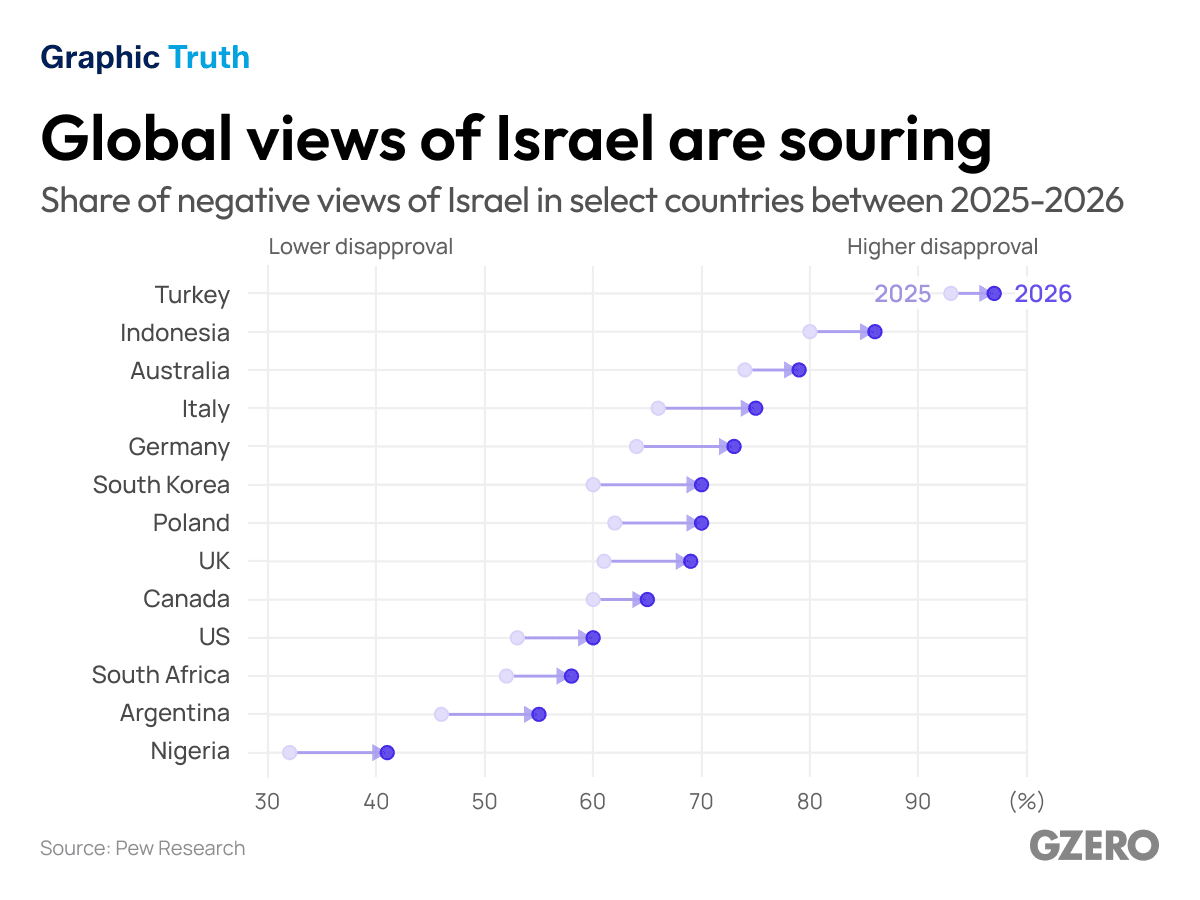
Trump’s comments come amid a broader shift in public opinion in the United States and abroad. While the US has been one of Israel’s staunchest allies for decades, negative views of the country have risen sharply and now stand at 60%. It’s a trend that began in the wake of Hamas’s Oct. 7, 2023, attacks and Israel’s subsequent war in Gaza.
The US is not alone. As our Graphic Truth shows, negative views of Israel are becoming more widespread around the world. Allies like the United Kingdom, Germany, and Canada have all seen increases in unfavorable perceptions.
A median of 67% of adults across 36 countries hold negative views of Israel, according to Pew Research. Those attitudes are closely tied to perceptions of Netanyahu himself: majorities in most countries surveyed said they were either “not too confident” or “not at all confident” in his ability to do the right thing in world affairs.
Israel’s deteriorating public image could leave it increasingly isolated on the world stage, with fewer diplomatic partners willing to support its actions. In the United States, in particular, the longer the already unpopular war drags on, the worse public views of Israel will get — especially if Netanyahu is seen as prolonging the conflict. For now, though, the Israeli leader seems unbothered — but that could change if the US sidelines Israeli concerns and makes a deal with Tehran that, much like the deal former President Barack Obamanabbed in 2015, isn’t to Netanyahu’s liking.More For You
Can Washington turn military pressure into a diplomatic strategy? Brett McGurk joins Ian Bremmer on the GZERO World podcast to discuss the Iran war, Houthi attacks, and how elections in Israel and the US could reshape the region.
Most Popular
Think you know what's going on around the world? Here's your chance to prove it.
Turkish President Recep Tayyip Erdogan receives Canadian Prime Minister Mark Carney with an official ceremony in Ankara, Turkiye on October 22, 2026.
Anadolu via Reuters Connect
Canadian Prime Minister Mark Carney is in Turkey on Thursday for talks with President Recep Tayyip Erdogan - the visit is the first by a Canadian prime minister.
© 2025 GZERO Media. All Rights Reserved | A Eurasia Group media company.