Analysis
Time for a US-Canada marriage counselor?
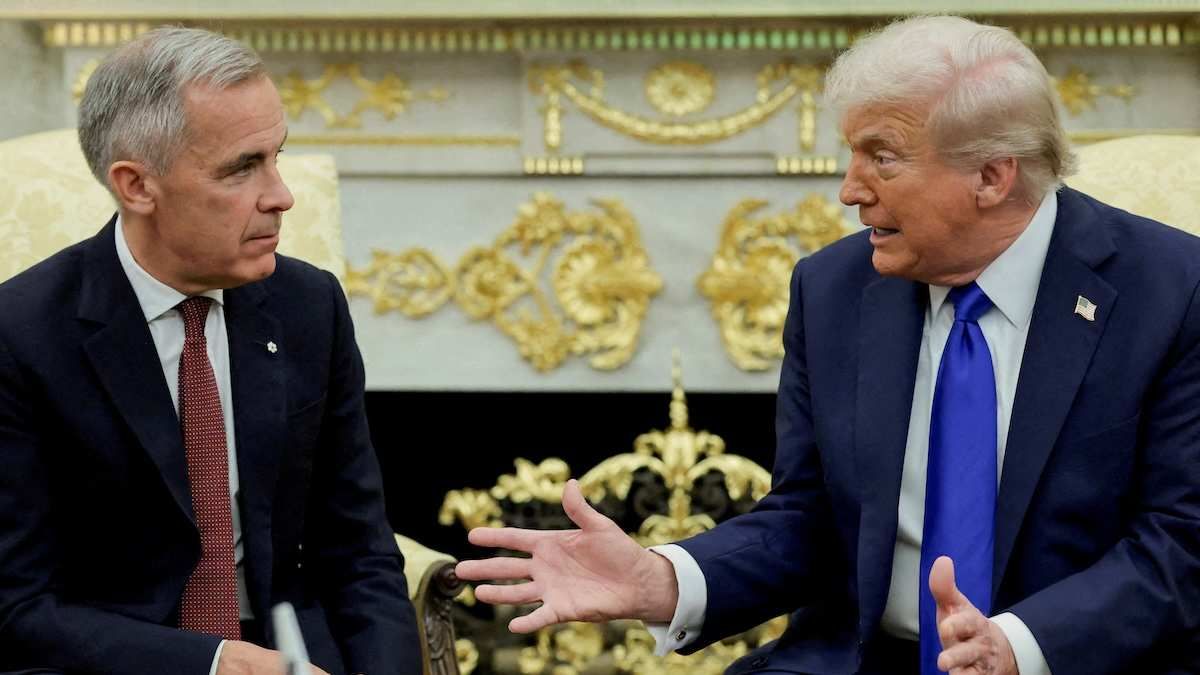
US President Donald Trump and Canada's Prime Minister Mark Carney meet in the Oval Office at the White House in Washington, D.C., USA, on October 7, 2025.
REUTERS/Evelyn Hockstein/File Photo
The US-Canada relationship has long been one of the closest partnerships in the world. The two countries share the world’s longest undefended border, exchange nearly $1 trillion in goods and services annually, and work closely together on defense and security.
But as business and political leaders gather for the US-Canada Summit, co-hosted by GZERO’s parent company Eurasia Group and Royal Bank of Canada, starting tomorrow in Toronto, love is not in the air.
Just last week, US President Donald Trump revived talks of Canada as a “51st state,” repeating a line that has irked Canadians for well over a year. Canadian Prime Minister Mark Carney recently referred to Canada’s economic dependence on the United States as a “weakness” and stressed the need to diversify its trade relationships. Ontario Premier Doug Ford continues to ban American alcohol from provincial liquor stores, while Trump’s tariffs on Canadian steel and aluminum remain largely in place.
It’s a far cry from three years ago, when then-President Joe Biden told Canada’s Parliament that the US had “no more reliable ally, no more steady friend” than Canada. It’s even a stark contrast to Trump’s first term in office, when the two countries engaged in a “grueling” renegotiation of NAFTA but walked away with the United States-Mexico-Canada Agreement (USMCA), which Trump touted as “the best and most important trade deal ever made” by the US. Today, Carney is busy forging alternative trading relationships and says that the US should envision a partnership with “a different Canada, a stronger Canada. A more confident Canada.” Tensions over trade, defense spending, and foreign policy continue to strain this friendship, and it’s unclear what it will look like going forward.
Trade: from integration to irritation. If there’s one issue driving the current tension, it’s trade. Trump no longer sees the USMCA in a positive light, repeatedly arguing it is unfair and Canada is “ripping off” the US. He often points to Canadian tariffs on US dairy and America’s trade deficit with Canada, while Canadians counter that they sell energy products – their leading export – to the US at a discount.
In his second term, Trump imposed tariffs on a host of Canadian exports, and Canada retaliated in kind. Last week, the US leader went further, adding Canada to a list of countries on which the administration plans to impose a general 10% tariff, citing allegations that they allow goods produced with “forced labor” into their supply chains. The measure would apply to any imports not already covered by the USMCA, which currently exempts over 90% of Canadian exports to the US under country-of-origin rules.
While the “forced labor” tariffs may not make a material difference, the bigger issue is what happens next.
The USMCA comes up for review on July 1, 2026. Though the agreement doesn’t automatically expire, it requires Canada, the US, and Mexico to decide whether to extend it for another 16 years. If any country declines, the pact stays in place until 2036, but is subject to annual review, staggering on like a “zombie deal” while negotiations continue, as Eurasia Group warned in its 2026 Top Risks report. Businesses fear this would create uncertainty, discourage investment, and disrupt supply chains. Ending exemptions would also damage both economies by raising costs for business and consumers. Canada reportedly made new proposals to the US recently, warning of “turbulence” if no deal is struck by the end of the month.
On defense: is Canada a freeloader? Defense is another area where the US and Canada don’t see eye to eye.In 2024, Canadaspent approximately 1.4% of its GDP on defense, one of 11 countries that failed to meet NATO’s 2% target. The following year, Trump again criticized Canada, echoing complaints from his first term, arguing that Ottawa assumes the US’s protection regardless of how much it contributes on its own.
This time, the criticism had an impact. Earlier this spring, Carney announced Canada had reached the 2% target and would hit NATO’s new 5% goal by 2035 through increased investments in Arctic security and its military infrastructure.
Even so, Washington doesn’t appear fully convinced. Last month, the US halted its participation in the Permanent Joint Board on Defense, a body established during WWII to coordinate on common defense issues between the two countries. Announcing the decision on X, the Pentagon’s policy chief, Elbridge Colby,wrote that “Canada has failed to make credible progress on its defense commitments.”
Foreign policy: allies, but less aligned. The two countries are also finding themselves at odds on foreign policy. Carney’s call to the world’s middle powers to band together at the World Economic Forum in January won him praise as a vocal defender of multilateralism at the same time Trump was panning the NATO alliance. After Carney’s address, US Treasury Secretary Scott Bessentadvised him to “do what he thinks is best for the Canadian people, not his own virtue-signaling, because we do have a USMCA negotiation coming up.”
China has become another sensitive issue. In January, Ottawa agreed to admit 49,000 Chinese vehicles into Canada annually, easing tariffs it had imposed jointly with the US in 2024. In exchange, China agreed to lower tariffs on Canadian canola and soybeans for a year. More recently, Chinese Foreign Minister Wang Yi visited Canada, and Ottawa announced plans to boost Chinese exports by 50% by 2030 – moves that have ruffled feathers in Washington.
Does tough love have some silver linings? For Canada, it’s not all bad news: Trump's America-first approach has forced Ottawa to seek new trade and defense deals – 20 so far in the past year, according to the government – and inspired a boost to its armed forces. Still, there are limits to how far Canada can pivot away from the US. Geography matters. Canada depends on the American market, and cannot simply replace nearby customers with far-off ones in Europe or Asia. The same is true for the US, which relies on Canada both strategically and economically. Neither country can easily do without the other. Whether they like it or not, these two are staying together – but whether they have a happy marriage or just one of convenience is another question.
With Israel and the US heading to the polls, could elections change the course of the Middle East’s conflicts? Brett McGurk joins Ian Bremmer to discuss the Iran war, escalating Houthi attacks, and whether Washington has a strategy to contain the turmoil.
Think you know what's going on around the world? Here's your chance to prove it.
Even as Israel grows increasingly isolated on the world stage, there is one region where a whole swath of newly-elected leaders can't seem to get enough of the Jewish State: Latin America.