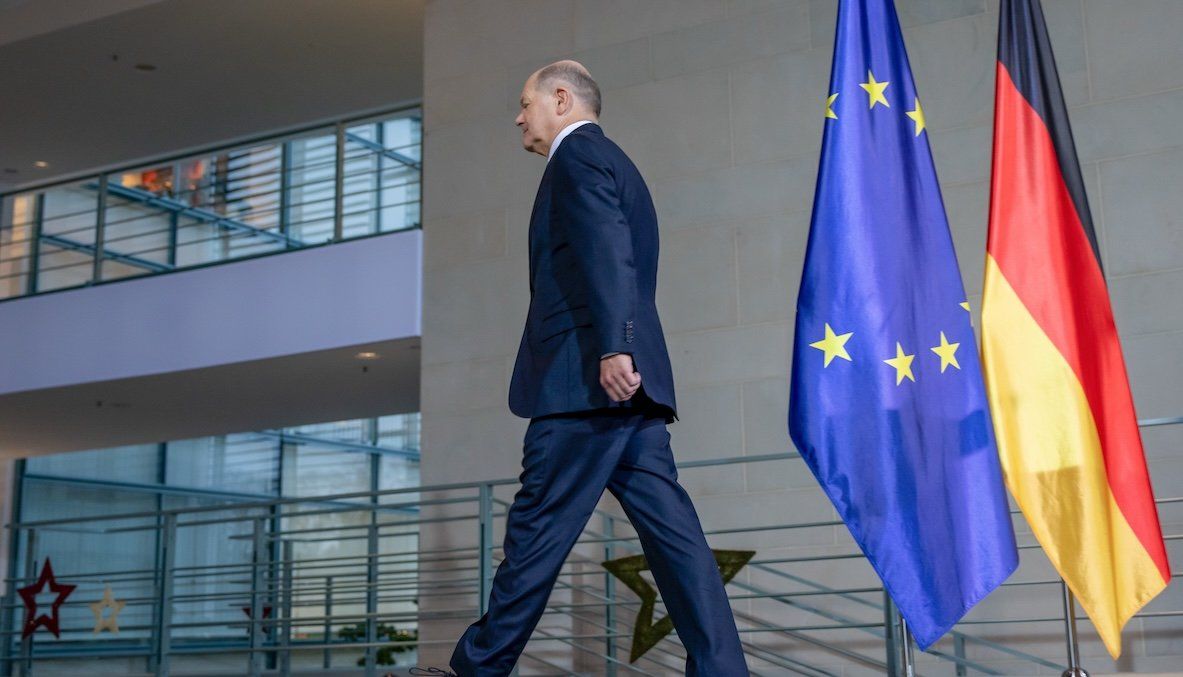
Faced with a political impasse preventing action on acute economic and geopolitical challenges, the German parliament will hold a vote of confidence in Chancellor Olaf Scholz’s government on Dec. 16. Based on an agreement among the main parties in the Bundestag, lawmakers will deliver a vote of “no confidence,” paving the way for snap elections on Feb. 23.
We asked Eurasia Group expert Jan Techau to explain what set off this chain of events and where it is likely to lead.
What has prompted this vote of confidence?
The chancellor called the vote after long-simmering tensions finally brought down the ruling coalition of Scholz’s Social Democrats, the pro-business Free Democrats, and the Greens. There are big ideological divides among these three parties, and it was never an easy marriage. Initially, they could paper over these divides with money for each party’s pet projects. But a little over a year ago, the Constitutional Court struck down large parts of the 2024 budget, saying they were financed with an illegal repurposing of unused pandemic-relief funds. That set up endless negotiations and finally a showdown over the 2025 budget, which ended with Scholz firing the finance minister, the Free Democrats’ Christian Lindner, and the subsequent collapse of the coalition agreement.
So, it sounds like fights over spending priorities are the main issue shaping German politics?
They are a symptom of a broader economic crisis that has undermined competitiveness, growth, and tax revenue. The country has high labor and energy costs and a high reliance on exports, especially to China. For a long time, China bought nearly everything that Germany produced, from machinery to cars and chemicals. But China has developed its own industries and is no longer just a customer but increasingly an aggressive competitor making many of the same goods. To put it simply: Germany is a high-cost country reliant on exports whose main customer no longer wants to buy all its stuff.
How are geopolitical issues shaping the domestic debate?
All these economic problems come at a time of mounting geopolitical challenges. Donald Trump’s election victory in the US is expected to bring increased pressure on Germany and other European countries to harden their stances against China. Trump could force Germany to choose between its economic reliance on China and its security reliance on the US. At the same time, you have the war in Ukraine and Russia’s hostility to Germany and the rest of the West that has prompted significant – and very costly – efforts to rebuild Europe’s defense capabilities.
What seems like the most likely outcome of the February elections?
The conservative Christian Democrats, led by Friedrich Merz, have a substantial lead in the polls. It seems unlikely that any other party will be able to close the gap by Feb. 23. They will need to form a coalition government (one-party parliamentary majorities and minority governments are very uncommon in the German system), probably with the Social Democrats and maybe a third party as well. One key watchpoint will be the performance of the two extremist parties, the far-right Alternative for Germany and the far-left Sahra Wagenknecht Alliance. They have no prospect of entering government this time around, but if they obtain a combined one-third of the seats in the Bundestag, they could block legislation requiring changes to the constitution, which needs a two-thirds majority. Such a blocking minority could hamper the next government’s ability to implement a forceful reform agenda.
What is the reason for the conservatives’ strength?
There are two factors. The first is that voters’ number one concern at the moment is the state of the economy. This issue has traditionally favored conservatives, who are seen as more competent in this realm. The second is the collapse in the popularity of the three parties of the ruling coalition amid a widespread sense of crisis and malaise. They have recovered a bit recently, but at one point the approval ratings of the three parties combined were at about the same level as those of the conservatives.
Assuming a conservative-led government emerges, what does that mean for domestic policy?
If the Christian Democrats form a coalition with the Social Democrats, they will have to jettison many conservative ideas. The German system is geared toward stability and continuity, an approach that has worked extremely well, though the downside is that it’s hard to make big changes when needed. The question is whether the current crisis is big enough to force change. I expect an overhaul of the so-called debt brake, a strict limitation on government borrowing that has restrained policymaking. But beyond that, a raft of politically difficult measures are needed to deregulate industries and lower labor costs to restore German competitiveness. We’ll see if the next government can deliver.
How about foreign policy?
There would certainly be more engagement with the EU. The Christian Democrats pride themselves on being the pro-EU party of Germany in the tradition of Konrad Adenauer and Helmut Kohl. My guess is that the next government will remain reluctant to embrace the proposals for common borrowing backed by some other EU countries. Still, it could be more supportive of other joint initiatives. Merz had been more hawkish in his rhetoric toward Russia but has recently toned it down because he knows there are a limited number of votes he can win with this approach. Regardless, foreign policy will be a somewhat lower priority for the next government than getting the economy going again.
Edited by Jonathan House, Senior Editor at Eurasia Group.