September 09, 2024
Carl Bildt, former prime minister of Sweden and co-chair of the European Council on Foreign Relations, shares his perspective on European politics from Stockholm, Sweden.
What's going to be the division of responsibilities in the new European Commission of Ursula von der Leyen?
Well, I think we'll get a hint of that towards the end of the week, where she is supposed to present her proposal before it goes then to the European Parliament and then eventually for ratification, be that early November, or whenever. There's a significant battle, primarily over the key economic portfolios. The Italians are demanding that their nominee, Fitto, be a minister in the government, should be given a key economic role. That's somewhat controversial, because he also will be the representative of the extreme right part of the European political spectrum. The French, needless to say, want to have their present commissioner, Breton, who’s been key with the outgoing commission, as an even more important personality. So that's going to be one of the battles. Another battle is that the Hungarians want to retain control of enlargement that will, in all probability, be refused. And then trade, financial affairs, budgets are going to be heavily contested or the focus, as well.
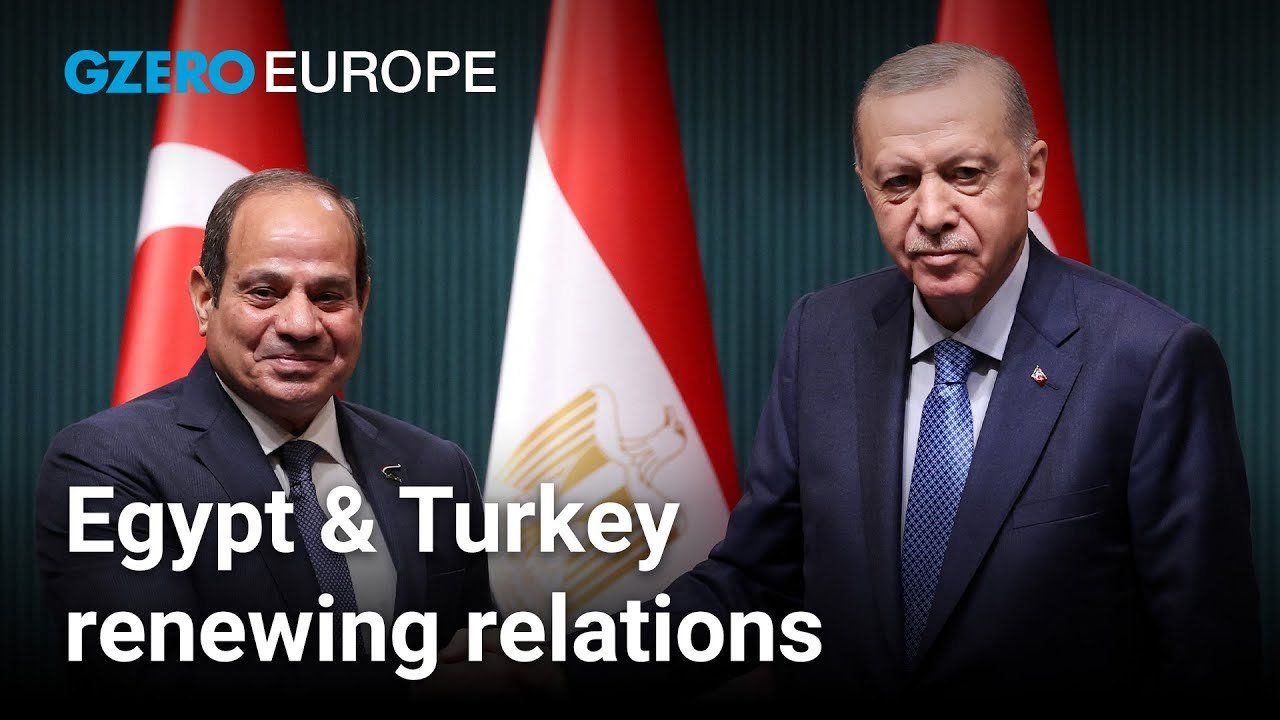
What's the significance of the visit of Egypt's President el-Sisi to Turkey?
Well, it is really a reconciliation after what happened in 2013 when el-Sisi staged the military coup against President Morsi, the Muslim Brotherhood president, who had been elected, and was heavily supported by President Erdogan, who made a jubilant visit to Cairo at the time. So, the relationship between these two important countries in eastern Mediterranean soured very considerably after 2013. And it's been a long road back to a more normal relationship that is now being established between Turkey and Egypt.
More For You
2.8 is way above the UN target of 1.5 degrees that was set by the 2015 Paris Agreement.
Most Popular
- YouTube
A Democratic sweep in 2026 could shake up Washington. Will it change Trump’s grip on power or set the stage for 2028? Amy Walter and Liam Donovan join Ian Bremmer on GZERO World.
Could Chinese AI give Europe an edge? | The Debrief with Heather West
Could China give Europe a shortcut in the AI race?
Europe has struggled to build models that compete with American and Chinese rivals. But Chinese models that companies can download, customize, and run themselves could offer another way forward—with more control over data and security.
This week, Microsoft launched the Velocity Prize, a global competition designed to give students ages 13–16 an opportunity to demonstrate their computational thinking, coding, and creative problem-solving skills in Minecraft. Supported by Microsoft’s Digital Crimes Unit, the competition encourages students to build digital skills and learn how to use technology responsibly while exploring future opportunities in cybersecurity. By helping equip the next generation with the skills to navigate and shape the digital world, the Velocity Prize is helping build a pipeline of future problem-solvers who can contribute to a safer and more resilient digital ecosystem. Read more here.
© 2025 GZERO Media. All Rights Reserved | A Eurasia Group media company.