Today, we assess whether Canada could become the maple leaf among the EU’s stars, examine Guyana and Venezuela’s long-running border dispute, and bring you a special message from Puppet Regime just in time for Cinco de Mayo.
- The Daily crew
As ties with the US fray, Canada looks across the Atlantic
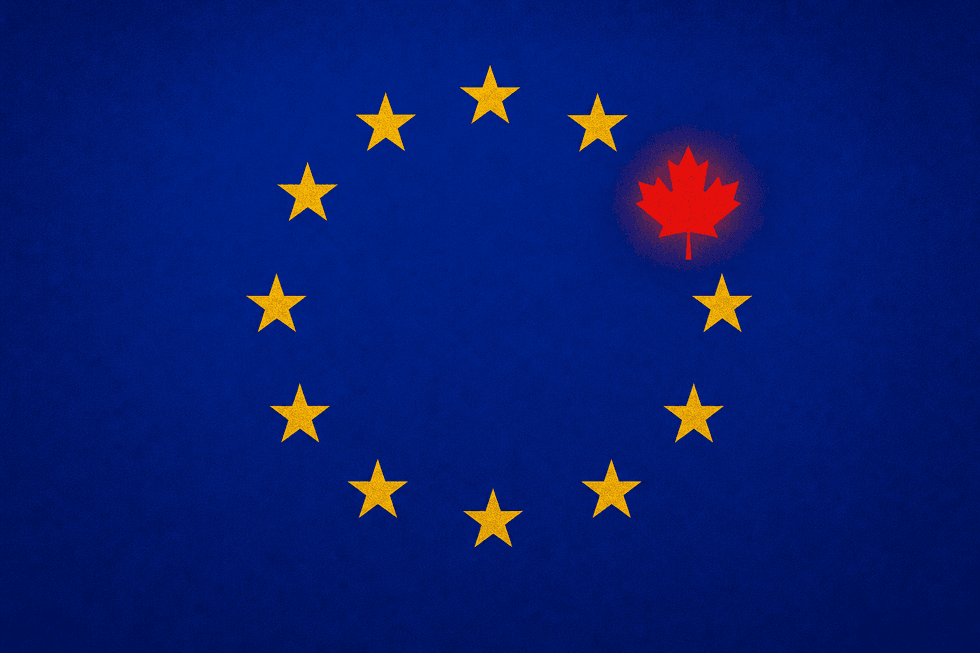 As ties with the US fray, Canada looks across the AtlanticNatalie Johnson
Canadian Prime Minister Mark Carney attended a meeting of the European Political Community in Armenia this weekend, a first by the leader of a non-European country. He was invited to discuss common interests in trade, energy, and security. In a speech that echoed his address to the World Economic Forum in Davos two months earlier, Carney called on middle powers, including Canada and European nations, to work together in the wake of disruption of the established world order — implicitly pointing to the United States. “It’s my strong personal view that the international order will be rebuilt,” he told the crowd in Yerevan, “but it will be rebuilt out of Europe.”
Carney’s trip — and somewhat more optimistic tone — comes on the heels of suggestions by French and Finnish politicians that Canada should consider joining the European Union. The question isn’t new; it has been cropping up in Canadian media ever since US President Donald Trump imposed tariffs on Canadian exports and mused about the country becoming America’s 51st state. Europe, meanwhile, is also grappling with Trump’s impact, including his promise to withdraw US troops from Germany and new tariffs on EU auto exports. Taken together, these developments are pushing Canada and the EU closer, and despite a body of water between them, are making the case for joining the union that much stronger.
A lot in common. Canada and the EU have deep cultural, historical, and demographic ties, rooted primarily in British and French traditions. Canada’s legal system recognizes both common and civil law, derived from the French Napoleonic Code. Politically, its parliament is modeled on Britain’s Westminster system and maintains the British monarch as head of state. The country is officially bilingual, and more than half of its population has European ancestry.
Canada’s political and social systems are also more closely aligned with Europe than with the United States. Canada has a universal, single-payer health care system, state-subsidized childcare, pharmacare, and dental care, and imposes higher taxes than the US. In sectors like banking, telecommunications, and agriculture, Canada mirrors Europe’s more regulated approach and limits foreign competition with domestic firms.
A growing bromance with Brussels. In 2016, Canada signed the Comprehensive Economic and Trade Agreement (CETA), a free-trade agreement with the EU, eliminating 98% of tariffs and improving market access for goods and services between the two parties. Canada’s exports to the EU have since increased by 57%, reaching $34 billion.
Since the start of Trump’s second term, those ties have deepened. In 2025, Ottawa and Brussels signed the New European Union (EU)-Canada Strategic Partnership of the Future and a Security and Defense Partnership to strengthen cooperation in trade, the digital economy, and the environment. In February of this year, Canada became the first non-European country to join the EU’s Security Action for Europe (SAFE) initiative, expanding access to European markets for Canadian defense industries.
Canada has also contributed over $25 billion in economic, military, and humanitarian assistance to Ukraine since the start of the war, plus a $270 million contribution announced this week. While the assistance is a fraction of the $223 billion the EU has made available since 2022, it remains significant – and could boost the bloc’s overall contributions.
Should Canada join the EU, both sides could gain. Canada could secure even greater access to one of the world’s biggest economies and a strong new partnership at a moment when its longstanding relationship with its North American neighbor is under strain. For Europe, Canada offers access to commodities including natural gas and critical minerals, and another gateway to North America at a moment when ties to the US also look uncertain.
But there are barriers to EU membership – and disadvantages. The first roadblock for Canada is geography, though this may not be insurmountable. While Article 49 of the EU constitution says that only “European States” can join, Turkey was deemed an eligible candidate in 1997 (even though it has not yet achieved it) despite being partly in Asia. The European Parliament stated that Turkey’s case “shows that the term ‘European State’ need not be interpreted in a strictly geographical sense,” but is “subject to political assessment.” Still, all 27 member states must agree to that assessment to admit a new member — a consensus that still eludes Turkey, and even European nations like Ukraine.
Membership would require Canada to adopt the EU’s acquis communautaire, the body of EU law developed since 1957 – a process that some experts estimate could take 10 years. Canada would also have to adopt the EU’s strict environmental regulations, replace its supply management system with the EU’s Common Agricultural Policy, contribute to the EU’s carbon emissions trading program, and apply EU tariffs to non-member states, including the US, potentially complicating trade deals with Washington.
Joining could also prove expensive. With the fourth-highest GDP in the bloc after Germany, France, and Italy, Canada could become a net contributor to the EU’s budget, subsidizing programs in less wealthy member states. The EU’s labor mobility rules could also prove contentious, as membership would entail freer movement of people at a time when Canada is tightening immigration levels to lower the costs of housing and reduce unemployment levels.
Where does the public sit? Despite these downsides — or perhaps because they are not widely understood — Canadians appear broadly supportive of closer ties with the EU. A survey of 4,000 people conducted in April found that one in four Canadians supported the idea of formally joining the EU, with 58% saying it was worth considering.
As for the Europeans, a recent YouGov study found that a majority or plurality of adults in France, Germany, Italy, Poland, and Spain support admitting Canada. Support is highest among Germans at 55%, while Italians are the least likely at 41%, but that group still outnumbers those who oppose the idea, at 24%.
So while it’s unlikely that Canada will definitively swap Washington for Brussels, a deeper transatlantic partnership appears to be in the cards — and a popular option on both sides of the pond. What shape that takes might depend on the fate of the United States-Mexico-Canada Agreement (USMCA) this summer. Should that trade deal not be renegotiated by July 1, Canada — and Carney — will feel even greater pressure to diversify trade and shore up alliances elsewhere.
Tell us what you think: Should Canada try to join the EU? Send us a message with your thoughts here.PUPPET REGIME: Trump's Mariachis have arrived

TACO? FAFO? Puppet Regime has learned there’s a new ACRONYM that Wall Street traders are using to describe trades based on President Trump’s unorthodox approach to foreign policy. Just in time for Cinco de Mayo, el rey himself SINGS. See the music video on YouTube here, or on Instagram here.
What We’re Watching
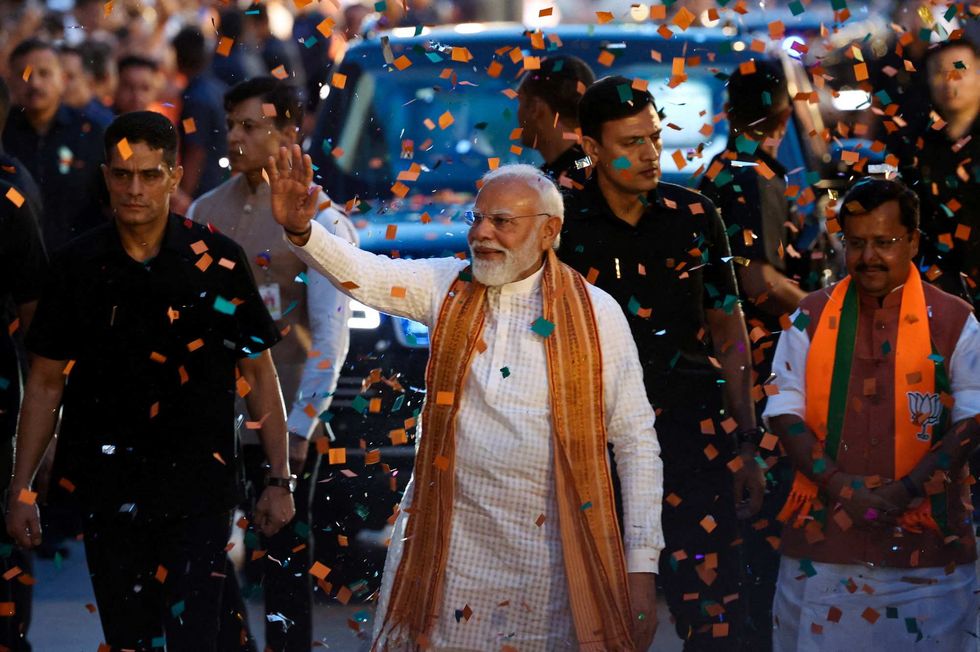 India's Prime Minister Narendra Modi greets his supporters as he arrives at the Bharatiya Janata Party (BJP) headquarters, as the BJP won the Assam state assembly election and was on course to win West Bengal, in New Delhi, India, May 4, 2026.REUTERS
India’s Modi consolidates grip after historic state election win
Prime Minister Narendra Modi’s Hindu nationalist party won the state of West Bengal for the first time, booting out the once-formidable opposition, the All India Trinamool Congress, which had governed for 15 years. This is the latest bit of good electoral news for Modi, whose party has now won a string of state elections since 2024, when the Bharatiya Janata Party (BJP) suffered a setback in national elections and was forced to govern in a coalition. The BJP now controls more than a third of India’s states, rekindling talk of whether Modi will seek re-election for a fourth term in 2029. The West Bengal triumph was charged by anger at corrupt and ineffective incumbents – a mood which drove out long-ruling parties in other states like Kerala and Tamil Nadu as well. But election observers have also focused on a darker factor: the BJP-led revision of voter rolls, which, they say, may have disenfranchised millions of voters.
Venezuela and Guyana are back in court over border dispute
The International Court of Justice is holding a week of hearings to sort out a border dispute that dates back more than a century. At issue is the resource-rich region of Essequibo, which European mapmakers, with US support, awarded almost entirely to Guyana in a decision that Venezuela has disputed ever since. Friction has grown since massive offshore oil deposits were discovered there a few years ago. In 2023, Venezuelan strongman Nicolás Maduro stoked nationalist sentiment by holding a referendum in which Venezuelans overwhelmingly voted to annex the area, and even threatened a cross-border invasion. Maduro’s successor, Delcy Rodríguez, who now works closely with Washington, is no less die-hard on this issue. Last week, she attended a regional heads-of-state gathering wearing a pin – increasingly popular among Venezuelan officials these days – that depicts Essequibo as part of Venezuela. Guyana is seeking a ruling that ends the legal issue once and for all. If so, would Venezuela walk away and drop it? Don’t bet on it.
Trump administration weighs a hands-on approach to AI
The Trump administration is considering vetting artificial intelligence models before they’re released to the public, according to The New York Times. The effort to boost oversight would mark a sharp reversal from the administration’s laissez-faire approach toward Silicon Valley. So what changed? As we noted recently, Anthropic’s powerful new Mythos model may have been the catalyst. Designed to identify software vulnerabilities, the model raised a global alarm over its ability to exploit those same cybersecurity weaknesses, prompting Anthropic to release it only to a small group of companies. The administration has since sought access to Mythos following its announcement, and reportedly wants to avoid potential political fallout should an AI-powered cyberattack occur. The vetting process may not be an idea AI companies will necessarily oppose. While the Times notes companies don’t agree on what regulation should look like, they may find it easier to work with the administration than against it — so long as the White House doesn’t slow the rollout of their models.
Romania's government collapses
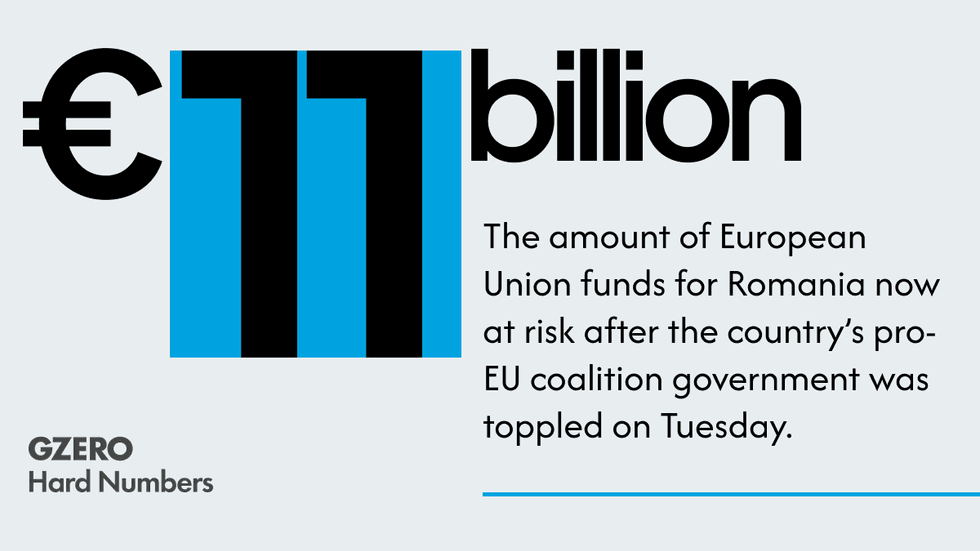 Prime Minister Ilie Bolojan’s government fell after losing a no-confidence vote, putting Romania’s access to EU recovery funds – worth approximately $13 billion – at risk.Natalie Johnson
Prime Minister Ilie Bolojan’s government fell after losing a no-confidence vote, putting Romania’s access to EU recovery funds – worth approximately $13 billion – at risk. The country, which has the largest budget deficit in the EU, has to complete the bloc’s mandated economic reforms by August to unlock the funds. But with the country’s pro-EU government pushed out, those reforms are uncertain.
Quote of the Day
Natalie Johnson
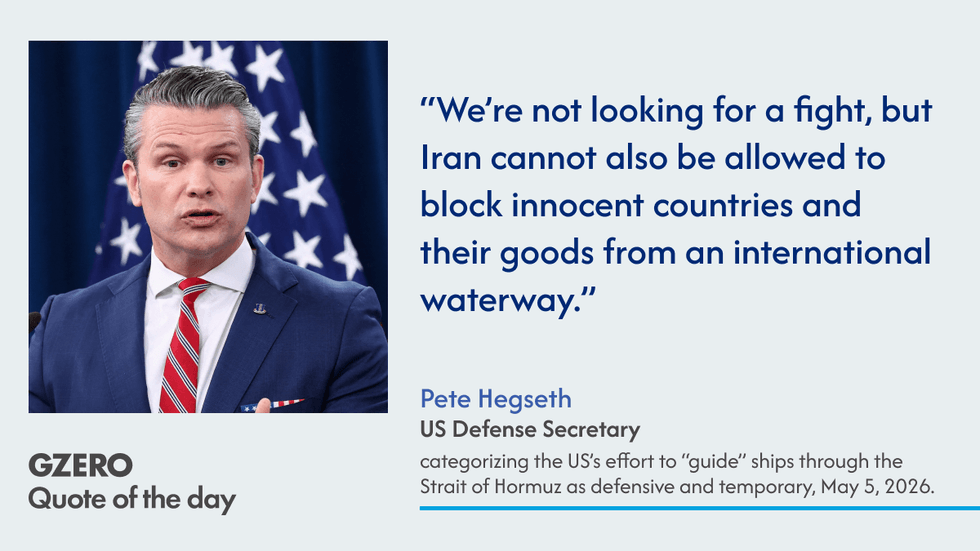
Washington and Tehran made competing claims over the Strait today after the US began a new effort on Monday – dubbed “Project Freedom” – to guide ships through the waterway. As Ian Bremmer noted in a recent Quick Take, the plan is unlikely to lead to any new traffic through Hormuz. Given the US military buildup in the region, Ian says that the risk of escalation remains high, with no clear off-ramp in sight. Watch the video here.
This edition of GZERO Daily was produced by Suhani Lakhotia, Alex Kliment, Tasha Kheiriddin, and Natalie Johnson.