
Skip to content
Search

Latest Stories

The United States will no longer play global policeman, and no one else wants the job. This is not a G-7 or a G-20 world. Welcome to the GZERO, a world made volatile by an intensifying international battle for power and influence. Every week on this podcast, Ian Bremmer will interview the world leaders and the thought leaders shaping our GZERO World.

Presented by

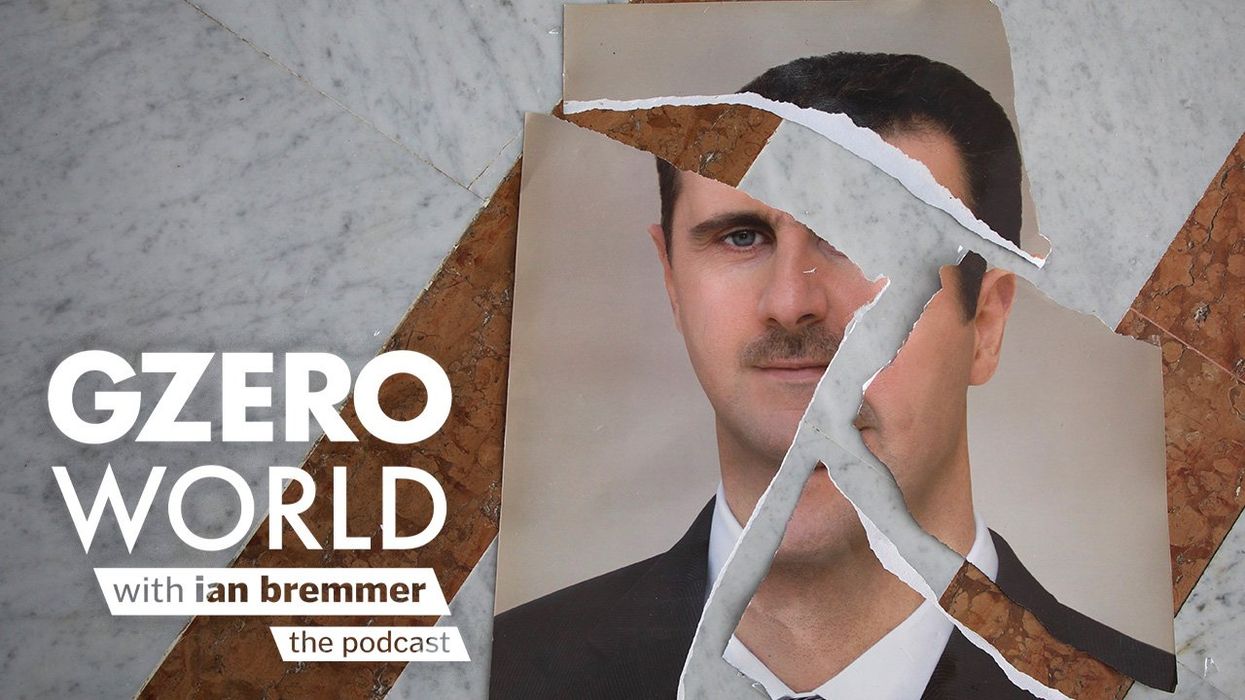
Photo illustration of Bashar al-Assad’s torn portrait, symbolizing the fractured state of Syria and the collapse of his regime and GZERO World with ian bremmer - the podcast

What's next for Syria after Assad, with Beirut-based journalist and author Kim Ghattas

Listen: After 14 years of brutal civil war and, recently, a largely frozen conflict, Syria's regime fell this week like a house of cards. So what comes next? Middle East expert and Beirut-based journalist Kim Ghattas joins Ian Bremmer on the GZERO World Podcast to help make sense of these shocking past few weeks and the potential power vacuum to come.

Transcript

Listen: How did Syria’s government rule with an iron fist for five decades, only to collapse in two weeks? And after 14 years of bloody civil war, why was now the moment that a frozen war exploded into the global spotlight? The cost Syrians have already paid is greater than any nation could reasonably be expected to bear. Since 2011, more than 500,000 Syrians have died, including 200,000 civilians, and nearly six million refugees flooded neighboring Arab States and some European nations, most notably Germany.

But what comes next? Nature abhors a vacuum, and so does geopolitics. Iran, Russia, Israel, the Gulf states, and the United States all have vested interests in Syria's future, a country that this week's GZERO World with Ian Bremmer Podcast guest calls "the crown jewel" of proxy influence in the Middle East. Here to help make sense of these shocking past few weeks and the potential power vacuum to come is Kim Ghattas, a contributing editor at the Financial Times and author of Black Wave.

Subscribe to the GZERO World Podcast on Apple Podcasts, Spotify, Stitcher, or your preferred podcast platform, to receive new episodes as soon as they're published.
Next Page

listen on:

More from GZERO World Podcast

Bioweapons, AI, and the end of the world, with Annie Jacobsen

For decades, nuclear war has represented the ultimate doomsday scenario. But investigative journalist and author Annie Jacobsen says biological warfare may pose an even greater overall threat. Unlike nuclear weapons, which require tightly controlled materials, enormously expensive delivery systems, and specialized expertise, the barriers to developing biological weapons can be far lower. And artificial intelligence could lower them further.

Ian Bremmer sits down with Jacobsen to discuss how AI is changing the landscape of catastrophic risk. As increasingly powerful models make sophisticated scientific knowledge easier to access, they could allow bad actors to bypass years of specialized training and dramatically shorten the path from an idea to a potentially dangerous capability.

They also explore the struggle to govern a technology developing faster than regulators can respond, the gaps in existing AI safeguards, and what governments and tech companies could do to identify dangerous vulnerabilities before they are exploited. And they step back to a larger question at the heart of Jacobsen’s work: Why does humanity keep developing technologies with the potential to threaten its own survival – and can our ability to manage those risks ever catch up with our ability to create them?

AI is rapidly lowering the barriers to knowledge and expertise that once kept some of humanity’s most dangerous capabilities out of reach. Investigative journalist Annie Jacobsen joins Ian Bremmer to... More >

The enduring legacy of 9/11, with former Defense Secretary Mark Esper


This week marks 25 years since 9/11—the deadliest terror attack the world has ever seen and a defining moment in American history. The attacks transformed US politics and national security. The war on terror became the organizing principle of American foreign policy. Former Secretary of Defense Mark Esper joins Ian Bremmer on the GZERO World Podcast to reflect on the day that forever changed how Americans thought about national security, and how the United States wielded its enormous power around the world.
Keep reading... Show less

Former Defense Secretary Mark Esper reflects on 25 years since 9/11, the lessons of America’s forever wars, and the biggest threats to US national security today... More >

The race to build humanity's future in space, with Chris Hadfield

More than half a century after humans last walked on the Moon, the next era of space exploration is taking shape. Getting there is cheaper, private companies are playing a much bigger role, and discoveries like vast reserves of lunar water have made the prospect of establishing a permanent presence on the Moon far more realistic.

Ian Bremmer sits down with Canadian astronaut Chris Hadfield to talk about what this new space age could look like. They discuss the growing competition between the US and China, whether rivals can cooperate on the lunar surface, and who gets to write the rules as governments and companies begin looking beyond simply planting a flag.

Hadfield also breaks down the practical challenges of living on the Moon – from powering a settlement through long lunar nights to the unanswered question of whether humans can develop normally in low gravity. He explains how private companies are turning space into a commercial marketplace, why regulation will inevitably struggle to keep pace, and why robots alone can never satisfy humanity’s drive to explore Mars.

And drawing on nearly six months aboard the International Space Station, Hadfield reflects on the surprisingly wonderful experience of sleeping in zero gravity, circling Earth 2,600 times, and how seeing the planet from above fundamentally changed his perspective on humanity and our place in the universe.

The race to the Moon is back – but reaching it is only the beginning. Astronaut Chris Hadfield joins Ian Bremmer to explore how cheaper technology, private industry, and growing US-China competition... More >

The global aid crisis, with David Miliband

What happens when the world’s safety net disappears? For decades, international aid has helped fight poverty, stop disease outbreaks, and keep fragile societies from falling over the edge. But after the shutdown of USAID last year, the relief system is in danger of collapsing entirely. International Rescue Committee President & CEO David Miliband joins Ian Bremmer on the GZERO World Podcast to talk about the long shadow cast by America’s retreat from global aid and what comes next.

Keep reading... Show less

Humanitarian aid isn’t just charity—it’s the world’s safety net against disease, conflict, and instability. David Miliband joins Ian Bremmer to unpack what America’s retreat from global aid means for... More >

GZERO Podcasts

AI is rapidly lowering the barriers to knowledge and expertise that once kept some of humanity’s most dangerous capabilities out of reach. Investigative journalist Annie Jacobsen joins Ian Bremmer to... More >

Listen: What does global energy transition look like in a time of major geopolitical change, including rebalancing of trade? In this special episode of "Energized: The Future of Energy,” host JJ... More >

Creating artificial human retinas in zero gravity. Mining rare minerals on the moon. There seems to be no limit to what could be possible if we continue to take our more important industries to... More >

Advances in generative AI are transforming the information environment around elections, making it harder to distinguish authentic content from misleading or manipulated material. Ahead of the 2026... More >

In this episode of The Ripple Effect: Investing in Life Sciences, host Dan Riskin speaks with Patrick Horber, President of Novartis International, and David Gluckman, Vice Chairman of Investment... More >