June 01, 2026
Twenty-five years ago this spring, the Netherlands became the first country to legalize same-sex marriage. It was a watershed moment, one that spurred 37 other countries to follow suit in the years since, including Thailand and Liechtenstein most recently in 2025.
Despite that progress, same-sex marriage remains illegal in far more places than it is legal. It’s banned in nearly 100 countries, while same-sex relationships between consenting adults are criminalized in 65. Most of those countries are in Africa and Asia, though some are in the Americas, including Jamaica.
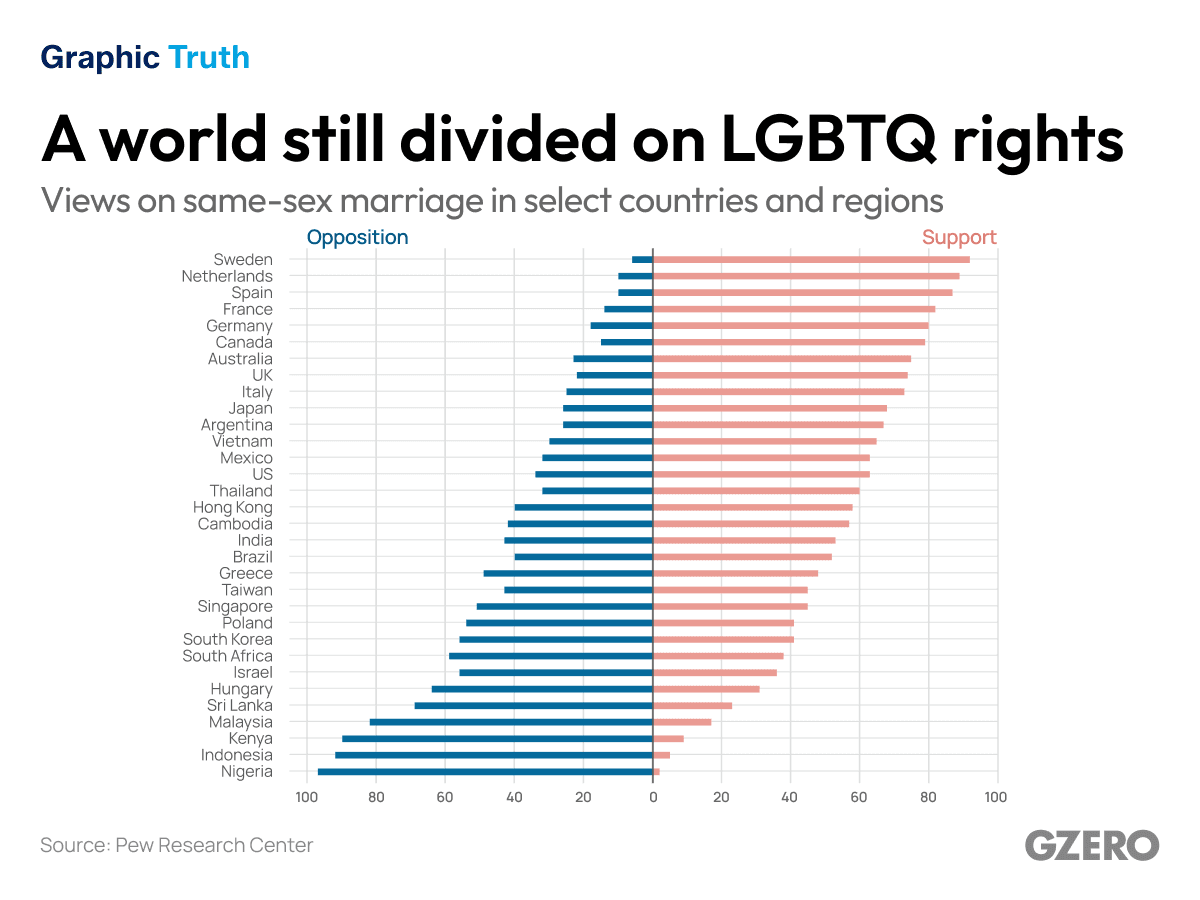
As countries around the world mark Pride Month this June, we examined the persistent global divide in LGBTQ rights. As our Graphic Truth shows, public attitudes toward same-sex marriage vary dramatically across countries and generally align with where same-sex marriage has been legalized. In Sweden, 92% of citizens support same-sex marriage, while that number is as low as 2% in Nigeria.
Public opinion, though, is not fixed. In the United States, for example, 68% of adults opposed same-sex marriage in 1996 – nearly a complete reversal of today’s views, with 63% now supporting it. In Greece, support for same-sex marriage rose by nearly 33 pointsover two decades (according to varying survey groups), helping pave the way for the country to become the first Orthodox Christian-majority nation to legalize it in 2024.
Then-Prime Minister Kyriakos Mitsotakisspoke to GZERO about backing the measure despite opposition from within his own center-right New Democracy party.
“I knew from the beginning that there are a lot of people within my party that did not agree with this,” Mitsotakis told Ian Bremmer, “But at the end of the day, human rights is about protecting smaller groups. Otherwise, you have the tyranny of the majority.”
But while some countries have become more accepting, others are moving in the opposite direction. In 2025, the number of countries criminalizing same-sex relations grew for the first time in nearly a decade. Burkina Faso adopted such a law for the first time in its history, and over the weekend, Ghana’s parliament passed a bill that would criminalize homosexuality and introduce a legal “duty” on citizens to report suspected same-sex relationships to police.
Other countries have cracked down on freedom of expression as well. Turkey’s government has proposed tighter measures targeting conduct deemed “contrary to biological sex,” while the US has seen state lawmakers propose ways to undermine same-sex marriage rights in the last year. So, as Pride Month begins, the global picture remains mixed: expanding recognition in some countries, new restrictions in others, and a stark divide over LGBTQ rights more broadly.
More For You
Most Popular
Supporters of the Forever Canadian group, who want Alberta to remain in Canada, wave Canadian flags as they wait for the results of a non-binding referendum on Alberta sovereignty in Edmonton, Alberta, Canada October 19, 2026.
REUTERS/Todd Korol
Alberta is staying in Canada. But the more important results may have come from the nine other questions on the referendum ballot that have received considerably less attention.
- YouTube
A Democratic sweep in 2026 could shake up Washington. Will it change Trump’s grip on power or set the stage for 2028? Amy Walter and Liam Donovan join Ian Bremmer on GZERO World.
Could Chinese AI give Europe an edge? | The Debrief with Heather West
Could China give Europe a shortcut in the AI race?
Europe has struggled to build models that compete with American and Chinese rivals. But Chinese models that companies can download, customize, and run themselves could offer another way forward—with more control over data and security.
© 2025 GZERO Media. All Rights Reserved | A Eurasia Group media company.