Analysis
What’s next for Zelensky?
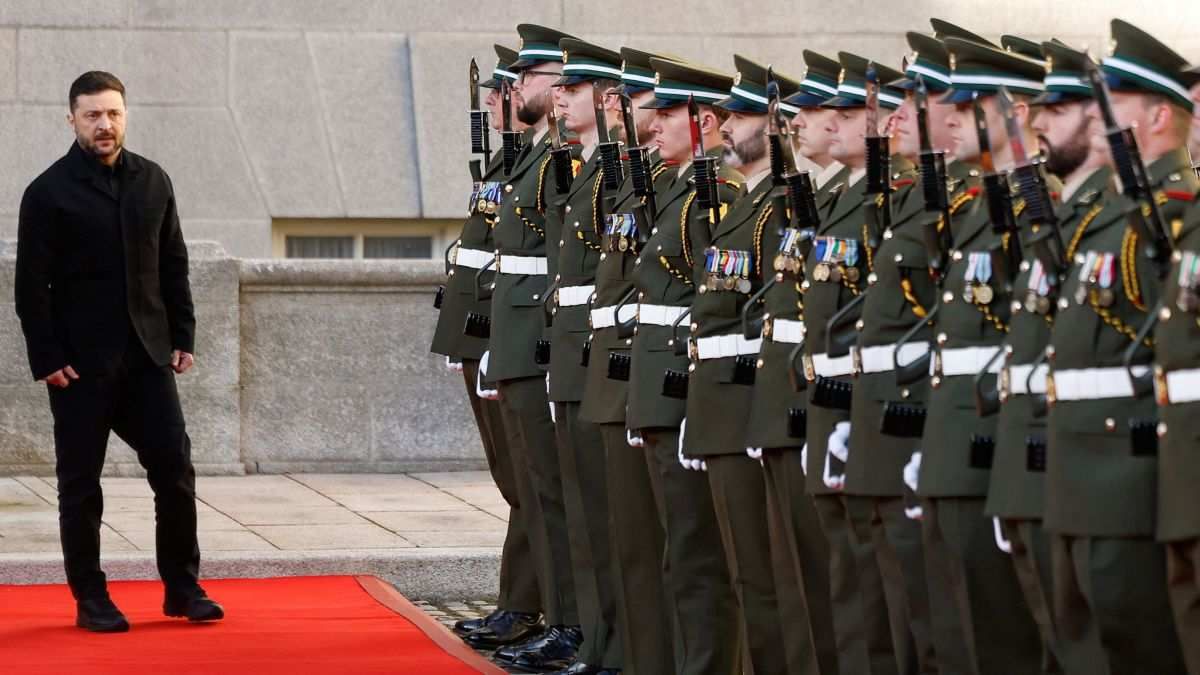
Ukrainian President Volodymyr Zelensky inspects a guard of honor by the Irish Army at Government Buildings during an Irish State visit, in Dublin, Ireland, on December 2, 2025.
REUTERS/Clodagh Kilcoyne
It hasn’t been an easy year for Ukrainian President Volodymyr Zelensky – and not just because Russia is still invading his country.
US President Donald Trump’s return to office heralded a sharp slowdown in new White House spending on Ukraine – it has dropped to virtually zero this year. Europe has made up for some of the shortfall, but is now struggling to find new funds for the war effort. Further, the US recently authored a plan that would force Ukraine to relinquish sizable parts of its territory.
Now, a corruption scandal is engulfing the Ukrainian leader, forcing his top aide, Andriy Yermak, to resign. Yermak was officially Zelensky’s chief of staff, but reportedly held a far greater role – he was also the vice president, lead negotiator, and held vast powers on economic and security matters. His exit will thus leave a major void in Zelensky’s government.
What this means for peace negotiations. The Trump administration believes that the corruption scandal will make Zelensky more willing to accept a peace agreement – even one that includes measures that have been red lines for Kyiv. Trump has been publicly pressuring the Ukrainian leader, dishing out another ultimatum for accepting a deal that involves giving up land in exchange for security guarantees.
The message seemed to fall on amenable ears: Zelensky told his countrymen on Nov. 21 that he must either accept a deal or lose the US as an ally. Washington and Kyiv reportedly made a little more progress during talks in Miami over the weekend.
Not so fast. There’s just one problem with the White House’s belief that it can pressure Zelensky into accepting a deal: Ukrainian soldiers don’t support the US peace plan, and Ukrainians at large increasingly believe that Washington is trying to force Kyiv to accept an unfair peace deal, according to polling from the Kyiv International Institute of Technology. If Zelensky accepts a bad deal, it might further harm his domestic standing.
“Zelensky’s political problems arguably make it even harder for him to make any major concessions to secure a cease-fire,” said Eurasia Group’s Eastern Europe expert Alex Brideau. “While the public wants negotiations and an end to the war, it does not support a deal that meets Russian demands on territory and neutrality.”
What does Zelensky want? He is focused on “obtaining security guarantees from Western partners that would protect the country from any future Russian invasion,” said Brideau. The US has offered this to Ukraine, but with the caveat that they must hand land to Russia that the Kremlin hasn’t yet taken – something the comedian-turned-wartime leader isn’t ready to do.
As such, Zelensky on Monday turned to a more sympathetic ally for support: Europe. The continent has been Ukraine’s principal supporter this year, and was quietly aghast at the 28-point peace proposal that the US released last month. After meeting with Ukraine’s leader in Paris, French President Emmanuel Macron reiterated that it was up to Kyiv whether it chooses to cede territory.
Not rushing yet. Zelensky wants to make a deal “as quickly as he can,” per Brideau. The Ukrainian leader even said that “now more than ever, there is a chance to end this war,” while visiting Ireland on Tuesday. However, he isn’t time-constrained, in large part because Ukraine refuses to hold an election during wartime – Zelensky’s five-year term technically expired 18 months ago.
“Under martial law, Ukraine cannot hold national elections,” says Brideau. “Until there is a path for a lasting cease-fire, the government will keep renewing the martial law declaration every three months.”
If there was an election, recentpolling suggests that Ukraine’s Ambassador to the United Kingdom Valerii Zaluzhnyi would defeat Zelensky in a hypothetical race.
The incumbent leader, though, has said that he would step down if the war ended. For all the various negotiations that have taken place between Kyiv, Moscow, and Washington, this isn’t necessarily going to happen imminently.
“A quick deal will remain elusive,” said Brideau, “given the wide gulf between Russia and Ukraine on their core demands and insufficient external pressure to force a change by one or both.”
Alberta is staying in Canada. But the more important results may have come from the nine other questions on the referendum ballot that have received considerably less attention.
A Democratic sweep in 2026 could shake up Washington. Will it change Trump’s grip on power or set the stage for 2028? Amy Walter and Liam Donovan join Ian Bremmer on GZERO World.
Could China give Europe a shortcut in the AI race?
Europe has struggled to build models that compete with American and Chinese rivals. But Chinese models that companies can download, customize, and run themselves could offer another way forward—with more control over data and security.