Today, we take a look at the growth of political violence in the US after an attempted attack at the White House Correspondents’ Dinner, report on the burgeoning insurgency in Mali, and weigh up whether an Israeli coalition can oust Benjamin Netanyahu from power.
- The Daily crew
On Saturday, an armed man sprinted through a security checkpoint at the annual White House Correspondents’ Dinner in Washington, D.C., where US President Donald Trump and other administration officials had gathered with all of the country’s top political journalists. The gunman shot a Secret Service agent before law enforcement apprehended him – the agent was saved by a bulletproof vest.
Ahead of the incident, the 31-year-old suspect from Torrance, California, allegedly sent writings to his family members describing himself as a “friendly federal assassin” and expressing anger at Trump administration policies, giving authorities increasing confidence that the attack was politically motivated. He is due in court for the first time today.
“I can’t imagine that there’s any profession that is more dangerous,” Trump said Saturday night. The attempted hit also took place at the same hotel as the attempted killing of then-President Ronald Reagan in 1981.
Saturday’s incident comes as attempted assassinations and attacks against politicians in the United States have surged to the highest level on record since the 1960s. Trump himself has now faced three assassination attempts in the last two years. Meanwhile, lawmakers from both parties have been affected by this wave of violence. Investigations into threats directed at members of Congress and members of their families rose for a third year in a row, according to the US Capitol Police, with a 58% increase in 2025. Supreme Court justices have faced assassination threats, too.
It’s not just the national level, though: local lawmakers have also been targeted. In June, the top Democrat in the Minnesota House of Representatives, Melissa Hortman, and her husband were killed in their home. The same gunman also stalked and shot Minnesota State Sen. John Hoffman and his wife that day, and carried an apparent hit list of more than 45 state and federal officials in Minnesota.
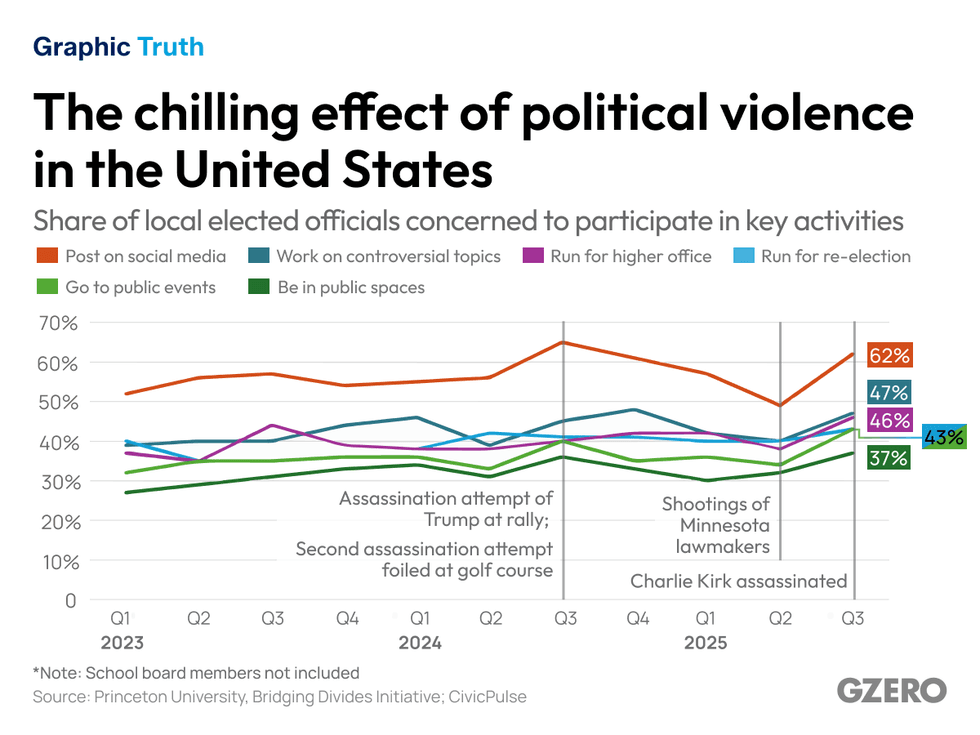
At the local level, research from Princeton University found that threats and harassment against officials spiked multiple times in 2025, with the largest increase occurring in the aftermath of conservative activist Charlie Kirk’s killing in September – Kirk’s widow Erika was herself present at the WHCD on Saturday. More than half of officials – think mayors, city council members, and school board members – reported being insulted, about a third reported harassment, and 17% reported threats.
As the Graphic Truth above shows, this has had a chilling effect on the willingness of local politicians, who frequently have fewer security resources than national-level counterparts, to participate in public events that are critical to their job. During the third quarter of last year, nearly 75% said they were less willing to participate in political activities – including working on controversial issues, posting on social media, or running for higher office – out of fear of hostility, up from 66% in the previous quarter.
While the United States has relatively low rates of targeted political violence compared to the rest of the world, the uptick has made extraordinary scenes like the shooting at the WHCD increasingly ordinary, raising alarms for every level of the US government.
What We’re Watching
REUTERS/Stringer
Killing of Mali’s defense minister exacerbates its security crisis
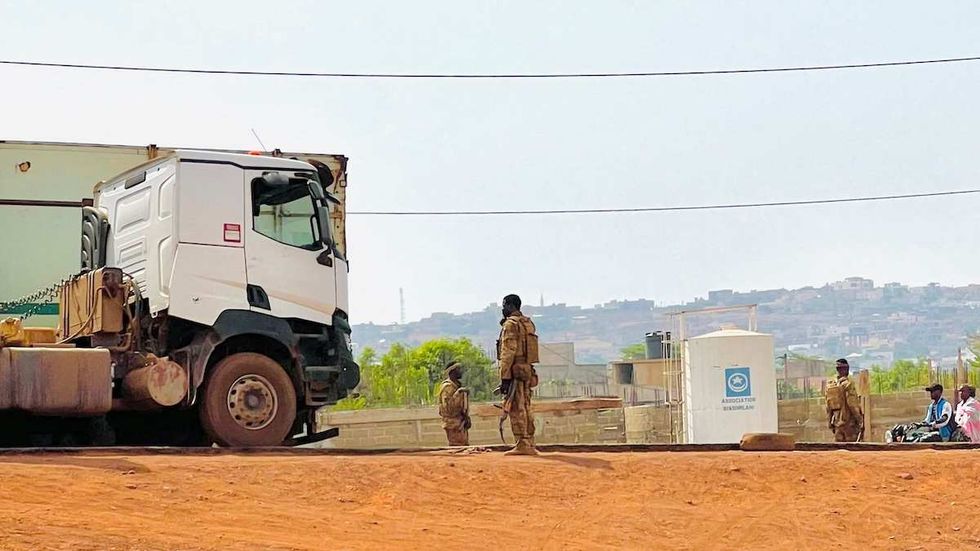
Jihadist insurgents and Tuareg secessionists assassinated Mali’s Defense Minister Sadio Camara at his home in Kati on Saturday during coordinated attacks across the West African country, as the junta faces yet another major challenge amid the 14-year-long nationwide security crisis. Camara was the architect of the ruling junta’s strategy toward rebel groups since coming to power in 2021. The rebels appear to be gaining ground, as they claimed to have seized full control of the northern town of Kidal on Sunday following the withdrawal of the government-backed Russian Africa Corps – the town has been a separatist stronghold. Mali’s security situation has been deteriorating for months, with the Jama’at Nusrat al-Islam al-Muslimin, the jihadist group that has pledged allegiance to al-Qaeda, surrounding the capital Bamako late last year and blocking the supply of oil ever since. The Russian-backed junta’s position, it appears, is only getting more precarious.
Israeli opposition joins forces again in effort to topple Netanyahu
Aiming to finally end the career of Israel’s longest-serving prime minister, Naftali Bennett and Yair Lapid – both former PMs – announced Sunday they’re once again joining their respective right-wing and centrist parties together ahead of parliamentary elections later this year. They did so back in 2021, with mixed results: they won the election that year, but their coalition, which included the Islamist party Ra’am, fell apart 18 months later. When announcing the effort, Bennett – who will lead the coalition – spoke of the need for unity while citing the recent defeat of Viktor Orbán, Hungary’s long-time leader, as a cause for hope. While frustrations are growing in Israel over Benjamin Netanyahu’s governance, amid wars with Iran and the Lebanese militant group Hezbollah, polls still suggest that this Bennett-Lapid coalition doesn’t have enough support to win a majority in the Knesset.
Romania hit with new political turmoil
Talk about strange bedfellows… Romania’s Social Democrats, the largest party in the current four-way governing coalition, have united with the far-right opposition to force a no-confidence vote on Prime Minister Ilie Bolojan as early as tomorrow. At issue? Bolojan’s bid to impose austerity measures in order to shrink Romania’s staggering budget deficit, the largest in the European Union. Brussels has already warned that the deficit could imperil billions of euros in EU financial assistance programs. The upheaval comes as Romania’s economy grinds to a halt and inflation soars. The far-right opposition party in question, Alliance for the Union of Romanians (AUR), currently tops opinion polls and is eager to force Romania into fresh elections. The AUR candidate won the first round of the 2024 presidential election, but his victory was controversially nullified over claims he had received assistance from Russia and violated campaign finance rules.Cuba on the brink

Cuba is living through its worst economic crisis in decades. Blackouts, fuel shortages, four-day workweeks, and a mass exodus that has cost the island more than 10% of its population. US President Donald Trump has made no secret of his ambitions, saying last month that he will have “the honor of taking Cuba.” But a military invasion is not on the cards, according to University of Miami historian Michael Bustamante tells Ian Bremmer on this week’s episode of GZERO World.
What Trump likely wants is a deal, one that opens Cuba to US investment and tourism, and lets him claim a historic win. The problem is that Cuba has no meaningful political opposition to replace the Castro government, and no equivalent of Venezuela’s interim President Delcy Rodriguez waiting in the wings.
A purely economic deal may seem like the easiest path forward, but it risks disappointing Cuban-American voters who were heavily invested in Trump’s 2024 election, and putting Secretary of State Marco Rubio in an impossible position with his own community. As Bustamante puts it, Cuba is attractive to Trump “not because of natural resource wealth” but because of “the symbolism of communism, and being able to say that we planted the flag and defeated that thing that no one else could.”
Watch the full episode here.Hard Number: Black Republicans all exiting the US House
Natalie Johnson
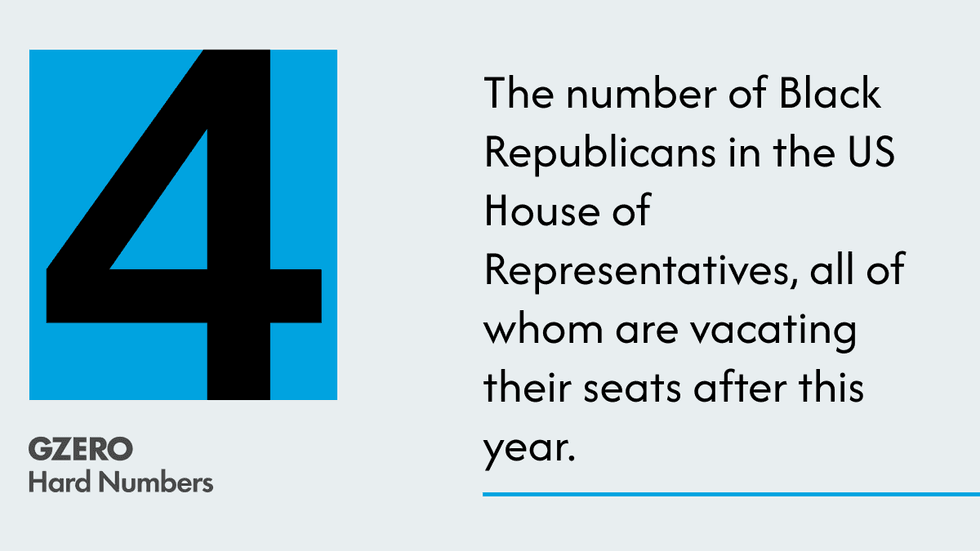
US Reps. Byron Donalds of Florida, Wesley Hunt of Texas, and John James of Michigan all decided to run for statewide office – Hunt lost in last month’s Texas Senate primary. US Rep. Burgess Owens of Utah is retiring after his state redrew district lines, making it difficult for him to retain his seat. Some Republicans, notably former House Speaker Kevin McCarthy, have been trying to recruit a more diverse group of Republican candidates. That effort appears to be going backward, as US Sen. Tim Scott could be the only Black Republican left in Congress next year. “When you look at the Democrats, they actually look like America,” McCarthy said after leaving Congress in 2023. “When I look at my party, we look like the most restrictive country club in America.”
Quote of the Day
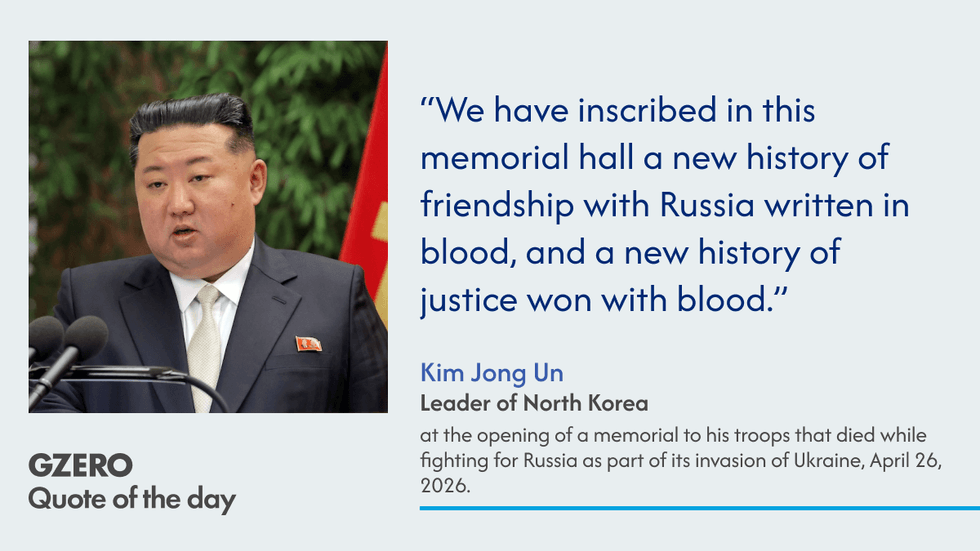
The opening of the memorial emphasized how Pyongyang is getting closer and closer to Moscow. According to South Korean intelligence, North Korea has lent roughly 15,000 to Russia to help with its invasion of Ukraine, 2,000 of whom have been killed. In return, the Kremlin pledged to sign a five-year security plan for bilateral military cooperation. Russia has also been sending fuel, food, and military technologies to North Korea, per Seoul.
Department of Corrections: In our Friday edition, our Graphic Truth on nuclear power station incidents incorrectly labeled the 1957 Windscale Pile accident as being located in Canada, when it was in fact in the United Kingdom. We apologize for the error.
This edition of GZERO Daily was produced by Natalie Johnson, Zac Weisz, and Alex Kliment. The Graphic Truth was designed by Paige Parsacala.