
Skip to content
Search

Latest Stories

The United States will no longer play global policeman, and no one else wants the job. This is not a G-7 or a G-20 world. Welcome to the GZERO, a world made volatile by an intensifying international battle for power and influence. Every week on this podcast, Ian Bremmer will interview the world leaders and the thought leaders shaping our GZERO World.

Presented by

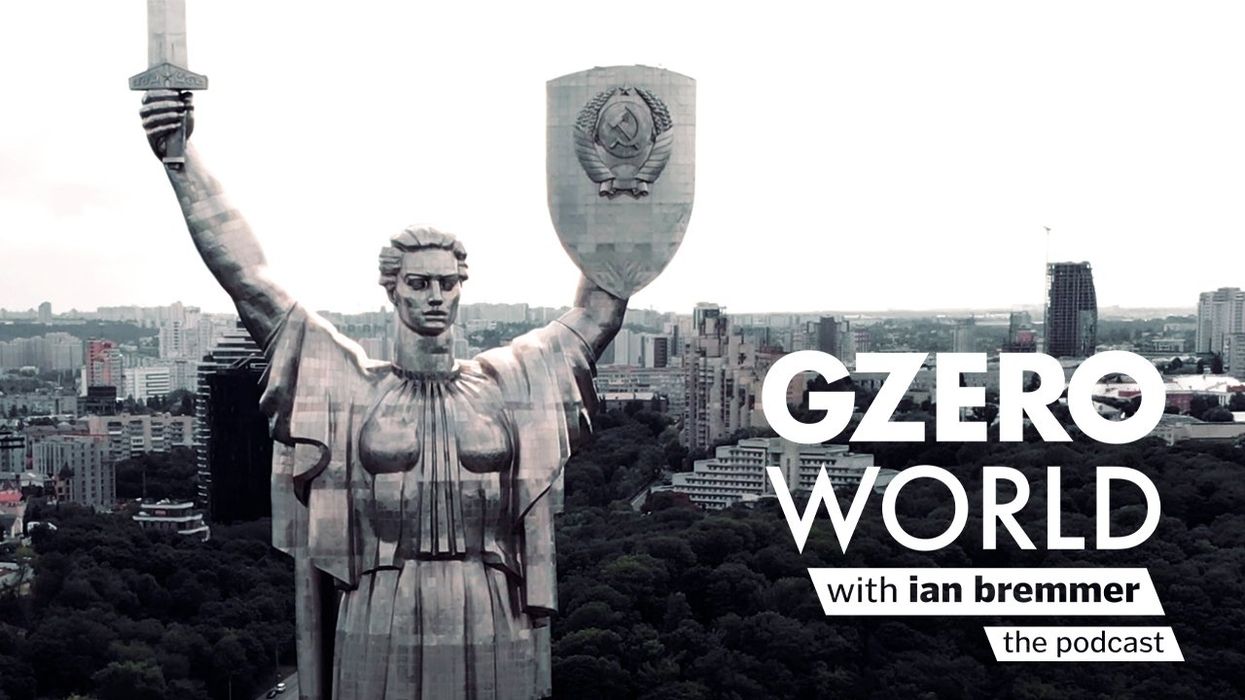
an image of Ukrainian Motherland Monument and GZERO World with ian bremmer - the podcast

Is it time for Ukraine to negotiate with Russia? Journalist Yaroslav Trofimov explains Kyiv's perspective

Listen: Ukraine is at a crossroads. It's been more than two years of brutal, deadly conflict. Despite some shifts to the front lines, neither side has a clear path to military victory, and support for the war effort is flagging amongst Ukrainians. Is it time for President Zelensky to think about negotiating an end to the war? On the GZERO World Podcast, Ian Bremmer sits with Yaroslav Trofimov, Wall Street Journal Chief Foreign Affairs Correspondent and author, about the challenges Ukraine faces, including waning morale and difficulties in military recruitment.


Listen: Ukraine is at a crossroads. It's been more than two years of brutal, deadly conflict. Despite some shifts to the front lines, neither side has a clear path to military victory, and support for the war effort is flagging amongst Ukrainians. Is it time for President Zelensky to think about negotiating an end to the war? On the GZERO World Podcast, Ian Bremmer sits with Yaroslav Trofimov, Wall Street Journal Chief Foreign Affairs Correspondent and author of "Our Enemies Will Vanish," about the challenges Ukraine faces, including waning morale and difficulties in military recruitment. Although recent polls indicate that Ukrainians are more receptive to peace talks, Trofimov warns that Russia’s endgame remains unchanged—total erasure of Ukrainian national identity. With the painful history of Soviet-Era aggression still fresh in the national memory, most Ukrainians are resolute that they won’t accept compromise unless it means the return of all internationally recognized land. Trofimov cautions that the absence of security guarantees by NATO and Western allies means Russia's assault on Ukraine is far from over.


Though Bremmer and Trofimov spoke in July before Ukraine’s incursion into Russia’s Kursk region, the larger picture remains bleak: no clear path to ending the war, hundreds of thousands of lives lost, and nearly 20% of Ukraine still under occupation. And if Donald Trump wins a second term, continued US military support is uncertain. So, is it time for Ukraine to negotiate with Russia for a swift end to the war? If not, what will be the cost of all this suffering?

Subscribe to the GZERO World Podcast on Apple Podcasts, Spotify, Stitcher, or your preferred podcast platform, to receive new episodes as soon as they're published.
More from GZERO World Podcast

The future of the Democratic party, with Josh Shapiro

What can Democrats learn from winning in America's ultimate swing state? On the latest episode of the GZERO World podcast, Ian Bremmer sits down with Pennsylvania Governor Josh Shapiro to discuss the future of the Democratic Party, the growing crisis of trust in American institutions, and the biggest challenges facing the country at home and abroad.

Keep reading...Show less

As Democrats search for a path forward after 2024, Pennsylvania Governor Josh Shapiro argues that voters aren't looking for more political rhetoric - they're looking for results.... More >

World Cup politics, with the Financial Times' Simon Kuper

The World Cup arrives in North America this week, bringing with it billions of viewers, billions of dollars, and no shortage of political controversy. But according to Financial Times columnist Simon Kuper, none of that is new - the tournament has always reflected the world around it.

Keep reading...Show less

The World Cup is the planet's biggest sporting event, and the most political one. This year, it will also be the most profitable spectacle of all time.... More >

The Supreme Court's biggest tests ahead, with Emily Bazelon

From birthright citizenship to the independence of federal agencies, the Supreme Court is poised to decide a series of cases that could redefine the balance of power in Washington. Yale legal scholar and New York Times Magazine staff writer Emily Bazelon joins Ian Bremmer to assess what's at stake and whether the judiciary remains an effective check on presidential authority.

Keep reading...Show less

The Supreme Court is facing some of the biggest legal and political questions of the Trump era. Emily Bazelon joins Ian Bremmer to break down the rulings that could reshape executive power, voting... More >

Winners and losers of the Iran war, with Kori Schake


Operation Epic Fury may be over, but the Iran war is far from resolved. On this week's episode, American Enterprise Institute Kori Schake joins Ian Bremmer to discuss the conflict's global ripple effects.

With the Strait of Hormuz effectively closed to commercial shipping, the US finds itself in what Schake calls a Mexican standoff, unable to force Iran's hand without dramatic escalation, and unwilling to accept the humiliation of ceding control of one of the world's most critical waterways. Meanwhile, Washington's two biggest rivals are gaining ground. Russia is cashing in on higher oil prices at a moment when the Kremlin was under mounting financial pressure over Ukraine.

In Beijing, the Trump-Xi summit took place with the White House in a weakened position. The US needs China's help pressuring Iran, and Xi knows it. As Schake puts it: "It's an important measure of just how much President Trump has lost in starting the war in Iran and pursuing it in the way he has, that he's having to go appeal to China, America's most powerful potential adversary, for assistance in delivering us from a problem of our own creation."

The costs for US allies are adding up too. Partner countries are absorbing economic pain they had no hand in creating, with energy prices squeezing European economies. Schake also raises a harder structural question: with Patriot systems redirected from Europe to the Gulf and munitions stocks stretched thin, the war has laid bare the limits of the American defense industrial base, and what it means for the credibility of US commitments around the world..

Three months into the Iran war, the Strait of Hormuz is in a standoff and the geopolitical fallout is spreading fast. Kori Schake of the American Enterprise Institute breaks down with Ian Bremmer... More >

GZERO Podcasts

As Democrats search for a path forward after 2024, Pennsylvania Governor Josh Shapiro argues that voters aren't looking for more political rhetoric - they're looking for results.... More >

Listen: What does global energy transition look like in a time of major geopolitical change, including rebalancing of trade? In this special episode of "Energized: The Future of Energy,” host JJ... More >

Creating artificial human retinas in zero gravity. Mining rare minerals on the moon. There seems to be no limit to what could be possible if we continue to take our more important industries to... More >

Italian Prime Minister Giorgia Meloni is reportedly considering early elections, as her popularity dips amid a rising challenge from the far right.... More >

In this episode of The Ripple Effect: Investing in Life Sciences, host Dan Riskin speaks with Patrick Horber, President of Novartis International, and David Gluckman, Vice Chairman of Investment... More >